
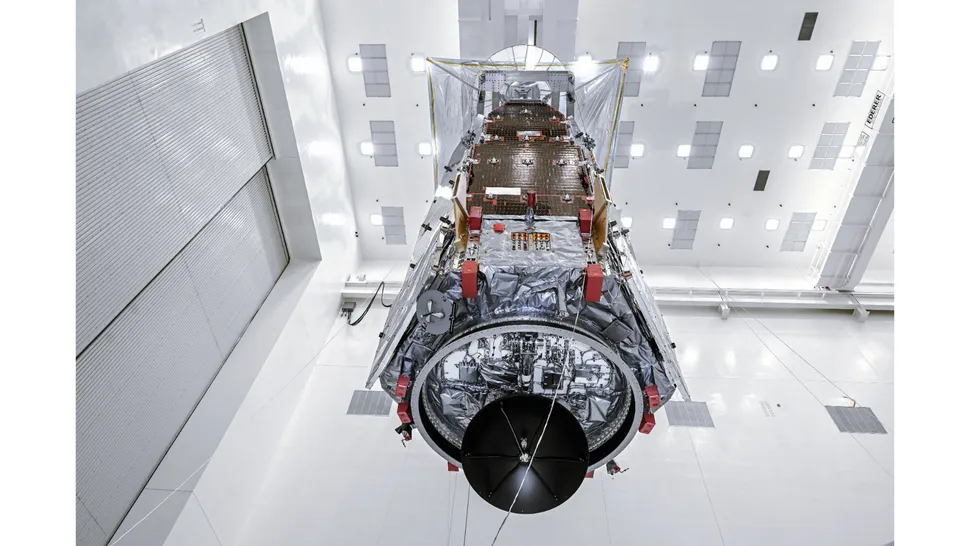
NASA announced that the Nancy Grace Roman Space Telescope is on track for its launch on August 30, 2023. This highly anticipated mission aims to push the boundaries of astronomical research, promising to gather data at an unprecedented scale. Positioned to orbit around Lagrange Point 2—approximately one million miles from Earth—the telescope is set to provide a unique perspective on our universe. The anticipated launch is generating excitement within the scientific community, as it represents a significant leap in our capabilities to explore the cosmos.
What makes the Roman Space Telescope revolutionary?
The Roman Space Telescope is equipped to handle a staggering amount of data—over 500 terabytes annually—far surpassing the 400 terabytes collected by Hubble over its 35-year mission. This leap in data collection is made possible by its Wide-Field Instrument, which allows for swift, broad surveys of the sky. As Julie McEnery, Roman's senior project scientist, pointed out, one month of Roman observations of the Milky Way would take Hubble about a century to complete. This capability will enable astronomers to study a vast array of cosmic phenomena, from galaxies to exoplanets, all while operating with a sensitivity comparable to Hubble.
The journey to launch begins
Preparations for the launch have been meticulous, with the Roman team recently announcing that the telescope is fully fueled with hydrazine, a highly efficient but toxic fuel. This fuel will facilitate essential maneuvers as Roman makes its way to Lagrange Point 2, where it will spend its operational life. According to Jeremy Perkins, the telescope's integration and test scientist, the next steps involve encapsulating the observatory for transport on a SpaceX Falcon Heavy rocket. The entire Roman team is optimistic about the mission, with project manager Jackie Townsend expressing confidence in their readiness for launch.
Exploring the cosmos like never before
Roman's mission extends beyond mere data collection; it aims to tackle some of the universe's most pressing questions. One of its innovative instruments, a coronagraph, is expected to revolutionize the search for exoplanets by blocking out starlight to reveal planets orbiting nearby stars. This capability could lead to significant discoveries in our understanding of planetary systems and their formation. Additionally, the telescope's expansive field of view will allow it to map dark matter and dark energy more effectively, shedding light on their influence on the cosmos.
What lies ahead for the Roman Space Telescope?
As the launch date approaches, the anticipation among scientists and enthusiasts alike continues to grow. Roman is not only a tribute to Nancy Grace Roman, a trailblazer in astronomy, but it also represents a new era of cosmic exploration. The potential discoveries await us are immense, and as history has shown, the most remarkable findings often arise unexpectedly. Shawn Domagal-Goldman from NASA emphasized that the technology developed for telescopes like Roman has already enabled us to observe near-Earth objects, showcasing the unforeseen applications of such missions. The future is bright for astronomy, and the Roman Space Telescope is poised to illuminate it.