
Venus is the second planet from the Sun and one of the brightest objects visible in Earth's night sky. Often called Earth's "sister planet" or "twin," Venus is similar to our planet in size and structure. However, beneath its beautiful, cloud-covered appearance lies one of the most extreme and hostile environments in the solar system.
Earth's Mysterious Twin
Venus and Earth are nearly the same size, with Venus having a diameter of about 12,100 kilometers (7,500 miles). Both are rocky planets made primarily of metal and silicate rocks. Despite these similarities, the two worlds evolved in dramatically different ways.
While Earth became a planet filled with oceans and life, Venus transformed into a scorching world with crushing atmospheric pressure and temperatures hot enough to melt lead.
The Hottest Planet in the Solar System
Even though Mercury is closer to the Sun, Venus is actually the hottest planet in our solar system. Surface temperatures on Venus reach around 465°C (870°F), remaining extremely hot both day and night.
This intense heat is caused by a runaway greenhouse effect. Venus has a thick atmosphere made mostly of carbon dioxide, which traps heat very efficiently. As sunlight enters the atmosphere, the heat cannot easily escape, causing temperatures to rise to extraordinary levels.
A Planet Hidden Beneath Clouds
Venus is completely covered by thick, bright clouds made primarily of sulfuric acid droplets. These clouds reflect most of the sunlight that reaches the planet, making Venus the brightest planet in our sky.
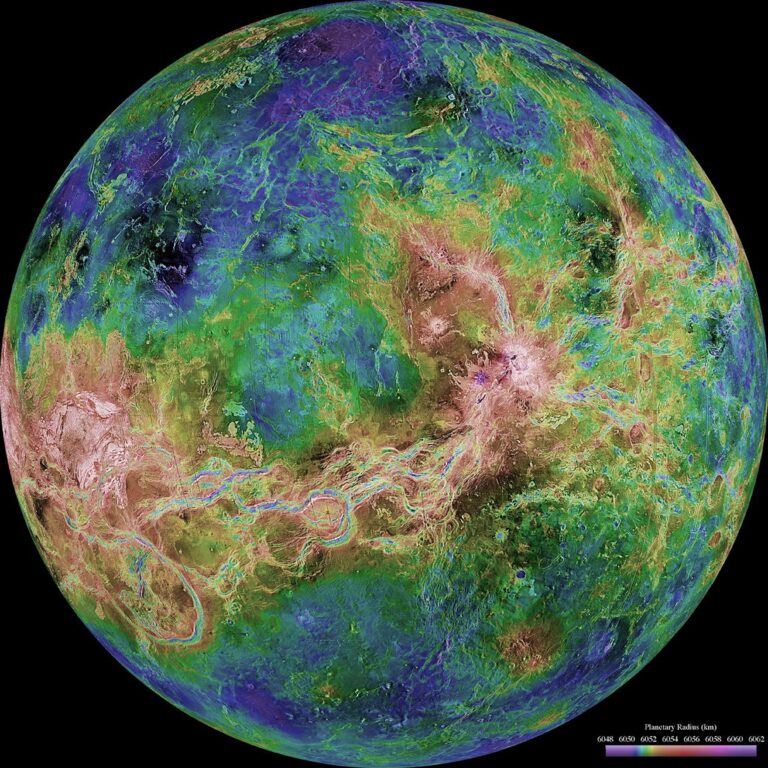
Because of these dense clouds, the surface of Venus cannot be seen with ordinary telescopes. Scientists have used radar instruments aboard spacecraft to map the hidden landscape beneath the clouds.
A World of Volcanoes and Mountains
The surface of Venus is dominated by vast volcanic plains, enormous volcanoes, and rugged mountain ranges. Scientists believe Venus has experienced extensive volcanic activity throughout its history, and evidence suggests that some volcanoes may still be active today.
Unlike Earth, Venus does not appear to have moving tectonic plates. Instead, its surface may undergo large-scale reshaping events over millions of years.
A Day Longer Than a Year
Venus has one of the strangest rotations in the solar system. It spins incredibly slowly, taking about 243 Earth days to complete one rotation on its axis.
Even more surprising, Venus completes one orbit around the Sun in only 225 Earth days. This means that a single day on Venus is actually longer than an entire Venusian year.
Venus also rotates backward compared to most planets. On Venus, the Sun would appear to rise in the west and set in the east.
Does Venus Have Moons or Rings?
Venus has no natural moons and no ring system. Along with Mercury, it is one of only two planets in our solar system without any moons.
Exploring Venus
Venus has fascinated astronomers for centuries. Several robotic spacecraft have explored the planet, revealing its extreme atmosphere and hidden surface. NASA's Mariner 2 became the first spacecraft to visit another planet when it flew past Venus in 1962.Scientists continue to study Venus because it may hold important clues about planetary evolution, climate change, and the conditions that make planets habitable. Future missions aim to investigate its atmosphere, geology, and history in greater detail.
Quick Facts About Venus
Position from the Sun: Second planet
Planet Type: Rocky (Terrestrial) Planet
Length of a Year: 225 Earth days
Length of a Day: 243 Earth days
Average Surface Temperature: About 465°C (870°F)
Moons: None
Rings: None
Atmosphere: Mainly carbon dioxide with thick sulfuric acid clouds
Special Feature: The hottest planet in the solar system
Venus may look like a beautiful shining star in our evening or morning sky, but it is a world of extreme heat, dense clouds, and volcanic landscapes. As Earth's closest planetary neighbor, Venus offers scientists a unique opportunity to understand how planets can evolve in dramatically different ways and what makes a world capable of supporting life.