
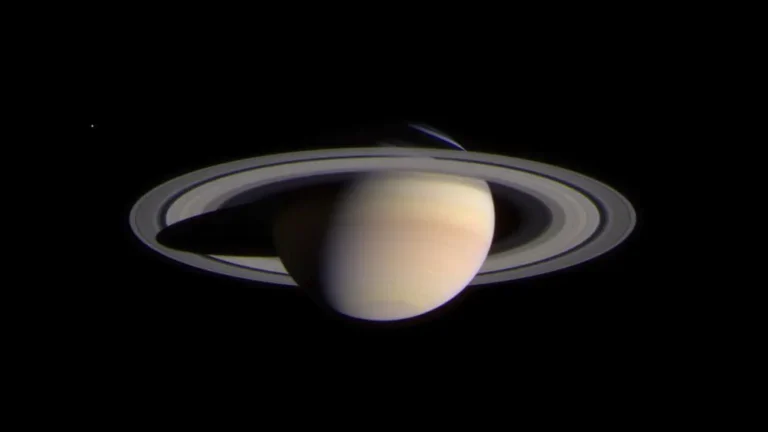
Saturn is the sixth planet from the Sun and the second-largest planet in our solar system. Famous for its spectacular rings, Saturn is one of the most recognizable and beautiful worlds in space.
Although it appears peaceful from afar, Saturn is a dynamic planet with powerful storms, dozens of moons, and a complex system of icy rings that continue to fascinate scientists.As a gas giant, Saturn is vastly different from Earth and offers valuable insights into how planets and planetary systems form and evolve.
A Giant Made of Gas
Saturn is composed primarily of hydrogen and helium, the same elements that make up the Sun. Unlike Earth, Saturn does not have a solid surface that astronauts could stand on. Instead, the planet's atmosphere gradually becomes denser and hotter as you move deeper into its interior.
Scientists believe Saturn has a small rocky core surrounded by layers of metallic hydrogen and liquid gases. The pressure inside the planet is so extreme that matter exists in forms unlike anything found on Earth.
The Least Dense Planet
Despite being enormous, Saturn is the least dense planet in our solar system. In fact, its average density is lower than that of water. If there were an ocean large enough, Saturn would theoretically float.
Saturn's diameter is about 120,500 kilometers (74,900 miles), making it more than nine times wider than Earth.
The Most Spectacular Ring System
Saturn's rings are its most famous feature. Although several planets have rings, none are as bright or extensive as Saturn's.The rings are made up of billions of particles ranging in size from tiny grains of dust to chunks of ice and rock several meters across.
Most of the material consists of water ice, which reflects sunlight and gives the rings their brilliant appearance.Although the rings appear solid from a distance, they are actually incredibly thin compared to their enormous width.
Scientists believe the rings may have formed from pieces of moons, comets, or asteroids that were torn apart by Saturn's gravity.
A Fast-Spinning World
Saturn rotates very quickly. A single day on Saturn lasts only about 10.7 Earth hours. This rapid rotation causes the planet to bulge slightly around its equator, making it appear flattened at the poles.However, Saturn moves much more slowly around the Sun.
One Saturnian year is equivalent to approximately 29.5 Earth years.
Storms and Extreme Weather
Saturn's atmosphere is constantly changing. Powerful winds can reach speeds of more than 1,800 kilometers (1,100 miles) per hour, making them some of the fastest winds in the solar system.The planet also experiences enormous storms.
One of its most unusual features is a giant hexagon-shaped jet stream surrounding Saturn's north pole. This mysterious six-sided weather pattern is unlike anything observed on Earth.
A World Surrounded by Moons
Saturn is orbited by more than 140 known moons, making it one of the most moon-rich planets in our solar system. These moons vary greatly in size and appearance, from tiny irregular objects to worlds larger than planets.
Titan
Titan is Saturn's largest moon and the second-largest moon in the solar system. It is larger than the planet Mercury and is the only moon known to have a thick atmosphere. Titan also has lakes and rivers made of liquid methane and ethane.
Enceladus
Enceladus is a small icy moon that has become one of the most exciting places in the search for extraterrestrial life. Scientists have discovered enormous plumes of water vapor and ice erupting from cracks near its south pole, suggesting that a global ocean may exist beneath its icy surface.
Several other moons also show signs of fascinating geological activity and continue to be important targets for future exploration.
Exploring Saturn
Saturn has been studied by several spacecraft over the decades. NASA's Pioneer and Voyager missions provided the first close-up views of the planet and its rings.The most detailed exploration came from NASA's Cassini mission, which spent more than thirteen years orbiting Saturn.
Cassini revealed extraordinary details about the planet, its ring system, and its moons, fundamentally changing our understanding of this giant world.
The mission also discovered evidence that moons such as Titan and Enceladus could potentially provide environments suitable for life.
Quick Facts About Saturn
Position from the Sun: Sixth planet
Planet Type: Gas Giant
Diameter: About 120,500 kilometers (74,900 miles)
Length of a Day: About 10.7 Earth hours
Length of a Year: About 29.5 Earth years
Average Distance from the Sun: About 1.4 billion kilometers (886 million miles)
Moons: More than 140 known moons
Rings: The largest and most spectacular ring system in the solar system
Special Features: Brilliant icy rings, the north polar hexagon, and the potentially habitable moon Enceladus
Saturn is far more than a beautiful planet with rings. It is a complex and dynamic world surrounded by fascinating moons, powerful storms, and clues about how planetary systems form. From the methane lakes of Titan to the hidden ocean of Enceladus, Saturn continues to inspire scientists and remains one of the most extraordinary destinations in our solar system.