
Uranus is the seventh planet from the Sun and one of the most unusual worlds in our solar system. Known for its pale blue-green color and unique sideways rotation, Uranus is an enormous ice giant that remains one of the least explored planets.
Its strange orientation, extreme seasons, and icy composition make it one of the most fascinating destinations in our cosmic neighborhood.Although Uranus may appear calm and featureless from a distance, it is a dynamic world with powerful winds, faint rings, and a diverse family of moons.
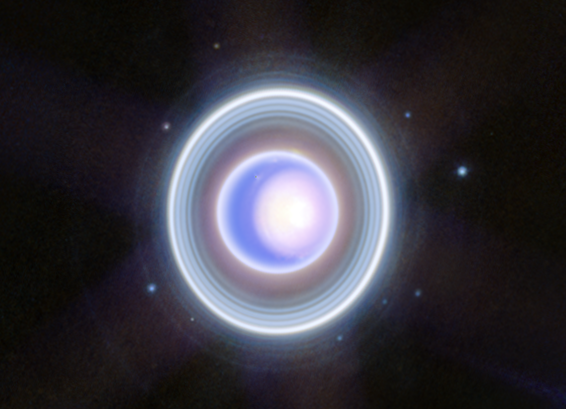
Why Is Uranus Blue-Green?
The beautiful blue-green color of Uranus comes from methane gas in its atmosphere. Methane absorbs red wavelengths of sunlight and reflects blue and green light back into space, giving the planet its distinctive appearance.
Beneath its upper clouds lies an atmosphere composed mainly of hydrogen and helium, along with significant amounts of water, ammonia, and methane in icy forms.
An Ice Giant Unlike Any Other
Uranus and Neptune are classified as ice giants because they contain larger amounts of water, ammonia, and methane than the gas giants Jupiter and Saturn.Scientists believe Uranus has a small rocky core surrounded by an enormous mantle of hot, dense fluids.
The planet's atmosphere forms only a thin outer layer above this unusual interior.Uranus is about four times wider than Earth, with a diameter of approximately 51,000 kilometers (31,500 miles).
The Planet That Rotates on Its Side
One of Uranus' most remarkable characteristics is its extreme tilt. The planet's axis is tilted by about 98 degrees, meaning it essentially rotates on its side.Scientists think this unusual orientation may have been caused by one or more massive collisions early in the solar system's history.
Because of this extreme tilt, Uranus experiences seasons unlike any other planet. Each pole can spend around 42 Earth years continuously facing the Sun, followed by another 42 years in darkness.
Long Years and Short Days
Despite being far from the Sun, Uranus spins relatively quickly. A single day on Uranus lasts about 17 Earth hours.However, because it orbits at such a great distance from the Sun, Uranus takes approximately 84 Earth years to complete one journey around our star.
This means that a person born during one Uranian year would have to live for 84 Earth years to celebrate their first Uranian birthday.
A Windy and Dynamic World
Although Uranus appears smooth and relatively featureless, it experiences powerful weather systems. Winds in its atmosphere can exceed 900 kilometers (560 miles) per hour.The planet occasionally develops enormous storms and bright cloud features that can be observed by telescopes and spacecraft.
Seasonal changes caused by its extreme tilt continue to influence its atmosphere in ways scientists are still trying to understand.
Uranus Has Rings Too
Many people associate rings with Saturn, but Uranus also possesses a ring system. Its rings are dark, narrow, and relatively faint compared to Saturn's brilliant icy rings.Scientists believe the rings may consist of rocky material and dark particles that absorb much of the sunlight reaching them.
A Family of Fascinating Moons
Uranus has 28 known moons, each named after literary characters from the works of William Shakespeare and Alexander Pope.
Among the largest moons are:
Titania
Titania is the largest moon of Uranus and features enormous canyons, cliffs, and impact craters.
Oberon
Oberon is heavily cratered and shows evidence of ancient geological activity.
Ariel
Ariel has one of the brightest surfaces among Uranus' moons and displays valleys and signs of past tectonic processes.
Miranda
Miranda is perhaps the strangest moon of Uranus, with gigantic cliffs and a patchwork surface that appears to have been broken apart and reassembled in the distant past.
These moons provide valuable clues about the formation and evolution of icy worlds throughout the outer solar system.
Exploring Uranus
Only one spacecraft has ever visited Uranus. NASA's Voyager 2 flew past the planet in 1986, providing humanity's first close-up images of this distant world.Voyager 2 revealed new moons, discovered additional rings, and transformed our understanding of Uranus and its unusual magnetic field.
Scientists continue to study the planet using powerful telescopes and hope future missions will return to explore this mysterious ice giant in greater detail.
Quick Facts About Uranus
Position from the Sun: Seventh planet
Planet Type: Ice Giant
Diameter: About 51,000 kilometers (31,500 miles)
Length of a Day: About 17 Earth hours
Length of a Year: About 84 Earth years
Average Distance from the Sun: About 2.9 billion kilometers (1.8 billion miles)
Moons: 28 known moons
Rings: Yes, a faint system of dark rings
Special Feature: Rotates on its side with an axial tilt of about 98 degrees
Uranus is one of the most mysterious planets in our solar system. Its sideways rotation, extreme seasons, icy interior, and fascinating moons make it a world unlike any other. Although it has been visited only once, Uranus remains an important target for future exploration as scientists continue searching for answers about how planets form and evolve in the far reaches of our solar system.