
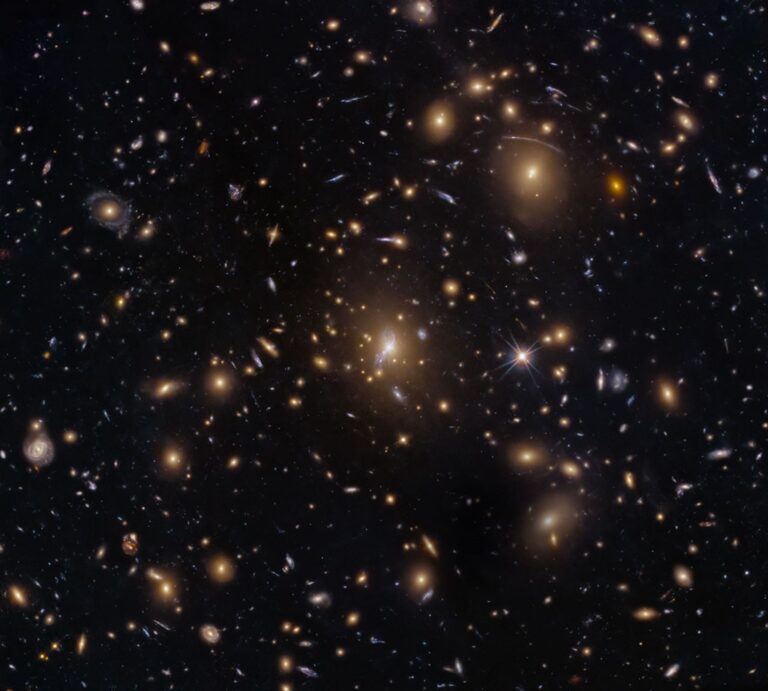
The NASA Hubble Space Telescope has once again delivered a breathtaking view of the cosmos. This time, Hubble captured an extraordinary image of a massive galaxy cluster known as MACS0329-0211, appearing like a brilliant swarm of galaxies scattered across deep space.But this stunning image is much more than cosmic artwork. Hidden within it are clues about how the universe evolved over billions of years and how gravity can transform entire galaxy clusters into natural telescopes.
What Is the Galaxy Cluster MACS0329-0211?
MACS0329-0211 is a massive galaxy cluster located billions of light-years from Earth. Galaxy clusters are among the largest structures in the universe, containing hundreds or even thousands of galaxies held together by their immense gravitational pull.
Hubble's image reveals an incredible variety of galaxies within the cluster. Some appear as large, smooth elliptical galaxies, while others are thin disk-shaped galaxies viewed from the side. Several spiral galaxies can also be seen face-on, displaying graceful swirling arms filled with stars.
The diversity of shapes and sizes demonstrates the remarkable complexity of the universe and highlights how galaxies can evolve differently over cosmic time.
How Gravitational Lensing Creates a Cosmic Magnifying Glass
One of the most fascinating features of MACS0329-0211 is its enormous gravitational power.
According to Einstein's theory of general relativity, massive objects bend the fabric of space itself. Because this galaxy cluster contains an enormous amount of matter, including invisible dark matter, it significantly warps space around it.
As light from even more distant galaxies travels toward Earth, it passes through this distorted region of space and becomes magnified and stretched. This phenomenon is called gravitational lensing.
In Hubble's image, several faint arcs can be seen around the cluster. These arcs are not part of the cluster itself. Instead, they are extremely distant galaxies whose light has been bent and amplified by the cluster's gravity.
Near the center of the image, astronomers also identified a bright figure-eight-shaped object that may represent another distant galaxy being dramatically distorted by gravitational lensing.
Why Scientists Study Massive Galaxy Clusters
Galaxy clusters such as MACS0329-0211 are valuable laboratories for understanding the universe.By studying these enormous structures, astronomers can:• Investigate how galaxies formed and evolved over billions of years
• Map the distribution of dark matter throughout the universe
• Observe galaxies that existed much earlier in cosmic history
• Better understand how gravity shapes large-scale structures in space
Because gravitational lensing magnifies distant galaxies that would otherwise be too faint to detect, these clusters effectively function as natural telescopes created by the universe itself.
What Hubble's Deep-Space Image Reveals About the Universe
The Hubble Space Telescope observed MACS0329-0211 using both visible and infrared light. By combining different wavelengths, astronomers can examine galaxies in exceptional detail and uncover features that might otherwise remain hidden.
More than three decades after its launch, Hubble continues to transform our understanding of the cosmos. Each new image not only reveals incredible beauty but also provides scientists with valuable information about the origins and evolution of the universe.
The image of MACS0329-0211 serves as another reminder that the universe is far larger, more complex, and more extraordinary than we can imagine.
Frequently Asked Questions
What is a galaxy cluster?
A galaxy cluster is a massive collection of hundreds or even thousands of galaxies that are held together by gravity.
What is gravitational lensing?
Gravitational lensing occurs when the gravity of a massive object bends space and magnifies light from more distant galaxies behind it.
What is MACS0329-0211?
MACS0329-0211 is a massive galaxy cluster observed by NASA's Hubble Space Telescope. Its powerful gravity acts like a cosmic magnifying glass, allowing astronomers to study galaxies located even farther away.
Why is Hubble's image important?
The image helps scientists investigate galaxy evolution, dark matter, and the large-scale structure of the universe while also revealing distant galaxies that would otherwise be difficult to observe.
Image Credit: NASA, ESA, M. Postman (STScI); Image Processing: G. Kober (NASA/Catholic University of America).
Source: NASA Science – Hubble Sees Swarm of Galaxies