
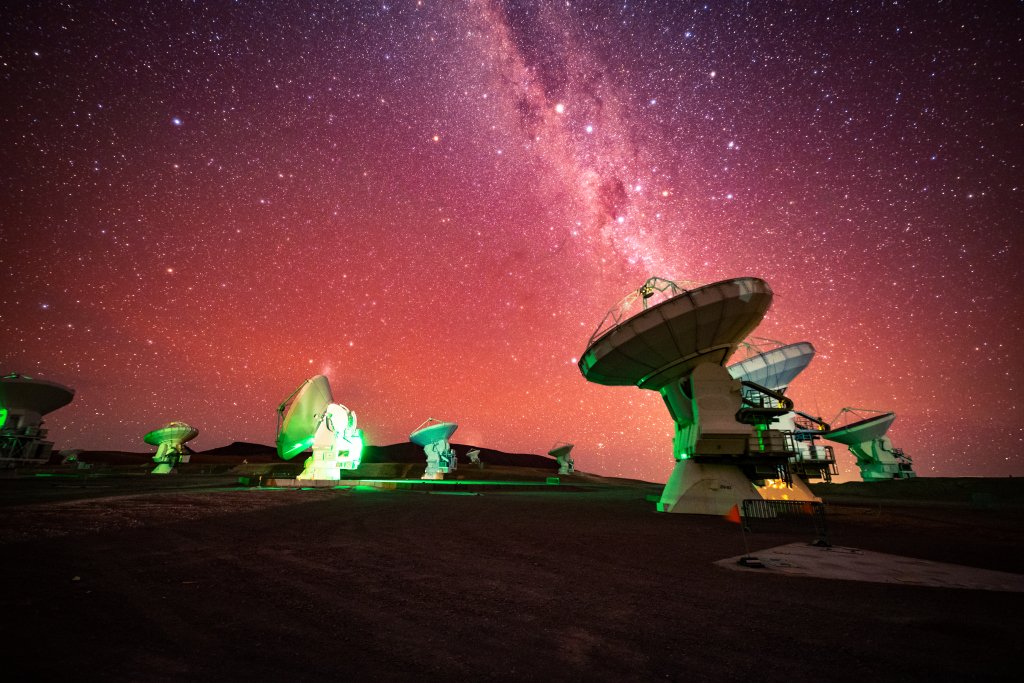
A new study has provided exciting insights into the role young stars play in shaping the evolution of galaxies. By examining approximately 18,000 star-forming regions in nearby spiral galaxies, astronomers are uncovering the significant impact of stellar feedback on cosmic environments. This research was presented during a press conference at the 248th meeting of the American Astronomical Society and involved collaboration among the Atacama Large Millimeter/submillimeter Array (ALMA), the James Webb Space Telescope, and the Hubble Space Telescope. These observations are part of the international research project known as Physics at High Angular resolution in Nearby GalaxieS (PHANGS), which aims to deepen our understanding of how galaxies grow and evolve over time.
The Power of Stellar Feedback
The researchers discovered that in typical galaxies, the energy released by newly formed massive stars generates a significant amount of ionized gas pressure. This pressure drives the expansion of star-forming regions, which is critical for the birth of new stars. However, whether these regions can continue to grow or if they stall is heavily influenced by their surrounding environment. Lead author Debosmita Pathak, a graduate student at The Ohio State University, explains that when massive stars come into existence, they unleash energy that disrupts their surroundings and pushes interstellar material outward. This dynamic process is what we refer to as stellar feedback.
Comparing Normal and Active Galaxies
To better understand how stellar feedback varies in different conditions, the team compared typical galaxies with the highly active galaxy NGC 3256, which is the result of a collision between two galaxies. They found that the pressures caused by stellar feedback in NGC 3256 were around 100 times stronger than those in more typical galaxies like the Milky Way. This intense feedback creates a much more turbulent and unpredictable environment, influencing the formation and evolution of stars in ways that differ significantly from calmer galaxies.
Unlocking Secrets of Galactic Evolution
These groundbreaking measurements reveal physical conditions previously unexplored, allowing scientists to gain a better understanding of the processes that drive galactic evolution across diverse cosmic environments. This research does not only illuminate how young stars influence their galaxies well before more dramatic events, such as supernova explosions, occur, but it also establishes a foundation for refining models of galaxy evolution throughout the universe.
A New Era in Astronomy
This innovative study showcases the collaborative efforts of astronomers utilizing ALMA, the James Webb Space Telescope, and Hubble, offering unprecedented views into the complexities of galaxy formation. As we continue to explore the universe, understanding how young stars affect their galaxies becomes crucial for piecing together the big picture of cosmic evolution. This research not only advances our knowledge but also inspires future explorations into the depths of space and time.