
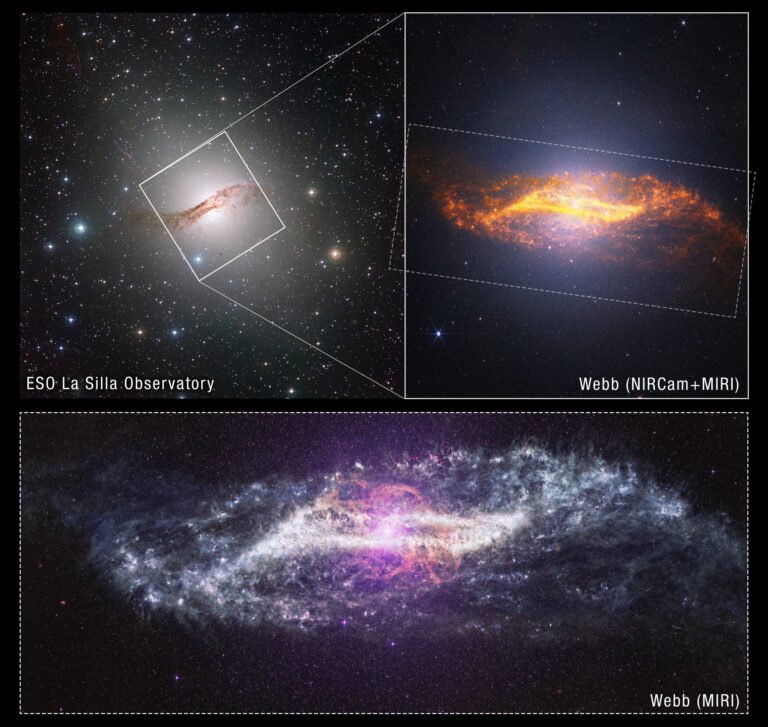
The James Webb Space Telescope (JWST) has unveiled spectacular new views of Centaurus A, a nearby galaxy that presents a unique blend of features. This exciting journey through space takes viewers into the heart of this intriguing galaxy, showcasing its dusty structures and the energetic activities that define it. Celebrating four years of scientific achievement, Webb's Mid-Infrared Instrument (MIRI) has revealed details that were previously hidden from our eyes. By utilizing infrared technology, Webb is capable of penetrating thick layers of dust that obscure much of the galaxy's visible light, providing an unprecedented glimpse into its true nature.
Unveiling the Secrets of Centaurus A
Centaurus A is not just any galaxy; it is a striking example of a galaxy that has undergone significant transformation due to past collisions. The newly released imagery allows scientists to witness intricate structures, such as filaments and loops, that stretch across the galaxy's center. These features are a result of the interactions between gas, dust, and stars, creating a cosmic tapestry rich in detail. Webb's advanced capabilities enable us to see these phenomena in a way that visible light cannot, bringing to light the dynamic processes that occur within this galaxy.
The Heart of the Galaxy: A Supermassive Black Hole
At the core of Centaurus A lies a supermassive black hole that is actively consuming material from its surroundings. This black hole shines brightly in the infrared spectrum, surrounded by a complex arrangement of dust and gas that has been sculpted by its powerful gravitational influence. The energetic activity around the black hole is a testament to the ongoing evolution of the galaxy, as it feeds on the material that falls into its grasp. Such observations are crucial for understanding the life cycles of galaxies and the significant role black holes play in shaping their environments.
A Cosmic Collision and Its Aftermath
The unique characteristics of Centaurus A can be traced back to a galactic collision that occurred in its past. This collision has not only formed the distinctive shape of the galaxy but has also contributed to the active processes we observe today. The intricate structures visible in Webb's images are remnants of this interaction, showcasing how galaxies can evolve and change over billions of years. This ongoing activity provides astronomers with invaluable data on the lifecycle of galaxies and the events that lead to their current state.
Celebrating Webb's Achievements
As we celebrate the fourth anniversary of the James Webb Space Telescope's science operations, the discoveries made through its observations continue to inspire awe and curiosity. Centaurus A serves as a perfect example of how Webb's advanced technology is reshaping our understanding of the universe. By revealing the hidden aspects of this galaxy, Webb is paving the way for future research and exploration, allowing scientists to delve deeper into the mysteries of galactic formation and evolution. The journey through the cosmos is far from over, and with Webb at the forefront, we are sure to uncover even more astounding revelations.