
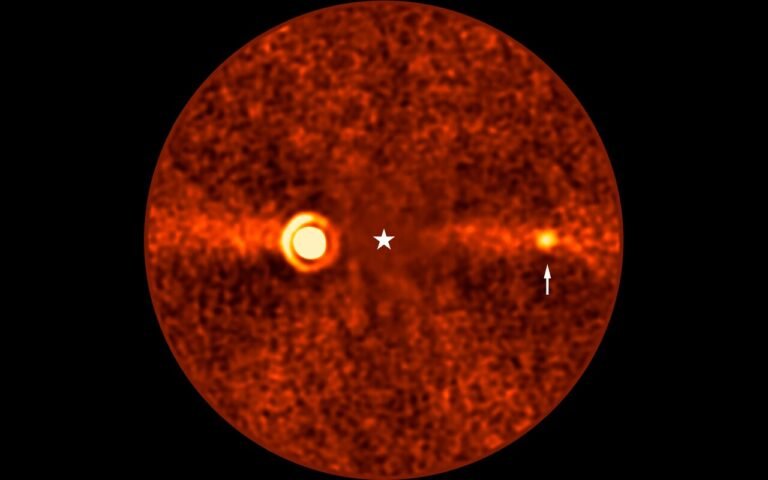
On July 15, 2026, astronomers announced a remarkable discovery: a third planet in the Beta Pictoris system, named Beta Pictoris d. This planet is incredibly faint, being 100 times dimmer than another planet in the same system, known as Beta Pictoris b. Even more intriguing, it is one of the lightest exoplanets ever captured in images from Earth. The breakthrough was made using the European Southern Observatory’s Very Large Telescope (VLT) in Chile, after a decade of searching through archival data.
When the search began for Beta Pictoris d
The story of Beta Pictoris d began over ten years ago when astronomers first focused on Beta Pictoris b. They initially wanted to observe this known planet to study its changes over time. As they analyzed images, they unexpectedly noticed a faint object nearby. Co-lead of the study, Ben Sutlieff from the University of Edinburgh, recalled the moment when he and his team realized they had discovered something new. "There’s something else there, did you see it?" he remembered saying. This prompted a deeper investigation, leading them to explore the extensive archives of the European Southern Observatory.
What makes Beta Pictoris d so special?
Beta Pictoris d is not just notable for being faint; it offers significant insights into planetary formation. The planet is a gas giant, like Jupiter, but only about 2.4 times more massive than our largest planet. This makes it one of the lightest exoplanets ever directly imaged from the ground. Its wider orbit compared to its sibling planets in the system allows scientists to study how different planetary masses and distances affect their development. As Jayne Birkby from the University of Oxford put it, "Planet d seems to have been playing a game of hide-and-seek with us for over a decade and only now can we say ‘found you!’"
Here are 3 things to know about Beta Pictoris d
Location: Beta Pictoris d is located 63 light-years from Earth, a relatively close distance in cosmic terms, which allows for detailed study.
Discovery method: The planet was initially detected using the VLT's ERIS instrument, showcasing the power of modern ground-based telescopes in discovering distant worlds.
Future potential: The findings suggest that many more faint planets may be lurking in the archives of existing telescopes, waiting to be uncovered.
How does Beta Pictoris d compare in size?
To put its size into perspective, Beta Pictoris d is about 2.4 times the mass of Jupiter. If we think about Jupiter, which could fit over 1,300 Earths inside it, Beta Pictoris d is a relatively small player in the cosmic game. Imagine the Great Pyramid of Giza, which stands at about 481 feet tall. If Jupiter were that height, Beta Pictoris d would stand only about the height of a small office building. This scale comparison highlights how vast and varied our universe is.