
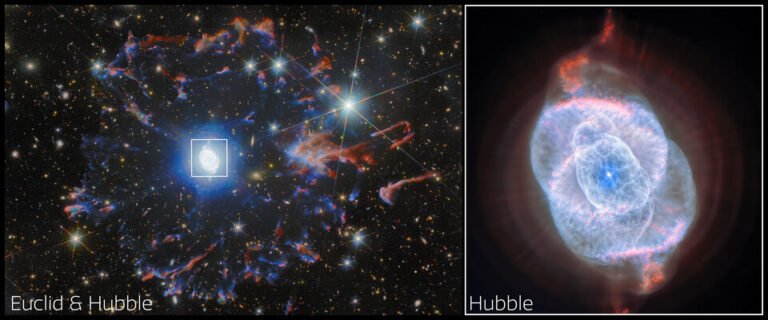
In an exciting collaboration, NASA's Hubble Space Telescope and ESA's Euclid have come together to provide a striking new view of the Cat’s Eye Nebula, one of the most intricate remnants of a dying star in our universe. Known scientifically as NGC 6543, this planetary nebula is located in the constellation Draco and has fascinated astronomers for many years with its complex and stunning structure. Positioned about 4,300 light-years away from Earth, the Cat’s Eye Nebula showcases the spectacular end stages of stellar evolution.
The Fascinating Nature of Planetary Nebulae
Planetary nebulae are named for their round, planet-like appearance when viewed through early telescopes, but they are actually clouds of gas expelled by stars at the end of their life cycles. The Cat’s Eye Nebula is particularly significant in this regard, as it was here that scientists first identified the nature of these celestial structures in 1864. By analyzing the spectrum of light emitted from the nebula, astronomers discovered that it contained gases rather than solid bodies, thus distinguishing planetary nebulae from stars and galaxies.
A New Perspective on Stellar Death
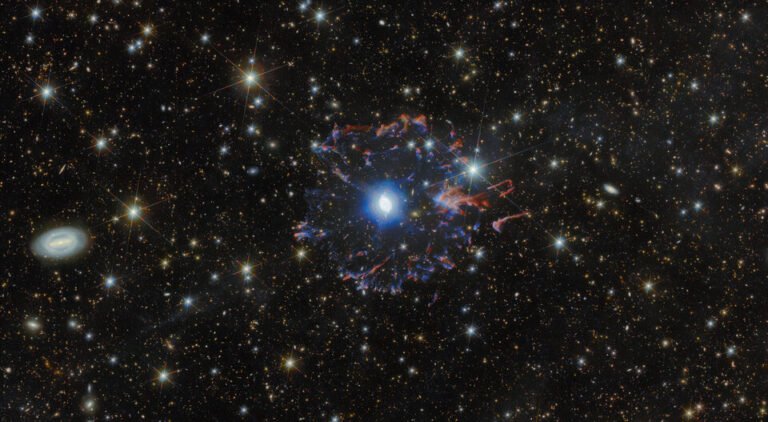
The latest observations by Hubble and Euclid have revealed the exquisite details of the Cat’s Eye Nebula, showcasing the remarkable complexity of stellar death. While Euclid primarily focuses on mapping the distant universe, its deep imaging surveys have captured the Cat’s Eye Nebula in stunning detail. The nebula's bright central region is surrounded by colorful gas fragments that are expanding outward—these fragments were ejected at an earlier stage of the star's life, long before the nebula we see today began to take shape.
A Cosmic Tapestry of Structures
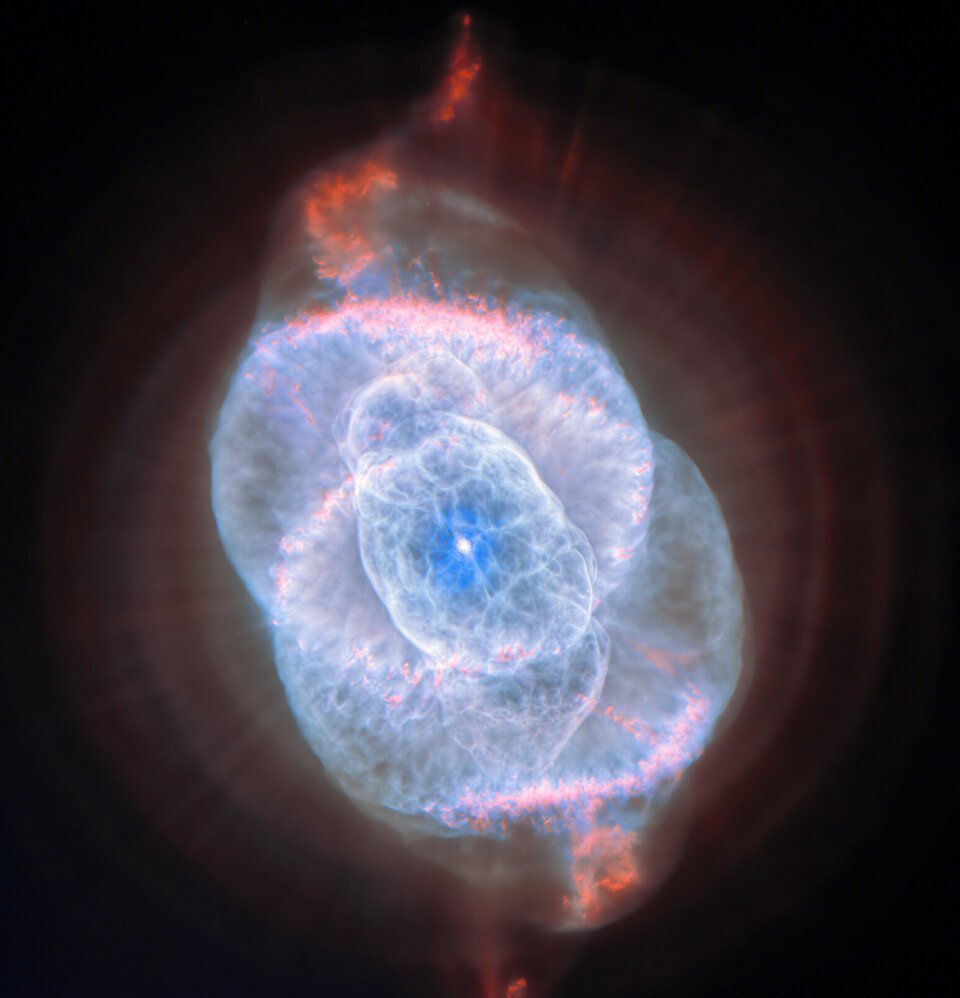
Hubble's high-resolution images provide a closer look at the core of the Cat’s Eye Nebula, revealing a mesmerizing tapestry of concentric shells, high-speed gas jets, and dense knots of material shaped by shock interactions. This intricate structure resembles a cosmic 'fossil record,' capturing the episodic mass loss from the dying star at the nebula’s heart. Each layer tells a story of the star's final evolutionary stages, making the Cat's Eye Nebula a fascinating subject for study.
Bridging Local Beauty and Cosmic Depth
By combining the focused observations of Hubble with the broad perspectives of Euclid, astronomers are able to appreciate the Cat’s Eye Nebula not just in isolation, but within the vast cosmic landscape of galaxies. This collaborative effort highlights the delicate balance between the spectacular local phenomena of stellar death and the far-reaching expanses of the universe. Such synergies between missions enrich our understanding of both the nebula itself and the broader cosmic environment it inhabits.
The Role of Hubble and Euclid in Astrophysics
Both the Hubble Space Telescope and the Euclid mission represent remarkable achievements in international cooperation between NASA and ESA. Hubble has been a cornerstone of astronomical discovery for over three decades, while Euclid is set to unlock new insights into the mysteries of dark energy and the formation of galaxies. Together, these missions are not only enhancing our knowledge of the Cat’s Eye Nebula but also paving the way for future discoveries in our understanding of the universe.
Continuing the Journey of Discovery
As we continue to explore the cosmos, the Cat’s Eye Nebula stands as a stunning reminder of the beauty and complexity of stellar evolution. With each new observation from Hubble and Euclid, we are reminded of the intricate processes that govern the life and death of stars. This collaboration showcases the power of modern astronomy, where advanced technology and international teamwork can unveil the mysteries of the universe, one beautiful image at a time.
Join the Exploration
For those captivated by the wonders of space, the Cat’s Eye Nebula presents an incredible opportunity to engage with the cosmos. The images and data produced by Hubble and Euclid not only enhance our scientific understanding but also inspire awe and curiosity about our universe. As we look deeper into the heart of these cosmic phenomena, we invite everyone to join us in this ongoing journey of discovery and exploration.