
Euclid, a mission from the European Space Agency (ESA) with contributions from NASA, has taken a fresh look at the heart of our Milky Way galaxy. This new perspective overlaps with an area that NASA’s Nancy Grace Roman Space Telescope will examine once it launches later this summer. This early insight is a significant boost for astronomers, allowing them to gather more information than either telescope could provide individually.
A Unique Observation
According to Jason Rhodes, a senior research scientist at NASA’s Jet Propulsion Laboratory, this is a rare moment where Euclid has paused its primary sky survey, which mainly focuses on the universe's structure. This strategic decision highlights the importance of the area being observed. By combining Euclid’s snapshot with Roman’s upcoming survey, astronomers can enhance their understanding of our galaxy and locate elusive cosmic entities like rogue planets and isolated black holes.
Euclid's Day Off
Euclid dedicated a single day from its six-year mission to preview the section of sky that Roman will investigate during its Galactic Bulge Time-Domain Survey. This survey aims to capture one of the deepest views of our galaxy's center. While Euclid's observation is shallower and lacks some of the color detail that Roman will capture, it covers a broader area—around 5 square degrees, equivalent to the space taken up by about 25 full moons.
Roman's Focus on Change
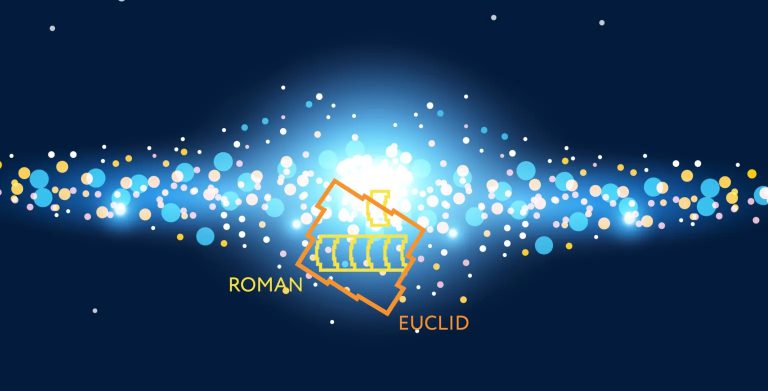
During its five-year mission, Roman will repeatedly image a smaller area of about 1.7 square degrees, roughly the size of 8.5 full moons. This will allow scientists to monitor how hundreds of millions of stars and other celestial objects vary over short periods. These observations are expected to uncover numerous new planets and other intriguing cosmic phenomena.
Discovering Cosmic Lenses
Roman will look for tiny increases in starlight that indicate a microlensing event, which occurs when a massive object such as a star, planet, or black hole aligns closely with a distant star. The gravity from the nearer object bends the light from the background star, allowing astronomers to see it more clearly.
The Role of Lensing Objects
Matthew Penny, an assistant professor at Louisiana State University and co-lead of Euclid’s exoplanet science team, notes that lensing objects are often other stars. However, Roman will also have the capability to detect planets orbiting these stars, along with other unusual objects that are challenging to find through conventional methods.
Hunting for Black Holes
Among the peculiar objects that Roman may discover are black holes formed after the death of massive stars. Astronomers estimate around 100 million of these stellar black holes exist in our Milky Way, but they have mostly been found through their interactions with companion stars. Many are thought to roam solo, and Roman aims to identify them even when they're not accompanied by anything else.
Longer Signals from Black Holes
Unlike planets, which create microlensing events that last just hours or days, black holes exert enough mass to bend light over a larger area, resulting in much longer signals. This means astronomers may need to observe them for extended periods to track their movement.
Extra Time for Discovery
The additional two years of data provided by Euclid will give astronomers more opportunities to observe the lensing and source stars as they drift apart, aiding in the identification of the lens and allowing for accurate mass measurements.