
Astronomers have made a groundbreaking discovery of a moon-like object in the CD-35 2722 system, which is unlike anything seen in our Solar System. This potential exomoon, as it's being called, orbits a brown dwarf rather than a planet. The implications of this finding are vast, as it challenges our traditional labels for celestial bodies.
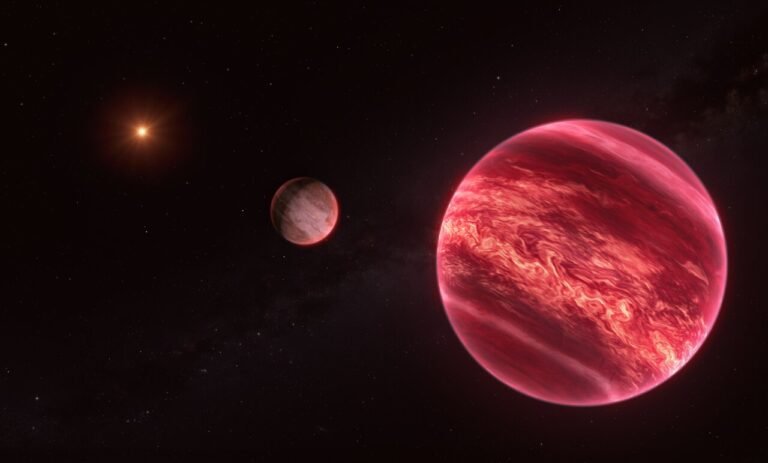
What led to this unexpected find?
The discovery was made using the European Southern Observatory’s Very Large Telescope (VLT) in Chile. Kevin Hoy, a lead author and student at the ESO, described the system as 'super weird' compared to our own. The central star, CD-35 2722, is about half the mass of our Sun, and it is orbited by a brown dwarf—an object that is too massive to be a planet but not massive enough to be classified as a star.
How astronomers know it's an exomoon
The research team utilized the CRIRES+ instrument on the VLT and applied the radial velocity method, the same technique that led to the first detection of an exoplanet around a Sun-like star. This method detects small wobbles in the brown dwarf's movement caused by the gravitational influence of the orbiting object. Hoy emphasized that the object, which could be as massive as Jupiter, is not simply a moon in the traditional sense, making the classification complex.
Why does this matter?
This discovery is significant not just for its novelty, but because it highlights the complexities of categorizing celestial objects. Traditional definitions of planets and moons may fall short in systems like CD-35 2722, where the lines are blurred. Alice Zurlo, a collaborator in the study, pointed out that in our Solar System, definitions are clear-cut, but this new finding complicates those boundaries significantly.
What happens next?
The team hopes to confirm this exomoon's existence through further observations. The upcoming Extremely Large Telescope (ELT) promises to enhance our ability to detect smaller exomoons and may provide more insights into the formation and evolution of such systems. As we continue to explore these distant worlds, our understanding of planetary systems will undoubtedly evolve.