
An exciting new study led by an international team of astronomers has unveiled fascinating details about the exoplanet WD 1856 b. Utilizing the advanced capabilities of the NASA/ESA/CSA James Webb Space Telescope, the researchers observed the planet as it transited its host star. This allowed them to gather critical data about WD 1856 b's mass, temperature, and even its atmosphere.
The Fate of Stars and Their Planets
Billions of years ago, a star similar to our Sun underwent a dramatic transformation as it neared the end of its life. It expanded into a massive red giant, engulfing nearby planets before shedding its outer layers and leaving behind a hot, dense core known as a white dwarf. Remarkably, astronomers have discovered the Jupiter-sized WD 1856 b orbiting this white dwarf every 34 hours, at a distance of less than 3 million kilometers.
The Mystery of WD 1856 b's Survival
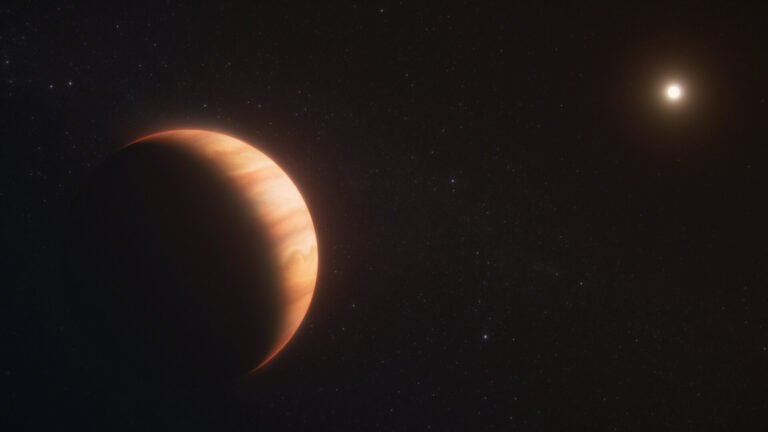
Exoplanet WD 1856 b, shown in this artist’s concept, is a gas giant that orbits its star at a distance 50 times closer than Earth orbits the Sun. Observations by NASA’s James Webb Space Telescope determined the planet’s temperature and detected molecules in its atmosphere.Artwork: NASA, ESA, CSA, Ralf Crawford (STScI)
Lead author Ryan MacDonald from the University of St Andrews explained, "The planet is about the size of Jupiter, but the white dwarf it orbits is only the size of Earth, making the planet seven times larger than its star." This unique size ratio raises intriguing questions about its formation and survival.
Webb's Observations Unravel Secrets
The Webb Telescope's observations involved tracking the planet as it passed in front of its star, a phenomenon known as a transit. This event allowed researchers to calculate the mass of WD 1856 b, estimating it to be between four and eleven times that of Jupiter. The team also measured the planet's temperature during this transit.
Unraveling the Heating Mystery
Co-author Christopher O’Connor of Northwestern University focused on tracing the planet's temperature back through time. He stated, "The big question is how WD 1856 b ended up where it is today, and there are two prevailing theories." One possibility suggests that the planet was engulfed by the host star during its red giant phase yet somehow managed to survive within.
The other theory posits that gravitational interactions with other celestial bodies in the system caused the planet to migrate inward over time. Notably, the white dwarf is part of a triple star system, meaning the outer companion stars could have played a significant role in shaping WD 1856 b’s current path.
Residual Heat Reveals History
The researchers noted that there was no present energy source to account for the planet's heat, leading to the conclusion that it must originate from an earlier period. By employing models that describe how sub-stellar objects like WD 1856 b cool down, combined with the new mass and temperature data from Webb, they were able to estimate when the heating occurred.
Their analysis indicated that this heating likely took place between 3 and 5.5 billion years after the star transitioned into a white dwarf. This suggests that the planet initially orbited at a safer distance, avoiding destruction during the red giant phase, before migrating inward due to gravitational forces.
Atmospheric Composition Insights
Additionally, light passing through WD 1856 b's atmosphere provided clues about its chemical makeup. Co-author Victoria Boehm from Cornell University highlighted, "We detected signatures of small cloud particles and hydrocarbons, likely methane, marking the first time an atmosphere has been observed on a planet transiting a dead star."
The team has recently observed four more transits of WD 1856 b with Webb, aiming to delve deeper into its atmospheric chemistry. These findings are anticipated to yield even more significant insights into the planet's characteristics.
A Glimpse into Our Cosmic Future
Image: Exoplanet WD 1856 b (Transmission Spectrum)
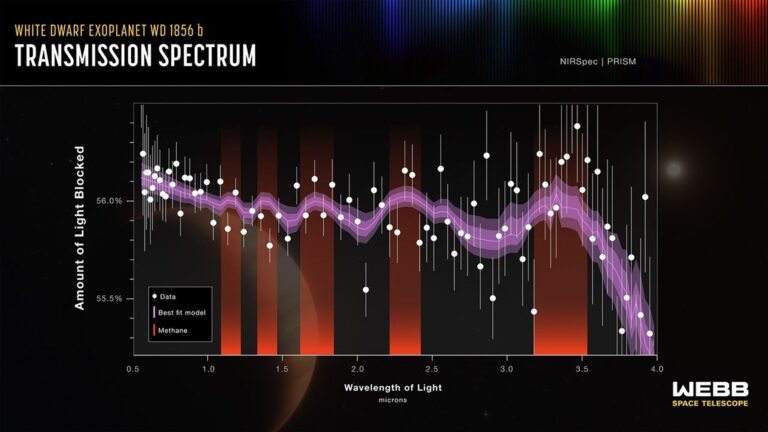
NASA’s James Webb Space Telescope measured the constituents of exoplanet WD 1856 b as it passed in front of its star, finding signs of methane. WD 1856 b orbits a white dwarf star the size of Earth. As a result, the planet blocks more than half of the star’s light.Illustration: NASA, ESA, CSA, Joseph Olmsted (STScI)
In roughly five billion years, our own Sun is expected to run out of hydrogen fuel, swelling into a red giant and ultimately shedding its outer layers to become a white dwarf. During this process, Mercury, Venus, and possibly Earth could face destruction. However, the fate of the outer planets, especially the gas giants, remains uncertain.
Investigating planets that orbit the remnants of Sun-like stars can help us understand what could happen to our own Solar System in the distant future. As MacDonald aptly put it, "We’re used to looking back in time when we use telescopes, but this is the first time we have been able to look forward to what might happen to the outer planets around the remnant of a Sun-like star."