
In an exciting collaboration, the Hubble Space Telescope and the James Webb Space Telescope have provided us with remarkable new views of NGC 6537, affectionately known as the Red Spider Nebula. This cosmic structure, resembling a spider in profile, has been observed by both telescopes, allowing scientists to compare two distinct snapshots captured over the span of more than 20 years. The latest images from Webb not only show the nebula's expansion but also reveal intricate details about its molecular hydrogen lobes and outflowing material, giving us a deeper understanding of this fascinating nebula.
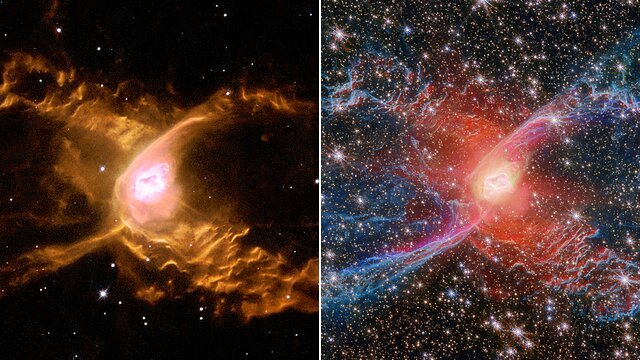
A Closer Look at the Red Spider Nebula
The Red Spider Nebula, NGC 6537, is a planetary nebula located about 3,500 light-years away in the constellation of Scorpius. Planetary nebulae are formed when a star similar to our Sun exhausts its nuclear fuel and ejects its outer layers, leaving behind a hot core that ionizes the expelled gas. This process can create stunning shapes and colors that are often quite mesmerizing. The nickname 'Red Spider' comes from its unique appearance, characterized by a narrow waist and four elongated 'legs' that seem to stretch out into the cosmos.
Why the New Observations Matter
Here are three significant insights gained from the recent observations of the Red Spider Nebula:
1. Expansion: The new data confirms that the nebula has expanded since Hubble's initial observations in 2001, providing evidence of dynamic changes in this region of space.
2. Molecular Hydrogen Lobes: Webb's sensitive instruments have unveiled the nebula's full extent, revealing lobes of molecular hydrogen that Hubble could not detect. This helps scientists understand how these structures evolve over time.
3. Outflowing Material: The new images indicate that material is actively flowing out from the center of the nebula, suggesting ongoing processes that influence its shape and behavior.
Visualizing Cosmic Scale
To put the size of the Red Spider Nebula into perspective, consider this: it spans about 1.2 light-years across. That's roughly equivalent to 7,000 times the distance from Earth to the Sun! Imagine a structure that stretches further than our entire solar system, showcasing the vastness of space and the dynamic processes happening within it. This nebula is like a cosmic art piece, constantly changing and evolving, reminding us of the beauty and complexity of the universe.
Looking Forward
As we continue to gather and analyze data from both Hubble and Webb, there's so much more to learn about nebulae like NGC 6537. The insights provided by these two powerful observatories not only enhance our understanding of stellar evolution but also inspire curiosity about the cosmos. Future observations may reveal even more details about the processes shaping such spectacular objects, helping us piece together the life cycles of stars and the intricate dance of matter in our universe.