
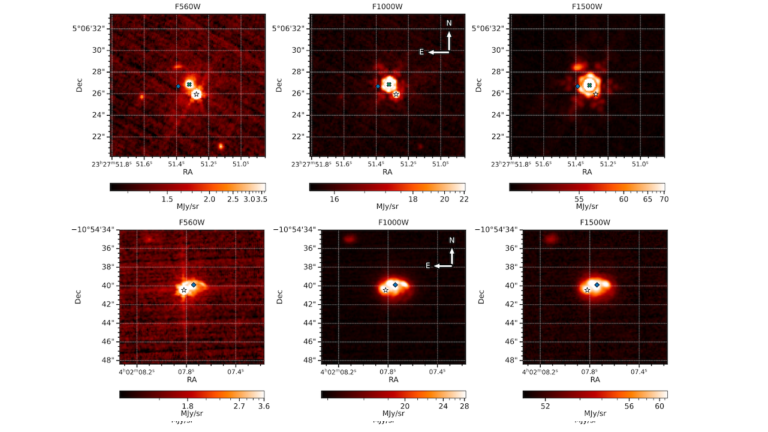
On July 10, 2026, a team of astronomers shared some intriguing findings from the James Webb Space Telescope (JWST). They focused on two M-dwarf stars that had previously been identified as possible candidates for Dyson spheres hypothetical megastructures built by advanced civilizations to capture energy from their stars. However, these latest observations revealed that the mid-infrared signals thought to indicate such structures actually come from distant background galaxies, not from the stars themselves. This unexpected twist has added a new layer of complexity to our search for signs of extraterrestrial life and advanced technologies in the universe.
When Project Hephaistos took the stage
Back in 2022, the Project Hephaistos team set out to investigate certain stars that seemed to show signs of unusual energy emission. These M-dwarf stars, known for their cool temperatures and long lifespans, were ideal candidates for hosting civilizations capable of building Dyson spheres. The idea is that such structures could potentially harness energy on a massive scale. Observations from previous missions, like the Wide-field Infrared Survey Explorer (WISE), indicated some excess infrared light, prompting excitement about the possible technological wonders lurking around these stars. Fast forward to 2026, and the JWST stepped in with its advanced imaging and spectroscopy capabilities to take a closer look.
What is a Dyson sphere?
A Dyson sphere is a theoretical megastructure that encompasses a star to capture a significant portion of its energy output. Proposed by physicist Freeman Dyson in 1960, the concept imagines an advanced civilization harnessing energy on a grand scale, essentially turning a star into a power source. While we haven't discovered any actual Dyson spheres, looking for them can help us understand the potential for intelligent life beyond Earth. The search involves identifying unusual energy emissions from stars, which might suggest advanced technology at work.
Here are 3 insights from the JWST's observations
1. The first candidate star, referred to as Candidate D, turned out to have its excess infrared emissions attributed to a background galaxy at a redshift of approximately 0.9. This galaxy, displaying characteristics typical of a Hot Dust Obscured Galaxy, misled our earlier observations and excitement.
2. The second candidate, Candidate E, revealed a different story. This star's infrared signals were linked to a galaxy at redshift 0.4, characterized as a dusty starburst galaxy. Here, stars are forming rapidly, creating a vibrant and active environment that can confuse our readings.
3. These findings emphasize the importance of the JWST's precision in distinguishing between the signals of distant galaxies and local stars, which can significantly impact our understanding of the cosmos.
How do these discoveries compare to familiar structures?
To put the scale of these observations into context, consider that the JWST's precision can resolve light from galaxies billions of light-years away. Imagine standing at the top of New York's Empire State Building, which is about 1,454 feet tall — now imagine looking out and detecting light from something similar to the diameter of our Milky Way, which spans about 100,000 light-years across. The observatory's ability to distinguish nearby stars from distant galaxies is akin to spotting a firefly in a dark field while being able to ignore the glow of a nearby city. This capacity is vital for understanding the universe and our place within it.