
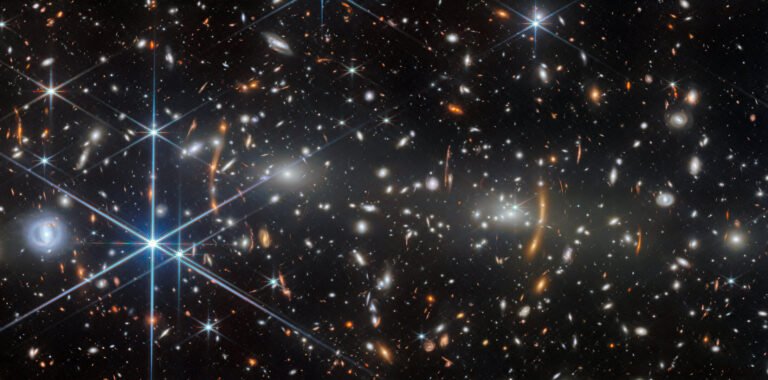
The universe is full of incredible sights, but few are as captivating as the galaxy cluster MACS J0553.4-3342. Recently captured by the advanced instruments of the James Webb Space Telescope, this cluster represents a dynamic construction site in the cosmos. Located in the constellation Columba, or the Dove, MACS J0553.4-3342 offers a unique glimpse into the past, revealing the ongoing processes that shape galaxy clusters. This observation not only deepens our understanding of cosmic evolution but also showcases the power of modern astronomical technology.
Understanding Redshift and Cosmic Time
To comprehend the significance of MACS J0553.4-3342, we must first grasp the concept of redshift. This measurement indicates how much the light from the galaxy cluster has stretched due to the universe's expansion, allowing astronomers to look back in time. With a redshift of 0.412, we are witnessing this cluster as it appeared 4.4 billion years ago. In cosmic terms, that's relatively young, suggesting that the cluster is still in a phase of active formation. Observations from the Hubble Space Telescope and other instruments support this notion, revealing a cluster that is continuously evolving.
The Merger of Two Sub-Clusters
MACS J0553.4-3342 is not a single entity but rather a complex assembly of two roughly equal mass sub-clusters that are currently merging. This cosmic collision is a chaotic process, with the sub-clusters having already passed through one another and now separated by over a million light-years. However, the gravitational attraction between them will eventually pull them back together, leading to an even larger, more massive galaxy cluster. The merging process is messy, filled with hot gas that emits powerful X-rays, painting a vivid picture of cosmic evolution.
The Role of Gravitational Lensing
Even while in the midst of its construction, MACS J0553.4-3342 has already developed a remarkable tool: gravitational lensing. This phenomenon occurs when the immense mass of the galaxy cluster bends and focuses light, similar to how a glass lens works. In the stunning images captured by Webb, we can see elongated orange arcs, which are actually distorted images of distant galaxies whose light has been warped as it passes through the gravitational field of the cluster. One of the most intriguing features is a trio of bright spots on the left side of the image, representing three images of a single background galaxy.
Unlocking the Secrets of the Universe
Gravitational lensing transforms MACS J0553.4-3342 from a mere cosmic spectacle into a powerful scientific instrument. By studying how the cluster's mass distorts light, researchers can identify and magnify far-off galaxies and even individual stars that would otherwise be too faint to observe. This capability allows astronomers to uncover distant objects, including galaxies formed less than a billion years after the Big Bang. Each arc and line seen in the images opens a window into the early universe, providing rich data for understanding the formation and evolution of celestial bodies.