
In a remarkable achievement, scientists have utilized NASA’s IXPE (Imaging X-ray Polarimetry Explorer) to directly measure the magnetic fields of the pulsar PSR J1101−6101, located within the intriguing Lighthouse Nebula. This groundbreaking work not only sheds light on the nature of pulsars but also enhances our understanding of some of the most extreme and energetic phenomena in the universe. A recent paper detailing these findings was published in the Astrophysical Journal.
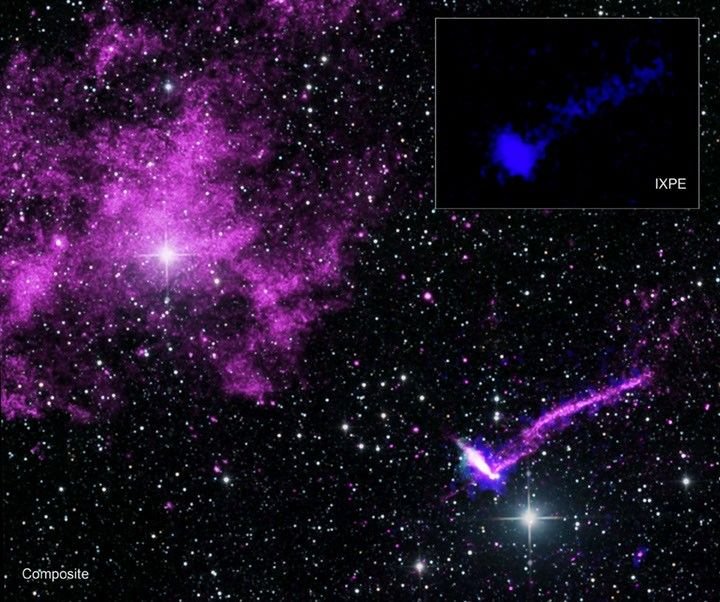
Exploring the Lighthouse Nebula
In June 2025, IXPE dedicated almost 18 days to observing the Lighthouse Nebula. The team focused on two distinct X-ray offshoots emerging from the pulsar, aiming to delve deeper into the interactions of high-speed electrons within this powerful system. The longer offshoot is termed the "filament," while the shorter one is referred to as the "trail." Understanding these features is crucial for grasping how pulsars influence their surrounding environments.
The Role of High-Energy Particles
As high-energy particles from the pulsar collide with the surrounding interstellar gas, they create a bow shock, much like the wave that forms at the bow of a fast-moving boat. Most of these particles become trapped behind this bow shock, giving rise to the turbulent trail that follows the pulsar. Researchers have theorized since 2008 that the highest-energy particles manage to escape this bow shock and travel along the galaxy's magnetic field lines, forming the nebula's elongated filament, and the IXPE mission set out to confirm this theory.
Measuring Polarization: A Key to Understanding
"We aimed to test that theory," explained Jack Dinsmore, an undergraduate student at Stanford University and lead author of the study. "The pivotal evidence would come from measuring the polarization of light, which reveals the direction of the magnetic field. If the magnetic field aligns with the filament, it would confirm that particles are indeed flowing along those lines." However, measuring polarization in the Lighthouse Nebula posed significant challenges due to its relatively faint nature.
Advanced Techniques Yield New Insights
To overcome the difficulties presented by the faintness of the nebula, IXPE scientists developed sophisticated analytical methods that optimize data usage and avoid oversimplification. Thanks to these innovative techniques, the science team successfully measured the polarization of the filament, as well as the trail and the pulsar's emission signal. Their findings ultimately confirmed with over 99% confidence that the magnetic field aligns with the flow of particles.