
Jupiter is the fifth planet from the Sun and the largest planet in our solar system. This enormous world is so massive that more than 1,300 Earths could fit inside it. Known for its colorful cloud bands and the famous Great Red Spot, Jupiter is a fascinating planet that has shaped the history and structure of our solar system.
Although Jupiter is called a planet, it is more like a miniature solar system, surrounded by dozens of moons, a faint ring system, and an incredibly powerful magnetic field.
A Giant Made Mostly of Gas
Unlike Earth, Jupiter does not have a solid surface that you could stand on. It is classified as a gas giant and is composed primarily of hydrogen and helium, the same elements that make up the Sun.
As you move deeper into Jupiter, the pressure and temperature increase dramatically. Scientists believe that beneath its thick clouds, hydrogen exists in a strange liquid metallic state that can conduct electricity and help generate the planet's enormous magnetic field.
At its center may lie a dense core made of rock and metal, although its exact structure remains a topic of scientific research.
The Largest Planet in the Solar System
Jupiter is truly enormous. Its diameter measures approximately 143,000 kilometers (89,000 miles), making it more than eleven times wider than Earth.
Its immense gravity has influenced the formation of the solar system and continues to affect the orbits of asteroids and comets. Some scientists even consider Jupiter a protective giant because its gravity can redirect or capture objects that might otherwise travel toward the inner solar system.
The Great Red Spot
One of Jupiter's most famous features is the Great Red Spot, a gigantic storm larger than Earth itself. This enormous storm has been raging for centuries and is one of the most recognizable features in our solar system.
Jupiter's atmosphere is constantly changing, with colorful cloud bands, powerful winds, and enormous storms that can grow and disappear over time. Winds in the upper atmosphere can exceed 600 kilometers (370 miles) per hour.
A Day Lasting Only 10 Hours
Despite its massive size, Jupiter rotates incredibly quickly. A single day on Jupiter lasts less than 10 Earth hours, making it the fastest-spinning planet in our solar system.This rapid rotation causes the planet to bulge slightly at its equator and contributes to the formation of its distinctive cloud bands.However, Jupiter takes nearly 12 Earth years to complete one orbit around the Sun.
Jupiter's Powerful Magnetic Field
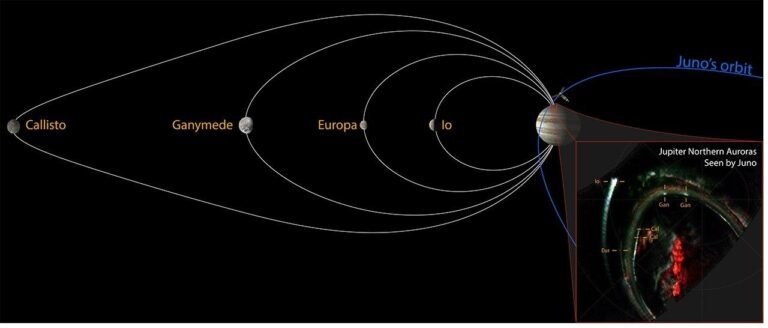
Jupiter has the strongest magnetic field of any planet in our solar system. Its magnetic environment is so vast that it extends millions of kilometers into space.This giant magnetic bubble traps charged particles and creates intense radiation belts around the planet.
The magnetic field also generates spectacular auroras near Jupiter's poles, which are even more powerful than the Northern and Southern Lights on Earth.
A World of Many Moons
Jupiter has more moons than any other planet in our solar system, with dozens of known natural satellites. Four of these moons are especially famous because they were discovered by astronomer Galileo Galilei in 1610.
Io
Io is the most volcanically active world in the solar system, with hundreds of active volcanoes continuously reshaping its surface.
Europa
Europa has a thick shell of ice that may hide a vast liquid ocean beneath it. Scientists consider Europa one of the most promising places to search for life beyond Earth.
Ganymede
Ganymede is the largest moon in the solar system. It is even larger than the planet Mercury and is the only moon known to generate its own magnetic field.
Callisto
Callisto is one of the most heavily cratered objects in the solar system and may also contain a hidden underground ocean.
Does Jupiter Have Rings?
Although Saturn is famous for its rings, Jupiter also has a ring system. However, Jupiter's rings are faint and difficult to see because they are made primarily of tiny dust particles.
Exploring Jupiter
Jupiter has been explored by several spacecraft over the years. NASA's Pioneer and Voyager missions provided the first close-up images of the giant planet. Later, the Galileo spacecraft spent years studying Jupiter and its moons in detail.
Today, NASA's Juno spacecraft continues to investigate Jupiter's atmosphere, magnetic field, and interior structure. Future missions will also explore moons such as Europa, which may harbor conditions suitable for life.
Quick Facts About Jupiter
Position from the Sun: Fifth planet
Planet Type: Gas Giant
Diameter: About 143,000 kilometers (89,000 miles)
Length of a Day: About 10 Earth hours
Length of a Year: About 12 Earth years
Average Distance from the Sun: About 778 million kilometers (484 million miles)
Moons: More than 90 known moons
Rings: Yes, a faint ring system
Special Feature: The Great Red Spot and the strongest planetary magnetic field in the solar system
Jupiter is much more than the largest planet in our solar system. It is a dynamic world of powerful storms, giant moons, and extreme magnetic forces. By studying Jupiter and its fascinating moons, scientists hope to better understand how planets form and whether environments capable of supporting life may exist elsewhere in the universe.