
Mars is the fourth planet from the Sun and one of the most fascinating worlds in our solar system. Known as the "Red Planet" because of its rusty, reddish appearance, Mars has captured human imagination for centuries. Today, it remains one of the most studied planets because scientists believe it may have once been capable of supporting life.
With its ancient river valleys, towering volcanoes, and polar ice caps, Mars offers a glimpse into a world that was once very different from the cold desert we see today.
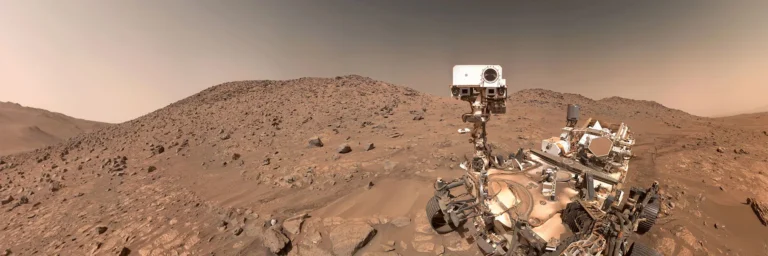
Why Is Mars Red?
Mars gets its distinctive red color from iron-rich minerals in its soil and rocks. Over billions of years, the iron reacted with oxygen, creating iron oxide—commonly known as rust. This rusty dust covers much of the planet's surface, giving Mars its famous reddish glow in the night sky.
A Cold and Dusty Desert World
Although Mars shares some similarities with Earth, it is a much colder and drier planet. Average temperatures are around -63°C (-81°F), though temperatures can vary greatly depending on the location and season.
Mars has a thin atmosphere made mostly of carbon dioxide. Because the atmosphere is less than one percent as dense as Earth's, it cannot retain much heat or provide protection from harmful radiation.The planet is also famous for its massive dust storms, some of which can cover the entire globe and last for weeks.
Evidence of Ancient Water
One of the most exciting discoveries about Mars is that it was once much wetter than it is today. Scientists have found evidence of ancient rivers, lakebeds, and minerals that could only have formed in the presence of liquid water.
Today, water on Mars mostly exists as ice beneath the surface and within the polar ice caps. Researchers continue to study Mars to understand where its water went and whether simple forms of life could have existed there long ago.
Home to the Solar System's Largest Volcano
Mars is home to some of the most extraordinary geological features in the solar system. The most famous is Olympus Mons, the largest volcano ever discovered on a planet.
Olympus Mons rises approximately 22 kilometers (14 miles) above the surrounding plains, making it nearly three times taller than Mount Everest. Mars also contains Valles Marineris, a vast canyon system stretching over 4,000 kilometers (2,500 miles), one of the largest canyons in the solar system.
Seasons on Mars
Like Earth, Mars has seasons because its axis is tilted. The planet experiences spring, summer, autumn, and winter, although each season lasts much longer because Mars takes about 687 Earth days to complete one orbit around the Sun.
Mars also has weather patterns that include clouds, winds, frost, and changing polar ice caps.
Does Mars Have Moons?
Mars has two small moons named Phobos and Deimos. Scientists believe these oddly shaped moons may be captured asteroids that became trapped by Mars' gravity long ago.
Phobos is gradually moving closer to Mars and may eventually break apart or crash into the planet millions of years in the future.
Exploring the Red Planet
Mars has been visited by more spacecraft than any other planet except Earth. Orbiters, landers, and rovers have transformed our understanding of this fascinating world.
NASA's robotic explorers, including the Spirit, Opportunity, Curiosity, and Perseverance rovers, have discovered evidence of ancient environments that may once have been suitable for microbial life. The Perseverance rover is currently collecting samples that could one day be returned to Earth for detailed analysis.
Scientists continue exploring Mars because it may hold important clues about how planets evolve and whether life exists elsewhere in the universe.
Future Human Missions to Mars
Mars is considered one of the most promising destinations for future human exploration. Space agencies and private companies are developing technologies that could eventually send astronauts to the Red Planet.
Future human missions could establish temporary bases, search for signs of ancient life, and test technologies needed for long-duration space travel.
Quick Facts About Mars
Position from the Sun: Fourth planet
Planet Type: Rocky (Terrestrial) Planet
Length of a Year: 687 Earth days
Length of a Day: 24.6 Earth hours
Average Surface Temperature: About -63°C (-81°F)
Moons: Two – Phobos and Deimos
Rings: None
Atmosphere: Thin atmosphere composed mainly of carbon dioxide
Largest Volcano: Olympus Mons
Special Feature: Evidence of ancient rivers, lakes, and water ice
Mars is much more than a red dot in the night sky. It is a world that may once have had flowing water, warmer climates, and conditions suitable for life. As robotic explorers continue their discoveries and plans for human missions advance, Mars remains one of the most exciting destinations in our search to understand the universe and our place within it.