
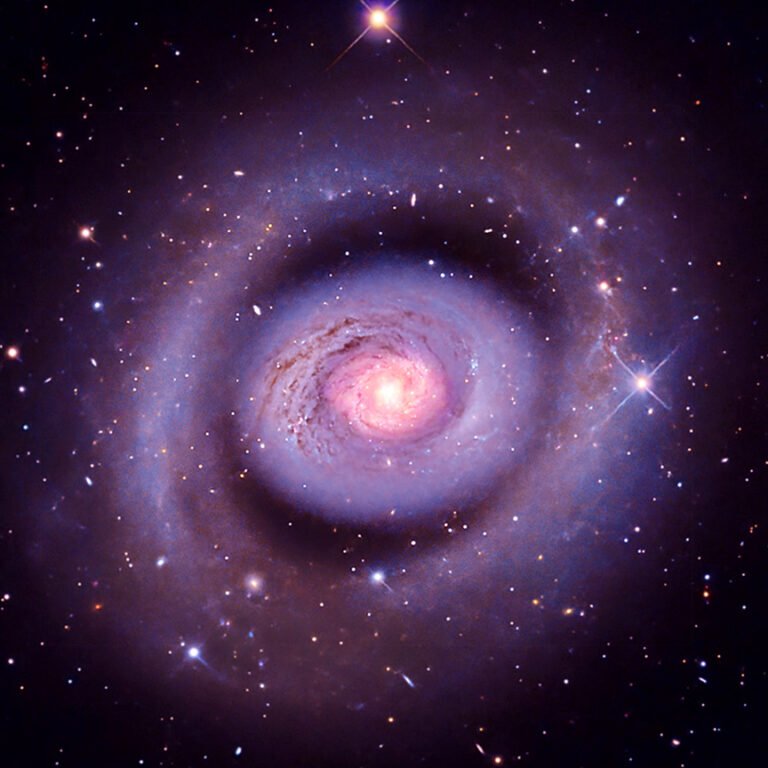
NASA's Chandra X-ray Observatory recently unveiled a stunning new look at Messier 94, also known as NGC 4736. This spiral galaxy, located about 16 million light-years away, is known for its dazzling starburst ring, where new stars are actively forming. Observations released on June 30, 2026, provide a fresh perspective on the dynamic processes shaping this celestial marvel.
What makes Messier 94 special?
Messier 94 stands out among spiral galaxies due to its bright inner starburst ring. This ring is a region where gas and dust converge, facilitating the birth of new stars. Such star formation is critical not only for the galaxy's evolution but also for our understanding of cosmic processes. As stars ignite, they contribute to the galaxy's luminosity and chemical enrichment, influencing the surrounding space.
How did Chandra capture this new view?
The striking new image of Messier 94 is a composite created by combining data from Chandra's X-ray observations with visible light images taken by ground-based astrophotographers. Chandra utilized its advanced X-ray instruments to capture different wavelengths, which were then color-coded for clarity red, orange, and blue represent various X-ray energies. This layering technique allows astronomers to discern various components of the galaxy, revealing features that would be invisible to optical telescopes alone.
What did scientists learn from the observations?
Through these observations, scientists have gained insights into the processes driving star formation in Messier 94. The X-ray data suggests that the oval shape of the starburst ring plays a significant role in channeling gas into the central regions, promoting the birth of new stars. This finding may alter our understanding of how spiral galaxies evolve and maintain their structure over time. The interplay between gas dynamics and star formation is a key area of research for astronomers studying galaxy formation.
What’s next for Messier 94 research?
As astronomers continue to analyze data from Chandra and other observatories, they hope to uncover even more about Messier 94's complex behaviors and characteristics. Additional studies may focus on the interactions between the galaxy's stellar populations and the gas that fuels them. By piecing together these intricate details, scientists aim to enhance our broader understanding of spiral galaxies and their life cycles. The journey of discovery is ongoing, and every observation provides a new piece of the cosmic puzzle.