
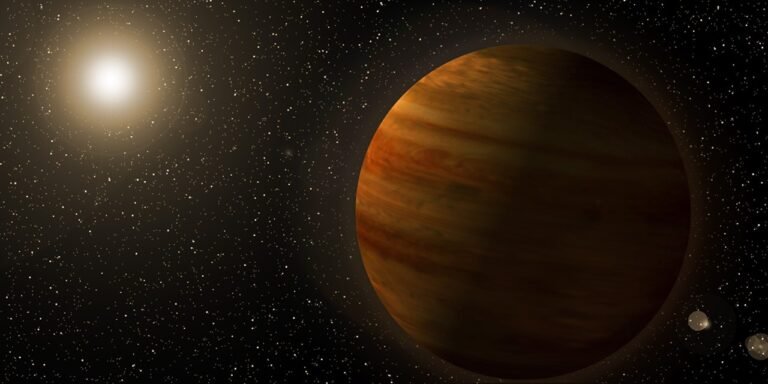
In a groundbreaking discovery, NASA’s Transiting Exoplanet Survey Satellite (TESS) mission has detected a planet orbiting a distant star through the fascinating phenomenon of gravitational microlensing. This discovery marks a significant departure from TESS's usual method of finding exoplanets, where it typically identifies planets that pass in front of their stars, causing a slight dimming in brightness. The newly found planet, known as Gaia23bra b, is a super-Jupiter, meaning it is much larger than our own Jupiter, and it orbits far away from its host star.
Unexpected Discoveries
Diana Dragomir, a professor at the University of New Mexico and a co-author of the study, shared that when TESS was launched, no one anticipated it would have the capability to find planets like this one. With a mass 1.6 times that of Jupiter and located at a considerable distance from its star, Gaia23bra b would not have been easily detected using TESS's primary transit detection method. This discovery suggests that there may be other microlensing planets hidden within TESS's extensive data archives that scientists have yet to uncover.
The Role of ESA’s Gaia Telescope

The first hints of Gaia23bra b emerged in 2023, when the now-retired European Space Agency (ESA) Gaia telescope detected a star that suddenly brightened. This phenomenon occurs when a foreground star passes in front of a more distant star, magnifying its light due to gravitational microlensing. Researchers then revisited TESS's archived data, discovering that the satellite had also observed the same event, providing a more comprehensive view of the planetary system in question.
Enhanced Observations
Mallory Harris, a Ph.D. candidate at the University of New Mexico and the study's lead author, explained that Gaia’s observations were not frequent enough to detect the planet itself. However, TESS was actively monitoring the same region of the sky during the event, allowing it to capture detailed light curves that revealed additional features caused by the presence of the planet. This collaboration between TESS and Gaia highlights the importance of different observational strategies in uncovering the secrets of our galaxy.
Far Beyond TESS’s Typical Range
The analysis published on July 1 in The Astrophysical Journal Letters revealed that Gaia23bra b orbits an orange dwarf star, which is about 80% the mass of our Sun, located nearly 40,000 light-years away from Earth. This distance is remarkable, as TESS typically focuses its search within a radius of about 150 light-years. The discovery of this distant planet opens up new avenues for understanding the diversity of planetary systems across the universe.
The Power of Microlensing
While TESS has discovered over 6,000 known exoplanets primarily through the transit method, microlensing has revealed less than 5% of these worlds. This technique occurs when two stars align from our point of view, causing the light from the more distant star to bend as it passes by the nearer star's gravitational field. If conditions are perfect, the foreground star acts like a lens, magnifying the light from the distant star, and planets orbiting the foreground star can add to this effect, creating observable brightness spikes.
Complementary Techniques
The transit method is particularly effective for discovering large planets that orbit closely around their stars, as these planets block a significant amount of starlight. While such hot Jupiter-type planets are captivating, astronomers are also keen to find planets that resemble those in our own solar system. This is where microlensing excels, as it can identify planets at greater distances from their stars.
Future Prospects with Roman
However, microlensing observations are often limited by time constraints, making it challenging to gather detailed information about these planets. Despite this, microlensing can provide valuable insights into the demographics of planetary populations. Michael Fausnaugh, a professor at Texas Tech University and a co-author of the study, compared this discovery to what the upcoming Nancy Grace Roman Space Telescope will achieve. Set to launch on August 30, 2026, Roman aims to survey the center of the Milky Way galaxy, which is expected to reveal around 1,000 microlensing planets and approximately 100,000 transiting planets.
Understanding Planetary Formation
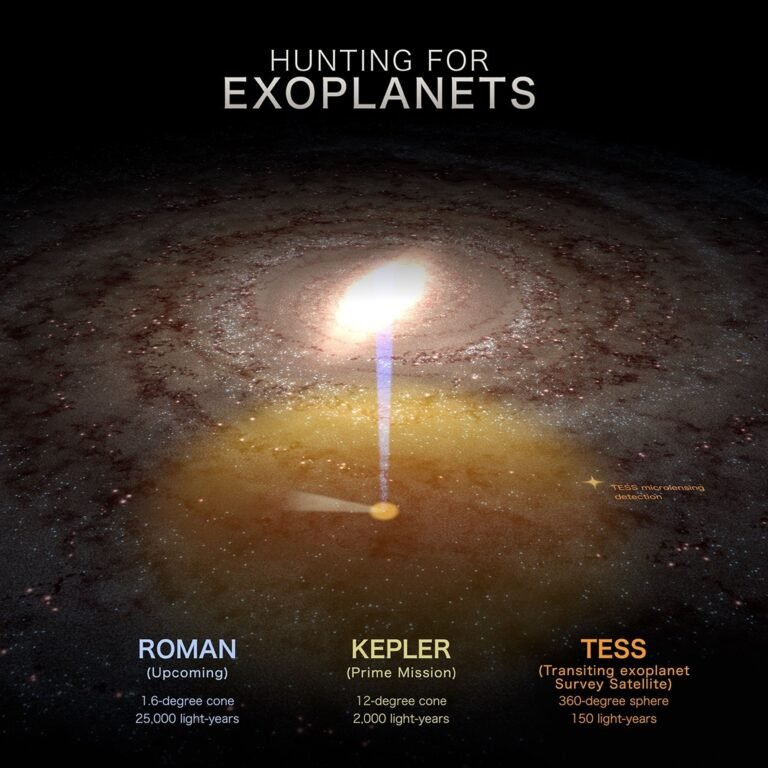
Roman's focus on the densely packed stars in the galaxy's center increases the chances of observing microlensing events. While TESS captures a broader view of the sky, focusing on areas where stars are more spread out, it has now proven capable of finding microlensing planets in diverse regions of the galaxy. This discovery allows scientists to explore how different environments influence planetary formation and the characteristics of planetary systems.