
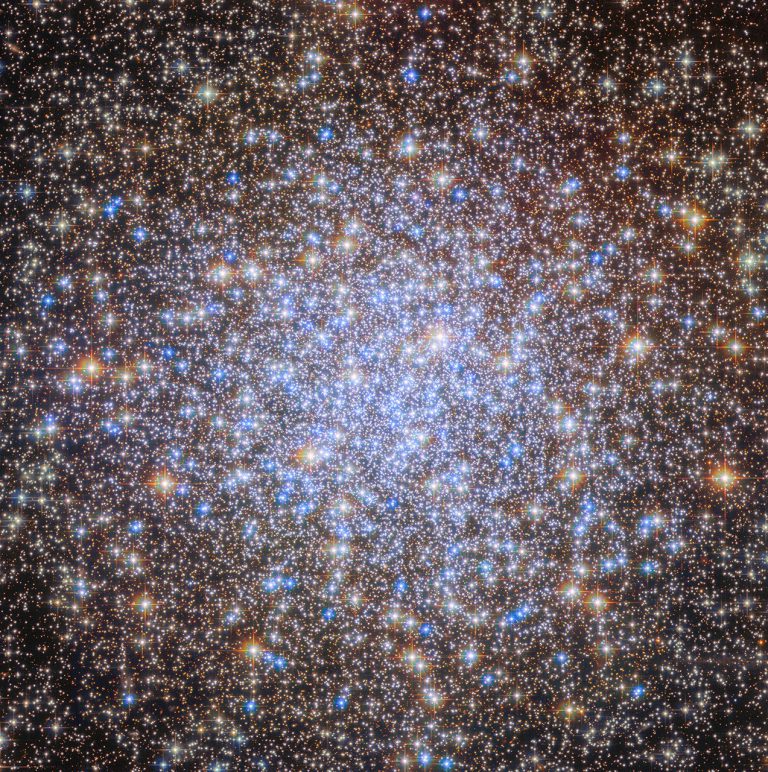
The latest image from the Hubble Space Telescope showcases a breathtaking view of NGC 6723, also known as the Chandelier Cluster. This globular cluster is like a cosmic chandelier, shining with a multitude of stars, each one a beacon of light 27,000 light-years away in the constellation Sagittarius.
What is a Globular Cluster?
Globular clusters are fascinating stellar collections that can contain anywhere from tens of thousands to millions of stars, all held together by gravity. Our Milky Way is home to over 150 known globular clusters, with potentially more waiting to be discovered, obscured by cosmic dust or dense star fields.
The Age of NGC 6723
NGC 6723 is a treasure trove of some of the oldest stars in our galaxy, with many of its stars exceeding 10 billion years in age. These clusters likely formed long before our Sun and are among the earliest structures in the Milky Way, although the exact details of their formation remain a mystery.
A Complex Stellar History
Astronomers once believed that all stars in a globular cluster formed simultaneously, leading to a uniform population. However, advanced observations from Hubble suggest a more intricate history, revealing that these clusters have a varied composition and age.
Hubble's Observations of NGC 6723
Hubble first observed NGC 6723 as part of a comprehensive study designed to uncover the properties of globular clusters in our galaxy. This survey has provided invaluable insights into the formation and evolution of these clusters, leading to numerous scientific publications.