
A significant development is unfolding as material expelled from the Sun during a powerful X1.1 solar flare on Tuesday is expected to reach Earth later today. This event could trigger disturbances in our planet's magnetic field, leading to geomagnetic storm levels classified as G1 (minor) or even G2 (moderate). Forecasters have indicated that we might start feeling the effects of these disturbances by late July 3, continuing into July 4. This could align perfectly with Independence Day festivities, offering a chance to see stunning auroras alongside fireworks!
Current Solar Activity Levels
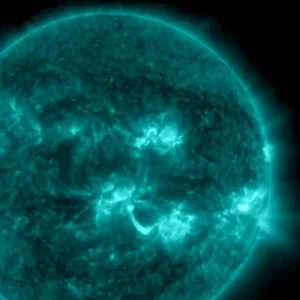
In the past day, solar activity has been moderate, with the Sun unleashing a total of 10 flares, including 2 M-class and 8 C-class events. Currently, there are three numbered active regions on the Earth-facing side of the solar disk. Two of these regions exhibit complex magnetic configurations, making them particularly interesting for solar watchers.
Spotlight on Active Regions
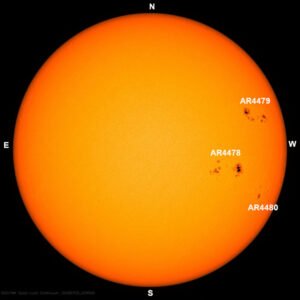
The most prominent of these regions is AR4479, characterized by its beta-gamma-delta magnetic configuration. This active region was responsible for the recent X1.1 flare and has been a prolific source of M-class flares this week. With its high complexity, AR4479 remains the focal point for observers who are curious about potential future flares.
Another Key Player: AR4478
AR4478, also classified as beta-gamma-delta, is the largest active region currently visible on the solar disk. Although it has not produced flares in recent observations, its significant size and magnetic complexity suggest that it could be building up energy for a more explosive event in the near future. Solar physicists will continue to monitor this region closely.
AR4480 Shows Potential
Another active region, AR4480, has been gaining attention as it develops further. This region retains its gamma component and is showing signs of increasing complexity. As it evolves, it holds the potential for producing additional flares, which could contribute to the ongoing solar activity.
Meanwhile, AR4475 has moved out of view, having fully rotated to the far side of the Sun. Its departure allows researchers to focus on the more active regions currently facing Earth.
The Halo CME Event
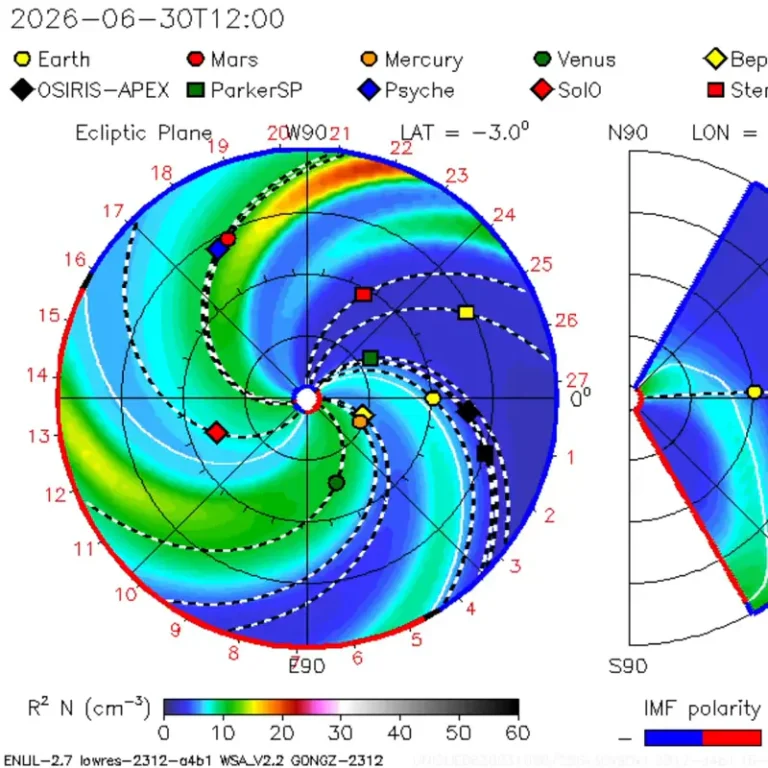
The main event that has captured the attention of scientists and enthusiasts alike is the confirmed halo CME associated with the X1.1 flare. Predictions indicate that this CME will arrive either late on July 3 or early on July 4. With the potential for G1 to G2 geomagnetic storm conditions upon its arrival, the excitement surrounding auroral displays is palpable.
Additional CMEs on the Horizon
In addition to the X1.1 flare, two more CMEs are expected to impact Earth. One of these was produced by a filament eruption on July 1, which has an Earth-directed component. The second CME, originating from a long-duration M4.2 flare from AR4479 on July 2, is also on its way. This second CME may even catch up to the first one, with their estimated arrival around July 5 or July 6.
Current Solar Wind Conditions
Throughout this period, solar wind speeds have generally remained at moderate levels. The total interplanetary magnetic field (IMF) has fluctuated but was primarily weak, with a brief increase noted as the period progressed. These conditions play a significant role in how solar material interacts with Earth's magnetic field.
What’s Next for Earth’s Magnetic Field?
The Bz component of the solar wind has shown a few weak peaks directed southward, but it has predominantly been pointing northward, which has kept Earth's magnetic shield intact. However, as the X1.1 CME approaches, this could change rapidly, and a sustained southward Bz is what typically allows for the most intense auroral displays.
Currently, Earth’s magnetic field is experiencing a calm period, with a Kp index of just 0-1. This could be seen as the calm before the anticipated storm, as forecasters expect that the Kp index will rise significantly with the arrival of the CME.
Future Solar Activity Predictions
Expectations for solar activity remain high, with moderate to high activity levels anticipated in the coming days. The chance of M-class flares has dipped slightly to 65%, while the likelihood of another X-class flare is estimated at 15%. Both AR4479 and AR4478 continue to exhibit their complex magnetic configurations, and AR4480 is rapidly evolving, indicating a sustained threat for solar flares.
As we look forward to the weekend, aurora watchers should stay alert! The predicted geomagnetic storms could produce stunning auroras, creating a cosmic light show that could rival any fireworks display on Independence Day.