
On August 5, 2026, a spent SpaceX Falcon 9 rocket stage will collide with the Moon, marking a significant moment in lunar exploration. This event is not just a routine space mission; it's a unique opportunity for scientists to observe the effects of a human-made object impacting the lunar surface. The impact is expected to create an ejecta plume, which could be visible from Earth with the right equipment. As we look forward to this event, the scientific community is buzzing with anticipation.
What led to this lunar encounter
The Falcon 9 upper stage is a leftover from a launch that occurred on January 15, 2025. This mission delivered Firefly's Blue Ghost-1 lander and the Hakuto-R Mission 2, a Japanese lunar lander developed by ispace, to the Moon. As the rocket stage orbits Earth, it has been on a trajectory that will lead it to collide with the lunar surface. This collision is particularly notable because it provides a controlled scenario for scientists to gather data on the dynamics of impact events.
How astronomers know what to expect
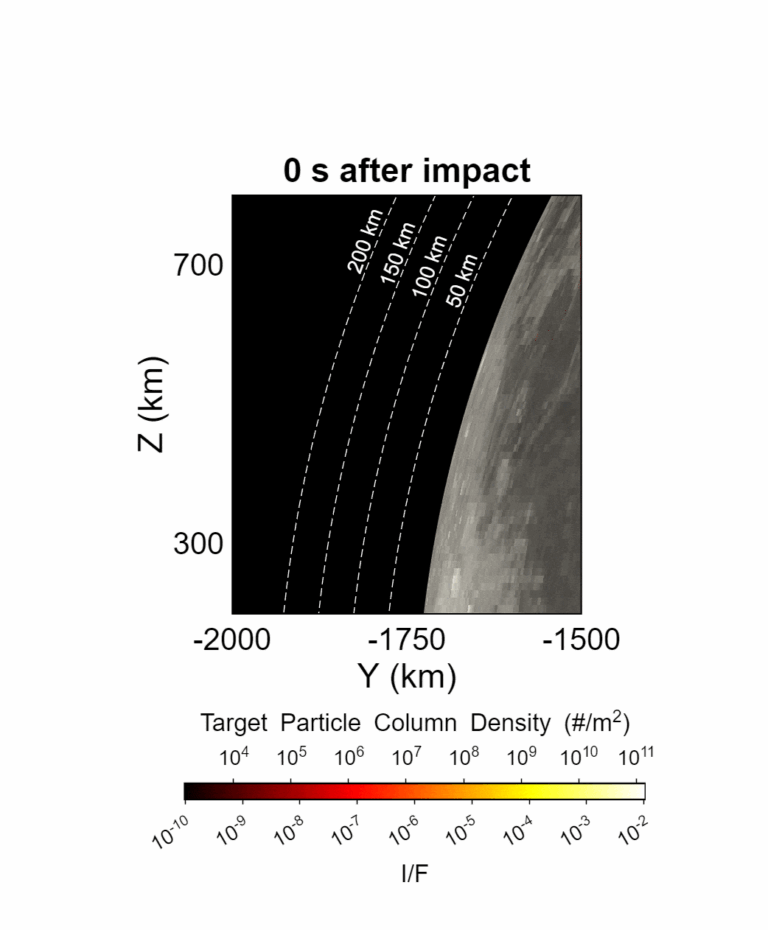
Researchers from the University of Texas at Austin have used physics simulations to model the expected impact. Their calculations indicate that the debris plume could reach altitudes between 47 and 60 miles (75 to 100 kilometers). Graduate research assistant William Jo explained, 'Our calculations suggest the plume should be several orders of magnitude brighter than the dark-sky background for the first few minutes after impact.' This brightness could make the plume observable from telescopes on Earth.
What scientists hope to learn from the impact
The anticipated impact offers a rare opportunity to refine models used in predicting the behavior of ejecta plumes. According to Benjamin Fernando from the Los Alamos National Laboratory, this event could also contribute to understanding the hazards posed by artificial space debris. 'The maximum ballistic range of resolved particles is found to be slightly under 1,000 km,' Fernando noted, emphasizing the potential risk this poses for future astronauts. Additionally, the event will allow for real-time observation of how debris behaves on the Moon.
What’s next for lunar science after the crash
Following the crash, NASA's Lunar Reconnaissance Orbiter (LRO) will play a crucial role in verifying the impact site. Project scientist Brent Garry explained that LRO will pass over the site both before and after the event. This will allow researchers to gather data and improve targeting for future lunar missions. The real excitement lies in the moments after the impact, as scientists look to study the ejecta rather than just the initial flash.