
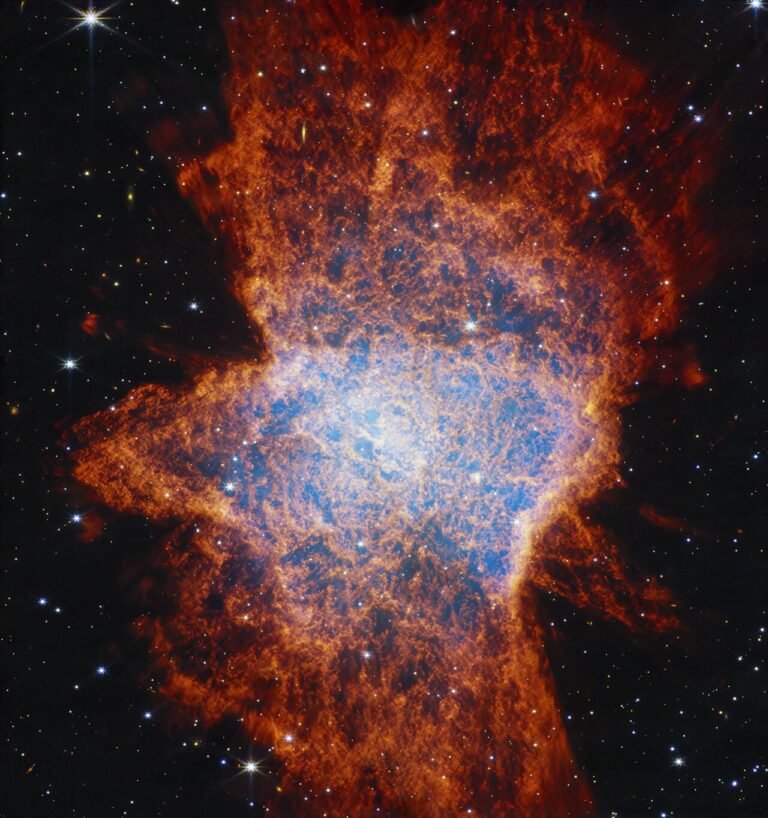
The James Webb Space Telescope (JWST) has turned its powerful gaze towards the planetary nebula NGC 6072, unveiling a chaotic yet fascinating tapestry of cosmic material. This new perspective shows a nebula that might appear as a messy splash of color, but it's more than just a pretty picture. The observations hint at intricate dynamics at play, suggesting that multiple stars are influencing the nebula's unusual shape. As astronomers delve deeper into the images, they begin to grasp the complex interactions occurring in this stellar graveyard.
What led to this observation?
Planetary nebulae, like NGC 6072, are formed during the late stages of stellar evolution, particularly in low to intermediate mass stars. As these stars exhaust their nuclear fuel, they expel the outer layers, creating beautiful shells of gas and dust. Traditionally, these shells have been observed as more symmetrical shapes, such as circular or elliptical forms. However, NGC 6072 defies these norms, presenting an irregular, multi-polar structure that intrigued astronomers and prompted further investigation by the JWST.
How did Webb capture these details?
Using its Near-Infrared Camera (NIRCam) and Mid-Infrared Instrument (MIRI), Webb captured stunning images that detail the nebula's intricate structures. The NIRCam images reveal multiple outflows of gas that appear to be jetting from the center, indicating the presence of at least two stars interacting at this late stage of stellar life. The dark orange materials visible in the images are composed of cooler gas and dust, while the bright regions are traced by hotter, ionized gas. This duality provides scientists with a clearer understanding of how these materials are distributed and the processes at work.
What insights do these images provide?
The findings suggest that a companion star is playing a significant role in shaping NGC 6072. As the central star sheds its mass, the gravitational influence of the companion star may be contributing to the nebula's unique morphology. Researchers have observed concentric rings in the mid-infrared images, which could be remnants of material expelled earlier, possibly sculpted into their current form by the dynamics of the two stars' interactions. This complex interplay raises further questions about the evolutionary pathways of such nebulae and their subsequent roles in star formation.
What's next for astronomers studying NGC 6072?
As Webb continues to provide unprecedented views of celestial phenomena, astronomers are eager to learn more about planetary nebulae like NGC 6072. The detailed observations will aid scientists in understanding how these intricate structures contribute to the lifecycle of stars and the enrichment of the interstellar medium. As we explore these cosmic entities, we gain insight into the processes that forge new stars from the remnants of their predecessors. The questions raised by these findings will undoubtedly guide future research efforts in stellar evolution and nebular dynamics. Bottom line: Webb's observations of NGC 6072 illuminate the complexity of stellar life cycles and the interactions that shape them.