
The Sun may look peaceful from Earth, but our star is constantly changing.
Recently, a fast stream of solar wind flowing from a large opening in the Sun’s atmosphere reached Earth and disturbed our planet’s magnetic field. At the same time, astronomers are watching a recent eruption of solar material to see whether it could produce a coronal mass ejection (CME) heading our way.
For skywatchers, that raises an interesting question:
Could more auroras be on the way?
A fast stream of solar wind reaches Earth
The recent disturbance was caused by a coronal hole, a darker region in the Sun’s outer atmosphere where magnetic field lines extend outward into space.
These regions allow solar wind to escape at much higher speeds than normal.
When that fast solar wind reaches Earth, it can interact with our planet’s magnetic field and cause geomagnetic activity.
The latest event pushed Earth’s magnetic activity to active levels, with the Kp index reaching around 4. However, it did not develop into a significant geomagnetic storm.
What about the northern lights?
Auroras are created when charged particles from the Sun interact with gases high in Earth’s atmosphere.
When solar activity increases and Earth’s magnetic field becomes disturbed, auroras can become brighter and appear farther from the polar regions.
During this recent event, conditions were favorable for some auroral activity at higher latitudes, including parts of northern Canada, Iceland and northern Scandinavia.
However, the disturbance was not strong enough to produce widespread auroras at much lower latitudes.
For aurora watchers, the Sun will continue to be worth watching.
A solar filament erupts
Another event has caught the attention of space-weather scientists.
On August 30, a large solar filament erupted from the northeastern part of the Sun.
A solar filament is a long structure of relatively cool, dense plasma suspended above the Sun’s surface by powerful magnetic fields.
When those magnetic fields become unstable, the filament can erupt dramatically.
Scientists are now examining observations from solar spacecraft to determine whether the eruption produced a CME and, more importantly, whether any of that material is heading toward Earth.
So far, no significant Earth-directed CME has been confirmed from this eruption.
The sun in recent days
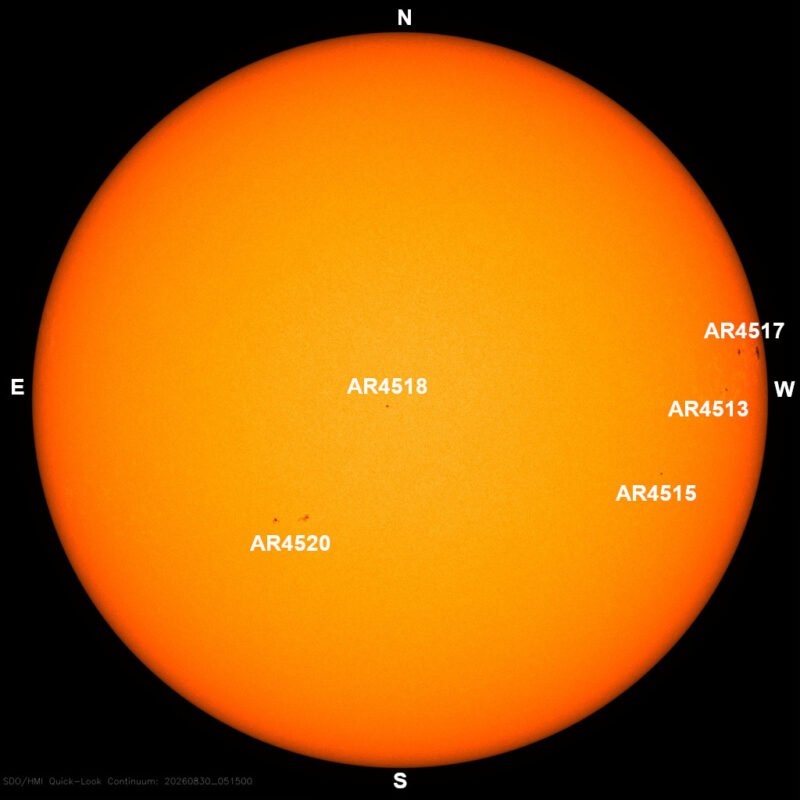
The Sun is relatively quiet for now
Despite all this activity, the Sun itself has been relatively calm.
Only a few small C-class solar flares have been observed recently. The strongest was a C2.2 flare from active region AR4513 on August 30.
Several sunspot regions are currently visible on the Earth-facing side of the Sun.
One region, AR4518, has attracted attention because it has been growing. Other active regions are approaching the western edge of the Sun and will soon rotate out of view.
For now, there is no indication of an imminent major solar storm.
What happens next?
Space-weather forecasters expect solar activity to remain relatively low over the next few days.
C-class flares are still possible, while stronger M-class flares have a much lower probability. An X-class flare — the most powerful category — is currently considered unlikely.
Geomagnetic activity is also expected to gradually decrease as the fast solar-wind stream moves away and conditions around Earth settle down.
But the Sun can change quickly.
A single eruption can transform a quiet day into a spectacular night of auroras.
Why solar activity matters
Solar storms are more than just a beautiful light show.
Strong solar flares and CMEs can affect satellites, GPS navigation, radio communications and other technologies that rely on space-based systems.
The most powerful geomagnetic storms can even produce currents in electrical grids on Earth.
That is why spacecraft constantly monitor the Sun.
Observatories such as NASA’s Solar Dynamics Observatory provide scientists with continuous views of the Sun, allowing them to track sunspots, flares, filaments and other changes on its surface.
The Sun never really sleeps
Right now, the latest geomagnetic disturbance is fading and the Sun appears relatively quiet.
But quiet does not mean inactive.
Deep beneath the Sun’s surface, enormous magnetic fields are constantly twisting, moving and reconnecting.
Somewhere on the Sun, another eruption could already be forming.
And when it happens, Earth’s skies could once again light up.
The Sun is 150 million kilometers away — but its activity can still reach us.
Quick Facts
Cause of recent activity: Fast solar wind from a coronal hole
Effect on Earth: Increased geomagnetic activity
Aurora possibility: Mainly at higher latitudes
Recent flare: C2.2-class flare
Recent event: Large solar filament eruption
Earth-directed CME: No significant one confirmed so far
What happens next: Mostly quiet to unsettled conditions are expected