
Saturn is famous for its spectacular rings and for a strange six-sided storm system at its north pole. Now, NASA’s Hubble Space Telescope has found something unexpected on the opposite side of the planet — a giant, evolving 10-sided atmospheric pattern surrounding Saturn’s south pole.
The newly discovered feature, known as a decagon, appears to be a powerful atmospheric wave embedded within one of Saturn’s jet streams. Scientists say it is the first large, regular-sided jet pattern ever observed in Saturn’s southern hemisphere.
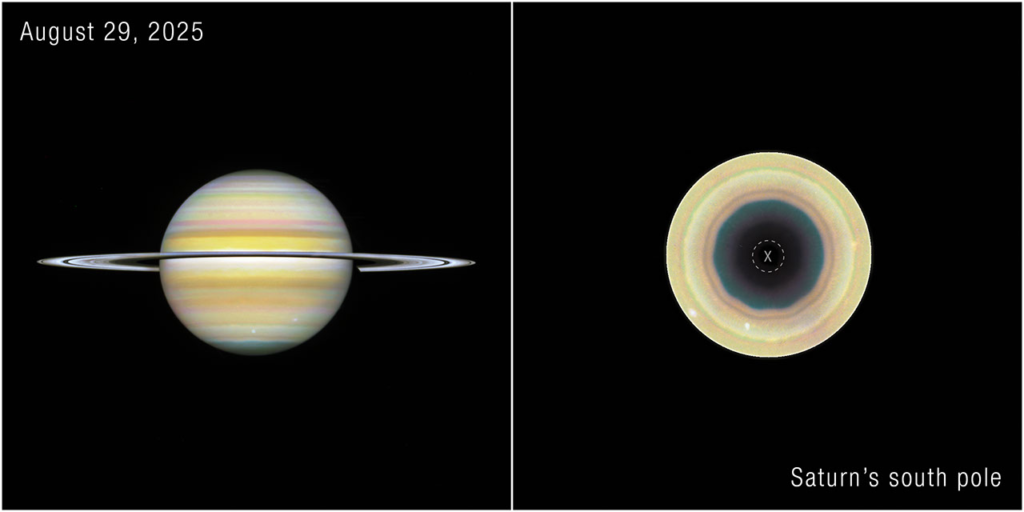
A New Shape on Saturn
For decades, astronomers have searched Saturn’s southern hemisphere for a counterpart to the famous hexagon at its north pole.
NASA’s Cassini spacecraft observed Saturn between 2004 and 2017, but its images showed no sign of a long-lasting geometric pattern at the south pole.
Hubble has now changed that picture.
By combining observations collected over several years, researchers found evidence that the unusual structure was already beginning to develop in 2023. A subtle undulating band became more noticeable in 2024, while observations from 2025 provided stronger evidence of the emerging 10-sided pattern.
What Exactly Is the Decagon?
The feature isn’t a solid object or a giant structure sitting on Saturn’s surface.
Instead, it is an atmospheric wave formed within one of the planet’s powerful jet streams. The decagon is centered around approximately 63 degrees south latitude and extends through multiple layers of Saturn’s atmosphere.
This vertical extent is particularly interesting to scientists because it suggests the phenomenon isn’t simply a pattern visible in Saturn’s uppermost clouds.
Hubble observed Saturn using different wavelengths of light, allowing researchers to examine different atmospheric altitudes. The apparent position of the decagon shifts slightly depending on the wavelength, revealing information about the structure at different levels of the atmosphere.
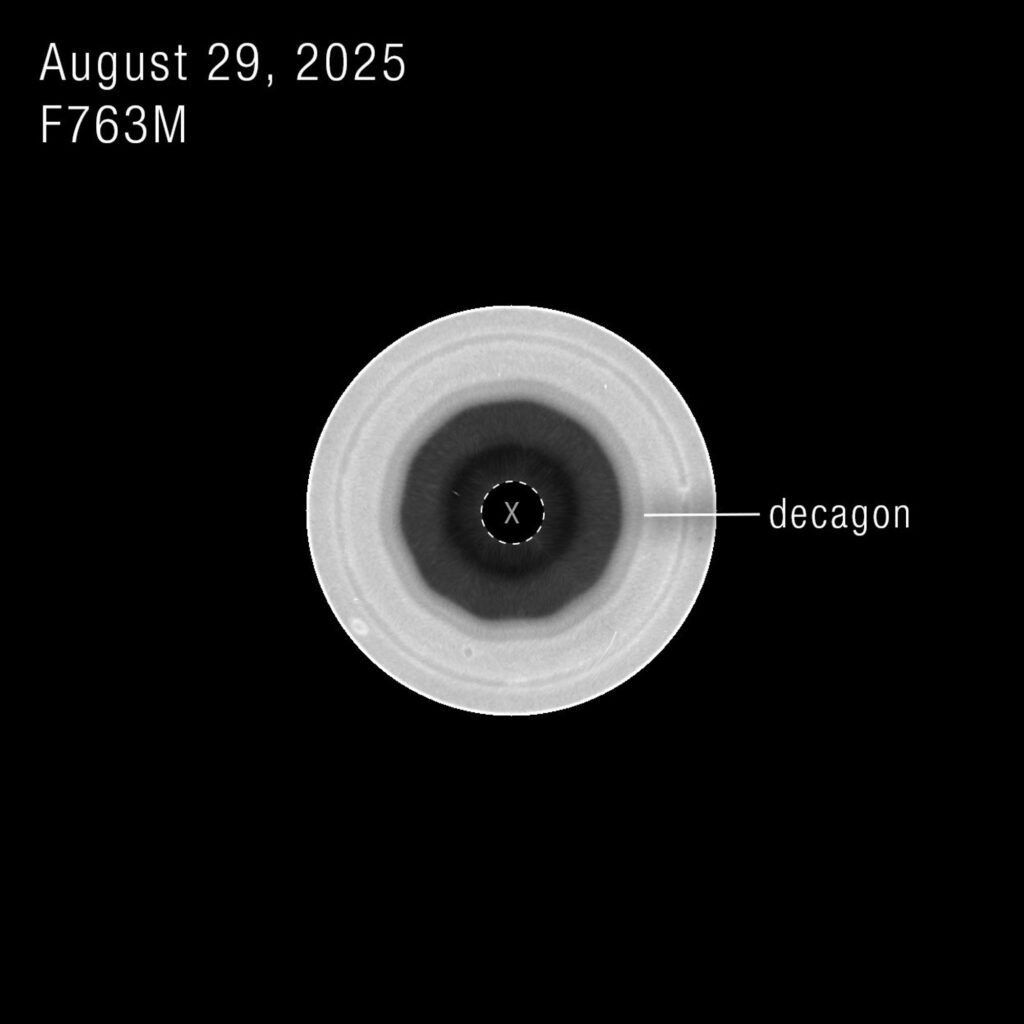
Image: NASA, ESA, STScI, Agustin Sánchez-Lavega (UPV), Amy Simon (NASA-GSFC), Michael Wong (UC Berkeley); Image Processing: Alyssa Pagan
Similar to Saturn’s Famous Hexagon — But Different
Saturn’s northern pole is home to one of the Solar System’s most recognizable atmospheric features: a gigantic six-sided jet-stream pattern known as the Saturn hexagon.
The newly discovered southern decagon naturally raises the question: could it be a southern counterpart?
The answer isn’t so simple.
While both features are large, geometric patterns associated with Saturn’s jet streams, the southern decagon appears to be evolving, unlike the remarkably persistent northern hexagon.
Scientists are therefore interested in watching how the new structure changes over time and whether it eventually becomes stable or disappears.
Hubble’s Unique View
Hubble’s location above Earth’s atmosphere gives astronomers an important advantage when studying Saturn.
Earth’s atmosphere can blur observations, making it difficult to track subtle atmospheric structures on a distant planet. Hubble can observe Saturn with much sharper resolution and can capture its atmosphere across different wavelengths.
This was especially important for identifying the faint structure that eventually revealed itself as a decagon.
The discovery also demonstrates the value of long-term observations. Rather than seeing the feature appear suddenly, scientists were able to piece together observations from different years and reconstruct its development.
A Changing Saturn
Saturn’s atmosphere is far more dynamic than its calm appearance might suggest.
Deep beneath the planet’s pale cloud bands are powerful winds, jet streams, waves and enormous atmospheric systems. The discovery of the southern decagon gives scientists another opportunity to understand how these atmospheric forces interact.
The fact that such a striking geometric pattern appears to be developing now also raises new questions about why Saturn’s atmosphere behaves differently at different times and latitudes.
For researchers, the most exciting part may be what happens next.
Continued Hubble observations could reveal whether the decagon becomes more clearly defined, changes its shape, moves through the atmosphere, or eventually disappears.
Saturn Has More Secrets to Reveal
Saturn’s northern hexagon has fascinated scientists for decades, and now its southern hemisphere has produced another atmospheric mystery.
The discovery of a giant 10-sided wave around Saturn’s south pole shows that even a planet studied for generations can still surprise us.
Hubble’s observations are giving astronomers a rare look at an atmospheric phenomenon that may be unfolding in real time — and the next few years could reveal whether Saturn’s mysterious southern decagon becomes a permanent feature or simply another temporary chapter in the planet’s constantly changing atmosphere.
Source: NASA / Hubble Space Telescope
Published: September 2, 2026