
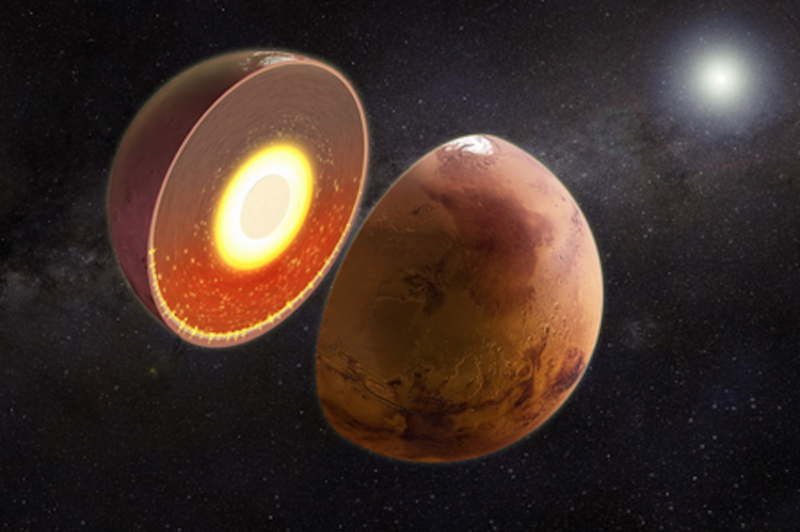
Mars may look like a cold, frozen desert from the outside, but scientists have discovered that its interior is far more unusual than previously thought.
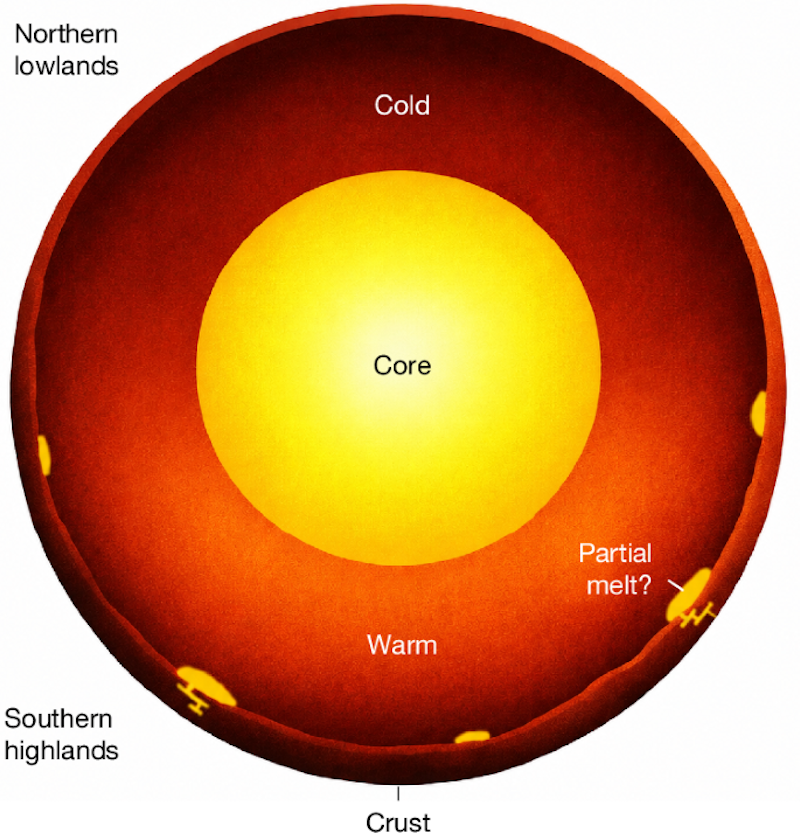
A new study led by researchers at Caltech has found evidence that the deep interior beneath Mars’ southern hemisphere is significantly hotter than expected. The estimated temperature difference reaches roughly 200–400°C (290–750°F), revealing a striking imbalance deep inside the Red Planet.
The discovery could help scientists understand one of Mars’ oldest mysteries: why its northern and southern hemispheres look so dramatically different.
Mars Is a “Two-Faced” Planet
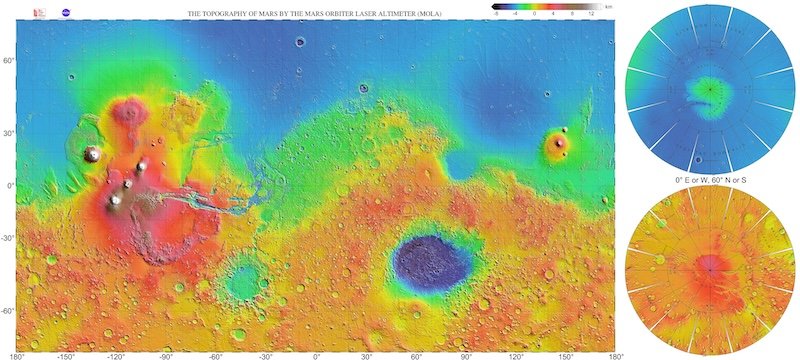
Mars has a remarkable geological divide known as the Martian dichotomy.
The northern hemisphere is dominated by relatively smooth, low-lying plains, while the southern hemisphere is characterized by ancient highlands, mountains and heavily cratered terrain. The southern highlands can stand several kilometers higher than the northern lowlands.
For decades, scientists have debated what caused this enormous difference.
Some theories suggest that a massive impact early in Mars’ history may have reshaped the planet. Other explanations point to processes occurring deep inside Mars.
The new research adds an important clue: the north-south difference may extend deep into Mars’ interior, not just across its surface.
How Did Scientists Detect Heat Deep Inside Mars?
Researchers cannot directly drill thousands of kilometers into Mars, so they instead study how the planet’s gravity affects spacecraft.
The team, led by Caltech researcher Alexander Berne, analyzed decades of measurements from three Mars missions: Mars Global Surveyor, Mars Odyssey and Mars Reconnaissance Orbiter.
They examined extremely small changes in the spacecrafts’ velocities as they orbited Mars. These changes contain information about variations in the planet’s gravitational field.
Using a technique known as tidal tomography, scientists were able to build a model of the structure inside Mars.
The results revealed an unexpected thermal asymmetry.
A Hotter Southern Interior
According to the study, the southern hemisphere’s interior could be approximately 200–400°C hotter than the corresponding region beneath the northern hemisphere.
At sufficiently high temperatures, portions of the rocky mantle can become partially molten or behave in a more fluid-like manner.
This suggests that Mars may not have a completely uniform interior. Instead, heat could be distributed very differently from one hemisphere to the other.
The finding is particularly interesting because the warmer region appears to correspond with the same hemisphere that contains Mars’ ancient southern highlands.
What Is Causing the Heat?
Scientists do not yet have a definitive answer.
The researchers proposed several possible explanations.
One possibility is that an enormous impact early in Mars’ history dramatically altered the planet’s interior and redistributed thermal energy.
Another possibility involves mantle convection. Hot material deep inside the planet can rise while cooler material sinks, creating large-scale movements that transport heat through the interior.
A third explanation is that unusually thick geological structures in the southern hemisphere could act as a thermal barrier, allowing more heat to remain trapped deep underground.
Further observations will be needed to determine which processes are responsible.
What Does This Mean for Ancient Mars?
The discovery could also provide clues about Mars’ ancient environment.
Billions of years ago, Mars was very different from the cold desert we see today. Evidence from ancient valleys, minerals and geological formations indicates that liquid water once existed on the surface.
The north-south division of Mars may have influenced how water moved and where large ancient basins formed.
Understanding the thermal structure beneath the surface could therefore help scientists reconstruct how Mars evolved from a potentially wetter world into the cold, dry planet it is today.
A New Look at the Red Planet
Mars continues to surprise scientists.
Its surface already reveals an extraordinary contrast between the northern plains and southern highlands. Now, new measurements suggest that this division may extend hundreds of kilometers beneath the surface.
Rather than being simply a feature of Mars’ landscape, the planet’s famous north-south asymmetry could be connected to processes deep within its interior.
Future Mars missions and improved gravity measurements may help scientists determine exactly why one half of the planet appears to be hotter than the other — and what that reveals about Mars’ earliest history.
Mars may look quiet and frozen today, but deep beneath its surface, the Red Planet could still be carrying the thermal fingerprints of its violent ancient past.