
Turbulence Is Disrupting Star Formation in Stephan’s Quintet
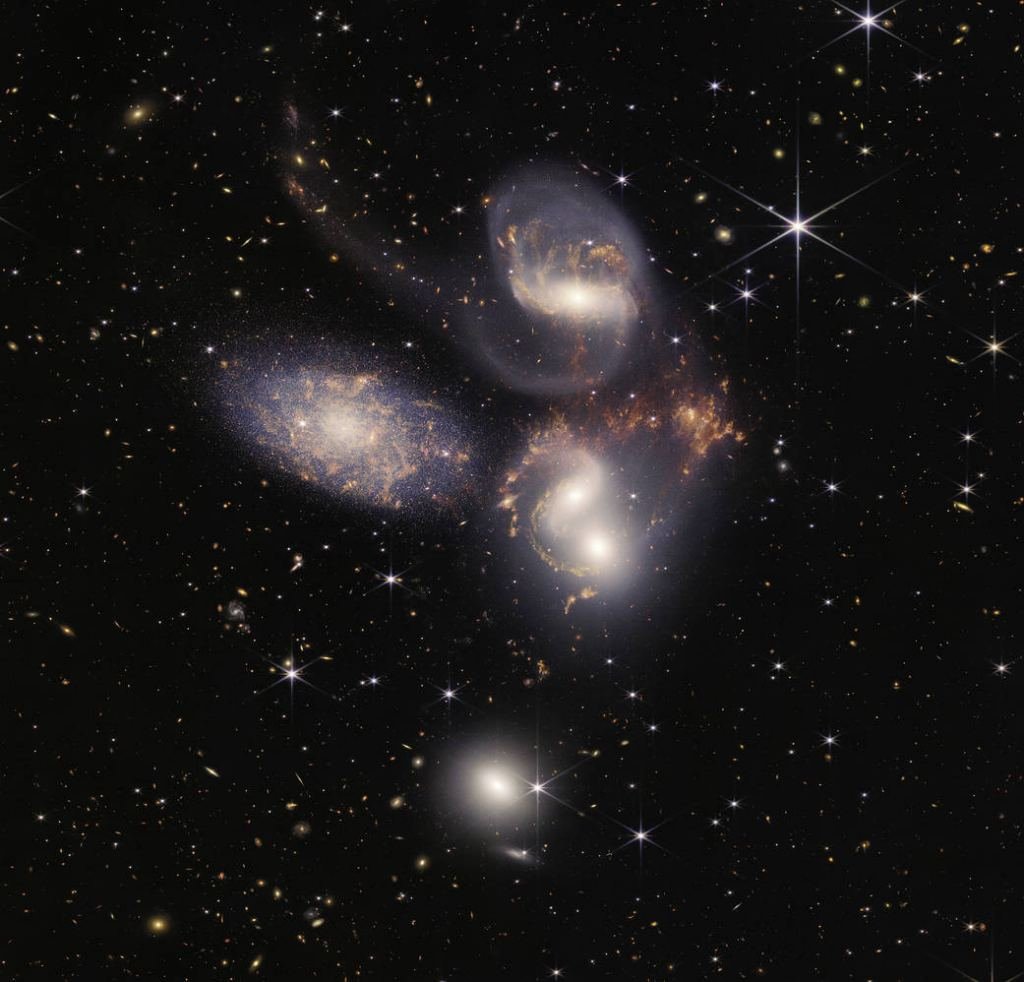
Astronomers have discovered that intense turbulence may be preventing stars from forming efficiently in one of the most spectacular interacting galaxy groups in the nearby universe: Stephan’s Quintet.
Using the Atacama Compact Array (ACA), a component of the Atacama Large Millimeter/submillimeter Array (ALMA), researchers created a detailed map of molecular gas across Stephan’s Quintet. The observations reveal how violent interactions between galaxies can dramatically alter the conditions needed for new stars to form.
A Cosmic Group of Interacting Galaxies
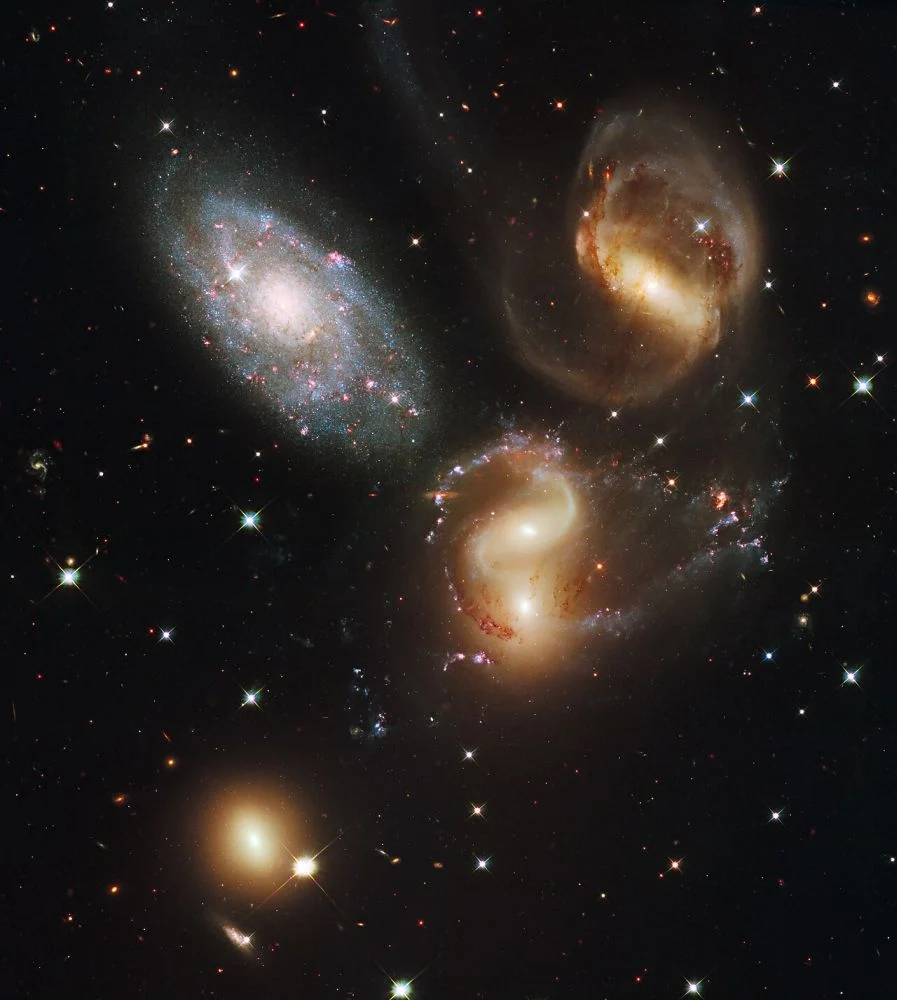
Stephan’s Quintet appears to contain five galaxies packed closely together. However, only four of them actually belong to the same compact galaxy group.
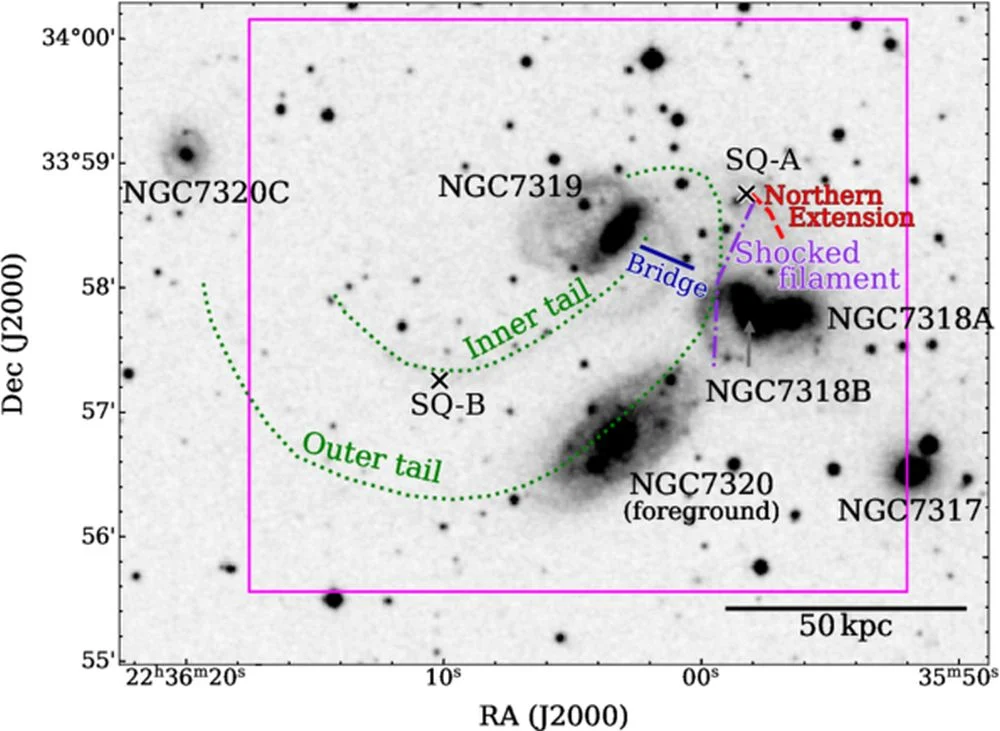
The fifth galaxy, NGC 7320, is much closer to Earth and only happens to appear in the same region of the sky.
The four interacting galaxies have been gravitationally disturbing one another for millions of years. Their encounters have stretched spiral arms, created enormous tidal tails and produced powerful shock fronts between the galaxies.
Stephan’s Quintet was also one of the first official images released by the James Webb Space Telescope.
Mapping the Gas That Makes Stars
Stars form inside enormous clouds of cold molecular gas. One of the most important molecules in these clouds is molecular hydrogen, but it is extremely difficult to observe directly.
Instead, astronomers often use carbon monoxide (CO) as a tracer of molecular hydrogen.
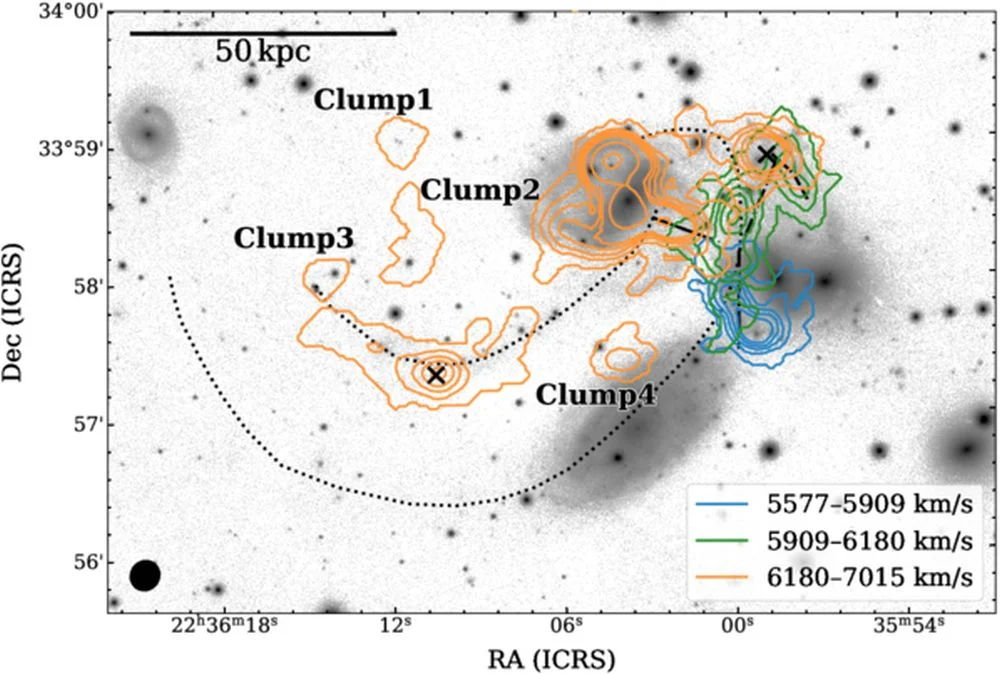
The Japanese research team used observations of CO to map the molecular gas throughout Stephan’s Quintet. Their observations covered an area roughly 137,000 by 119,000 light-years across and provided a detailed view of how the gas is distributed and moving.
The results show that much of the molecular gas is concentrated in the disk of NGC 7319 and in regions between the galaxies.
Large amounts of gas have also been stripped from the galaxies and pushed into enormous structures such as tidal tails.
Turbulence Makes It Harder to Form Stars
The most interesting result came from studying the motion of the gas.
Astronomers can estimate turbulence by measuring the velocity dispersion of gas. A wider range of gas velocities indicates stronger turbulence.
The researchers discovered that regions with relatively calm gas can form stars at efficiencies similar to those seen in normal nearby galaxies.
But around a major shocked filament in Stephan’s Quintet, the gas is moving much more violently.
There, velocity dispersions can reach roughly 50–150 kilometers per second.
And this highly turbulent gas appears to be much less efficient at forming stars.
The researchers found a negative relationship between turbulence and star-formation efficiency: as the velocity dispersion increased, the efficiency of star formation decreased.
Galactic Collisions Can Both Help and Stop Star Formation
Galaxy interactions are often associated with bursts of star formation because gravitational forces can compress clouds of gas.
But Stephan’s Quintet shows that the opposite can also happen.
Powerful interactions can stir molecular gas so violently that it becomes difficult for the gas to collapse into the dense structures required to create new stars.
In other words, a galaxy collision does not automatically mean more stars.
Depending on how the gas is affected, an interaction can either compress it and encourage star formation or disperse and heat it, suppressing the process.
A New Look at Galaxy Evolution
The study provides astronomers with a clearer picture of how turbulence influences star formation in interacting galaxies.
Stephan’s Quintet is particularly valuable because it gives researchers a natural laboratory for studying gas under extreme conditions.
Understanding these processes could also help astronomers interpret galaxies in the early universe, where interactions and mergers were much more common.
The researchers conclude that turbulence plays an important role in regulating where stars can form in interacting galaxy systems.
Stephan’s Quintet therefore offers a remarkable example of how the violent gravitational dance between galaxies can reshape not only their appearance, but also their ability to create the next generation of stars.
Source
Based on research published in The Astrophysical Journal: “Molecular Gas Structure and Star Formation Diversity in Stephan’s Quintet Revealed by ACA CO(1–0) Mapping,” led by Misaki Yamamoto of Osaka Metropolitan University.