
Astronomers searching for evidence of extraterrestrial civilizations may need to look beyond radio signals and giant megastructures. A new study suggests that extremely advanced alien civilizations could leave behind a distinctive signature produced by something much more familiar to us: computers.
The idea is based on a simple question: if an advanced civilization relies heavily on computation, how efficiently could it run its machines?
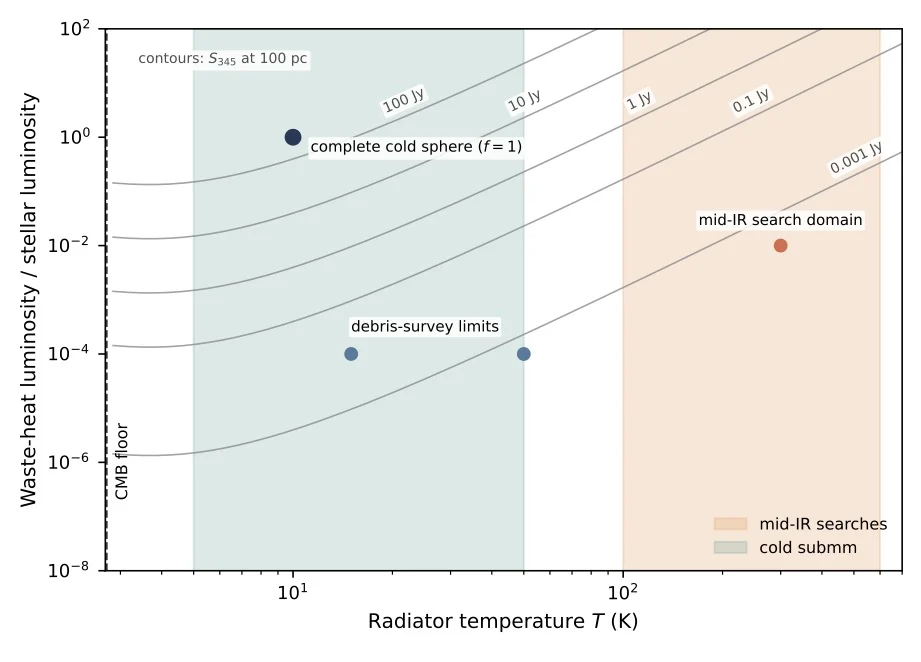
According to a recent study published as an arXiv preprint, a civilization capable of building extremely efficient computers could operate them at temperatures only a few degrees above absolute zero. The waste heat produced by these systems could create a detectable signature around their star—a hypothetical structure known as a Slysh halo.
Why Would Alien Computers Be So Cold?
Computers are not perfectly efficient. Whenever information is processed and certain operations are performed, some energy is inevitably converted into heat.
This is a fundamental consequence of thermodynamics.
The theoretical limit is related to Landauer’s principle, which describes the minimum amount of energy required for certain irreversible computational operations. One important consequence is that lowering the operating temperature can make computation more energy-efficient.
For example, an ideal computer operating at around 10 Kelvin (-263°C) could theoretically be about 30 times more energy-efficient than an equivalent optimal computer operating around room temperature, approximately 300 Kelvin.
For an advanced civilization that has had thousands or millions of years to develop its technology, maximizing computational efficiency could become extremely important.
The Slysh Halo
The proposed solution is a hypothetical structure called a Slysh halo, named after astronomer V. I. Slysh.
Instead of placing enormous computers close to a star, where the environment is relatively warm, an advanced civilization could distribute computing systems throughout a much larger region.
The computers would need to be close enough to the star to collect energy, while remaining far enough away to operate at extremely low temperatures.
The result would be a vast population of computational machines surrounding the star.
But even highly efficient computers cannot eliminate waste heat completely.
That heat would have to escape into space.
A Different Kind of Technosignature
This is where the idea becomes particularly interesting for the search for extraterrestrial intelligence.
A Slysh halo would potentially radiate its waste heat at temperatures of roughly 5 to 30 Kelvin. That means much of its emission would fall into the far-infrared and submillimeter portions of the electromagnetic spectrum.
Instead of looking for an obvious artificial structure blocking a star’s light, astronomers could potentially search for unusual, narrow-band thermal emissions surrounding nearby stars.
Such a signal could provide a new type of technosignature—evidence of technology rather than biological activity.
How Would We Know It Was Artificial?
There is an important problem.
Space is already filled with cold material that can produce far-infrared and submillimeter radiation.
Dust and debris surrounding stars can generate similar signals. Our own Solar System, for example, contains the distant Oort Cloud, which consists of icy bodies and other material far beyond the planets.
This means astronomers would have to carefully distinguish a potential Slysh halo from naturally occurring dust and debris.
However, the proposed artificial signal could have an important distinguishing characteristic: its emission could be concentrated within a relatively narrow range of wavelengths, rather than resembling the broader emission expected from ordinary debris.
Could We Detect One?
Possibly—but it would be challenging.
The predicted brightness of an ideal Slysh halo would put it close to the detection limits of existing facilities such as the Atacama Large Millimeter/submillimeter Array (ALMA).
According to the study discussed by Universe Today, an optimal Slysh halo could potentially be detectable from distances of around 100 light-years.
That raises an intriguing possibility: astronomers could search existing observations of nearby stars for unexplained, unusually narrow thermal signatures.
Future far-infrared and submillimeter observatories could make this search even more sensitive.
A New Way to Search for Alien Intelligence
The search for extraterrestrial intelligence has traditionally focused on signals such as radio transmissions, optical lasers, or enormous structures like Dyson spheres.
But an advanced civilization may not communicate in ways we expect.
If computation eventually becomes one of the most important activities of a technological civilization, then the waste heat generated by those computers could become one of the civilization’s most recognizable fingerprints.
A Slysh halo would therefore represent a fascinating new category of technosignature: not a message from an alien civilization, but the thermal footprint of its computing infrastructure.
The idea remains hypothetical, and the underlying study is currently a preprint rather than established evidence that such structures exist. No Slysh halo has been confirmed around any star.
But the concept demonstrates why the search for alien civilizations continues to evolve.
Perhaps advanced civilizations aren’t broadcasting powerful signals into space at all.
Perhaps they’re simply computing—very, very efficiently—and quietly radiating the heat into the darkness.
The Search Continues
The universe contains billions of stars in the Milky Way alone, and only a fraction have been examined for every possible type of technosignature.
Searching for cold computing systems could give astronomers another way to investigate the question of whether technological civilizations exist beyond Earth.
If such a signature were ever found and confirmed, it would be extraordinary evidence that technology has evolved somewhere else in the universe.
For now, however, the search continues—and astronomers are still figuring out exactly what an alien civilization might look like from across the stars.