
At first glance, NGC 4698 looks like a peaceful spiral galaxy floating through the darkness of space. But a closer look reveals something unusual: parts of this galaxy appear to be rotating in a completely different direction from the rest.
Captured by the NASA/ESA Hubble Space Telescope, NGC 4698 lies about 55 million light-years from Earth in the constellation Virgo. The galaxy is part of the enormous Virgo Cluster, which contains more than a thousand galaxies bound together by gravity.
A spiral galaxy with a strange structure
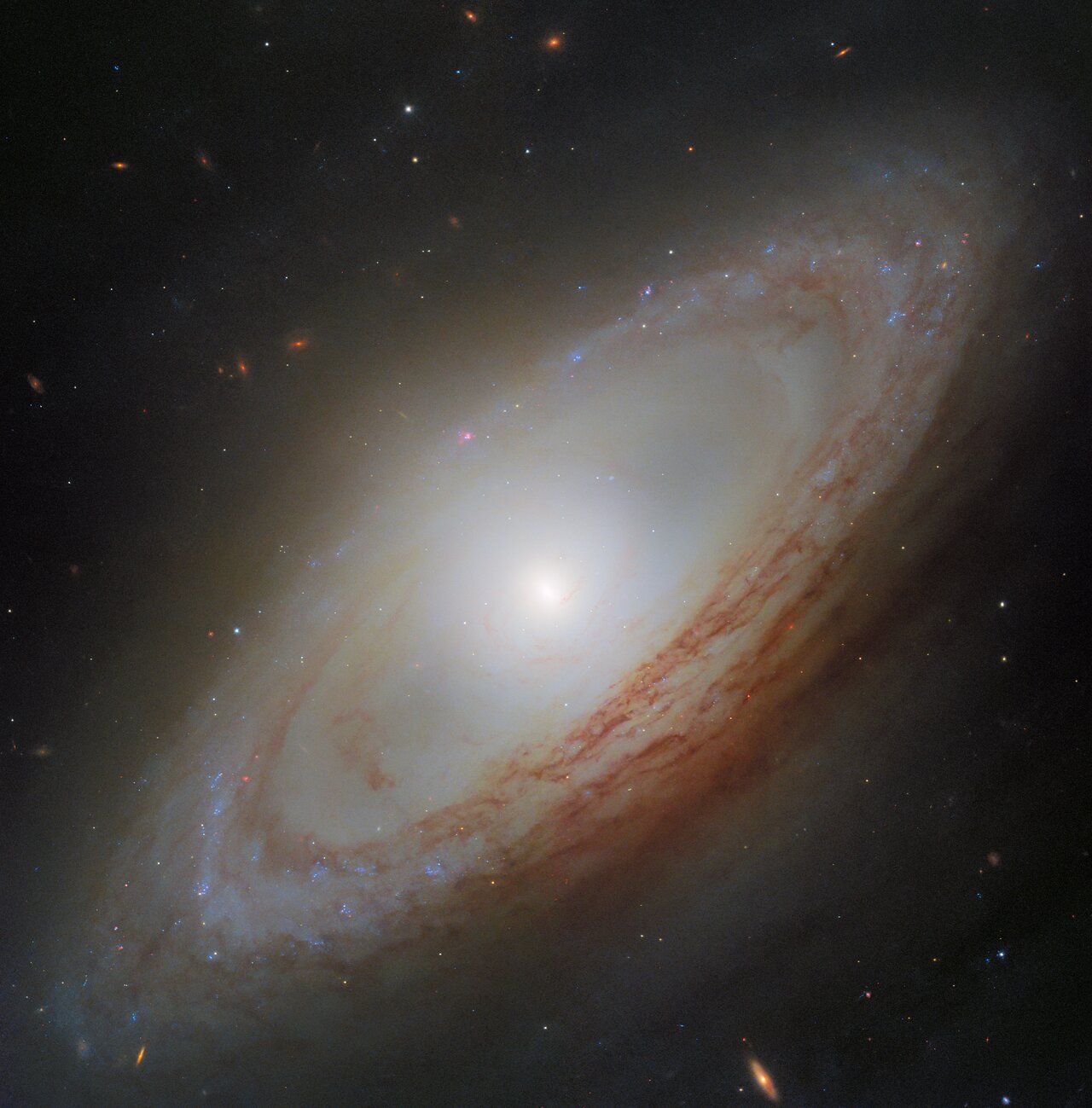
NGC 4698 has many of the features astronomers expect to see in a spiral galaxy. Its relatively thin disc contains stars, gas and dust, while delicate spiral arms extend around its outer regions.
However, the galaxy’s arms don’t behave quite like those of a typical spiral galaxy.
Instead of winding all the way toward the centre, NGC 4698’s spiral arms become most prominent farther out in the disc, forming something resembling a ring around its bright central region. Dark lanes of dust thread through the arms, while bright blue stars and regions of star formation stand out against the galaxy’s glowing background.
At the centre is a large galactic bulge dominated by older, cooler stars. Deep within this densely packed region lies a supermassive black hole containing millions of times the mass of the Sun. Astronomers have found evidence that the black hole is actively growing as it pulls surrounding gas inward.
The galaxy is literally spinning out of sync
The most remarkable feature of NGC 4698 is hidden in its central structure.
Unlike most spiral galaxies, the galaxy’s central bulge extends roughly perpendicular to its main disc. Even more surprisingly, the stars and gas close to the centre rotate in a direction that is perpendicular to the rotation of the galaxy’s outer disc.
In other words, different parts of NGC 4698 are effectively moving in different orientations.
This makes the galaxy one of a relatively small number of known spiral galaxies with such an unusual configuration.
What caused NGC 4698’s unusual rotation?
Astronomers believe the explanation may involve material that came from outside the galaxy.
One possibility is that NGC 4698 captured gas from an external source. If that gas entered the galaxy at a different angle from the existing disc, it could have settled into a new central structure with a different orientation.
There are also indications that NGC 4698 may have experienced a minor galactic merger in the past. A short stream or tail of hydrogen extending from one side of the galaxy provides evidence that another galaxy or cloud of material may have interacted with it.
Such interactions can dramatically reshape galaxies. Over hundreds of millions of years, gravitational encounters can redirect gas, trigger star formation and alter the way stars and gas orbit around a galactic centre.
Hubble looks beyond the beautiful image
The new Hubble observations are part of observing programme #18103, led by D. Thilker and the MAUVE-HST team.
The programme is studying galaxies in the Virgo Cluster in detail, allowing astronomers to examine individual star clusters, nebulae and other structures while also investigating the larger-scale effects of living inside a dense galaxy cluster.
By studying galaxies such as NGC 4698, researchers can learn more about how interactions with neighbouring galaxies and the surrounding cluster environment influence galaxy evolution and star formation.
A cosmic reminder that galaxies are not always orderly
NGC 4698 is a striking reminder that galaxies can be far more complicated than their beautiful spiral shapes suggest.
From a distance, it looks like an ordinary spiral galaxy. But hidden within its glowing centre is a structure that appears to have been shaped by a very different history — possibly involving captured gas and a past galactic encounter.
Hubble’s detailed view allows astronomers to see these subtle differences and reconstruct pieces of the galaxy’s history, 55 million light-years away.
NGC 4698 may look calm in the night sky, but beneath that serene appearance, its stars and gas tell a story of gravitational encounters, cosmic recycling and a galaxy that is, quite literally, spinning out of sync.
Image Credit
ESA/Hubble & NASA, D. Thilker, the MAUVE-HST Team.
Source
ESA/Hubble — A galaxy spinning out of sync, released 18 September 2026.