
The European Space Agency’s Euclid space telescope has discovered its first previously unknown comet, demonstrating its ability to detect unexpected objects while mapping the distant Universe.
The European Space Agency (ESA) has announced an exciting discovery from its Euclid space telescope: a previously unknown comet designated C/2026 S1 (Euclid). The comet was identified in observations taken between 16 and 24 September 2026, marking the first time Euclid has discovered a new comet rather than simply observing one already known to astronomers.
The discovery is particularly remarkable because Euclid was designed primarily to study distant galaxies and investigate two of the Universe’s greatest mysteries: dark matter and dark energy. Yet, while carrying out its deep-sky observations, the telescope captured a moving object that offered scientists an unexpected opportunity to study a new member of our Solar System.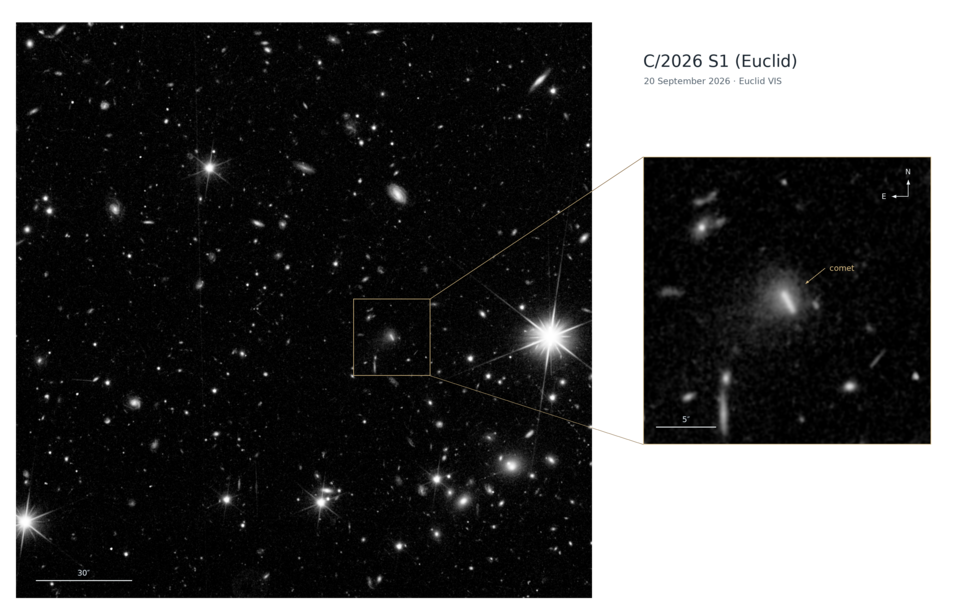
How Euclid Discovered the Comet
The discovery began when Mikko Pöntinen, a PhD student at the University of Helsinki, used specialised software to search Euclid’s images for moving objects.
The software identified a streak across several images, suggesting that an object had moved between exposures. By predicting where the object should appear in subsequent images, Pöntinen was able to locate it in multiple observations.
Further analysis revealed a fuzzy cloud surrounding the object. This feature indicated that it was likely an active comet releasing gas and dust into space.
After checking catalogues of known comets and asteroids and finding no match, the team reported the observations to the International Astronomical Union’s Minor Planet Center. Follow-up observations by astronomers on Earth helped verify the discovery, and the object was officially confirmed as a comet on 8 October 2026.
It was subsequently designated C/2026 S1 (Euclid).

A Comet More Than a Billion Kilometres Away
At the time of the reported observations, the comet was approximately 1.3 billion kilometres from Earth. Its location corresponds roughly to the region between the orbits of Jupiter and Saturn when measured from the Sun.
However, the comet follows an unusual path that takes it well above the main plane in which the planets orbit the Sun. Its orbit is expected to take thousands of years to complete, although astronomers will need additional observations to refine its orbital period.
Comets are ancient remnants from the formation of the Solar System around 4.6 billion years ago. These icy bodies contain dust, frozen gases and other materials preserved from the early stages of planetary formation.
When a comet receives enough solar energy, its ice can turn directly into gas, releasing dust and gas that form a hazy cloud called a coma. Some comets also develop spectacular tails as material is carried away by sunlight and the solar wind.
Studying these objects can provide valuable clues about the ingredients that existed when the planets formed, including possible insights into the origins of Earth’s water and the chemical building blocks of life.
Why This Discovery Is Unusual
Finding a new comet with Euclid is not straightforward. The telescope’s main mission requires it to capture exceptionally sensitive images of distant galaxies, so its observing strategy differs from that of telescopes specifically designed to track objects in our Solar System.
Euclid generally avoids the crowded region of the sky along the Solar System’s planetary plane, where dust and other objects can interfere with its observations. Its step-and-stare observing strategy also means that it usually moves on to another section of the sky rather than repeatedly observing the same location.
Despite these challenges, the comet happened to pass through areas captured in multiple Euclid images over several days. This fortunate alignment gave scientists enough observations to identify its movement and recognise it as a previously unknown object.
Although Euclid has observed comets before, those objects were already known. C/2026 S1 (Euclid) is the first new comet discovered by the mission.
A Useful Test for ESA’s Future Comet Interceptor Mission
The discovery also provides a valuable opportunity for ESA to test how rapidly a new comet can be identified, reported and followed up by ground-based astronomers.
This process is relevant to ESA’s future Comet Interceptor mission, which is intended to study a comet that has not previously visited the inner Solar System, or potentially another suitable pristine object. Such a target could preserve material from the distant regions where comets formed.
Although C/2026 S1 (Euclid) is not considered a suitable target for Comet Interceptor, the discovery demonstrates how observations from a mission designed for another scientific purpose can contribute to the search for interesting Solar System objects.
The ability to detect comets while they are still far from the Sun could prove useful when identifying and assessing potential targets for future missions.

Euclid’s Bigger Mission: Understanding the Dark Universe
While discovering a comet is an exciting bonus, Euclid’s primary objective remains much larger. Over its planned six-year survey, the telescope will observe billions of galaxies across a vast region of the sky, looking back across cosmic history.
By measuring the shapes and distributions of galaxies and studying how their light is affected by gravity, scientists hope to better understand dark matter and dark energy.
Dark matter does not emit or reflect light in the way ordinary matter does, but its gravitational influence affects the formation and movement of galaxies. Dark energy, meanwhile, is the name given to the phenomenon associated with the accelerating expansion of the Universe.
Euclid’s observations are expected to help scientists investigate how these mysterious components have shaped the cosmos over billions of years.
The discovery of C/2026 S1 (Euclid) highlights another benefit of this ambitious mission: even a telescope focused on the most distant galaxies can reveal unexpected objects much closer to home.
An Unexpected Discovery With Scientific Value
Euclid’s first new comet discovery is a reminder that astronomical exploration often produces surprises beyond a mission’s original goals. By detecting a moving object, analysing its appearance and coordinating follow-up observations, scientists have identified a previously unknown comet that can now be studied by the wider astronomical community.
As additional observations become available, researchers will be able to refine the comet’s orbit and learn more about its journey through the Solar System.
For now, C/2026 S1 (Euclid) stands as an unexpected discovery from a mission designed to map the dark Universe — demonstrating that the search for cosmic answers can reveal fascinating objects both near and far.
Source: European Space Agency (ESA) — Euclid discovers new comet.