
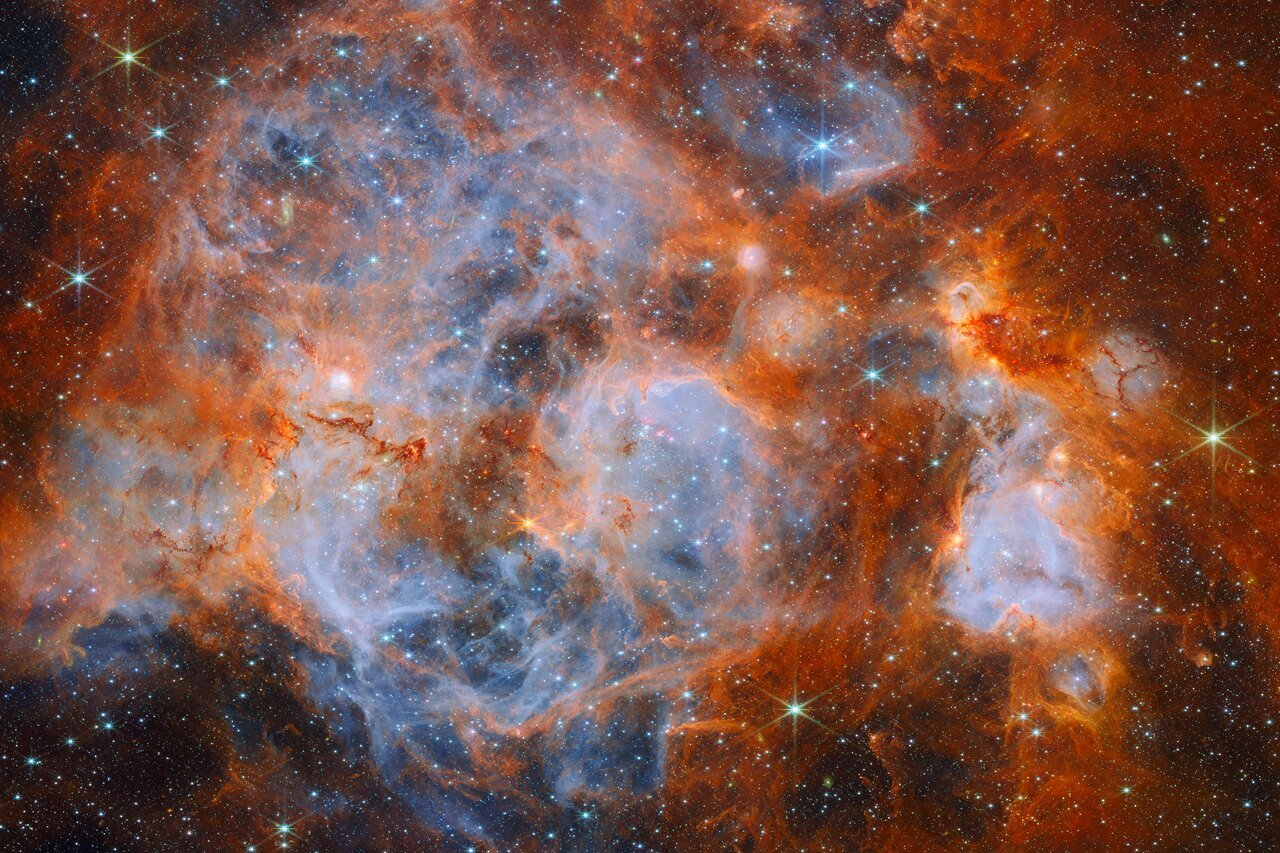
The NASA/ESA/CSA James Webb Space Telescope has captured a stunning new view of N159, a vast star-forming region filled with glowing gas, intricate dust clouds, and young stars emerging from their stellar nurseries. Released on October 22, 2026, this remarkable image reveals the turbulent processes shaping one of the youngest star-forming regions in the Large Magellanic Cloud.
Located approximately 161,000 light-years from Earth, N159 stretches across roughly 230 light-years of space. Its dramatic landscape offers astronomers a closer look at how stars are born and how their intense radiation and powerful stellar winds reshape the clouds from which they form.
A Stellar Nursery Filled With Glowing Gas
N159 is classified as an H II region, an area of space filled with ionised hydrogen gas. These regions form when massive, hot young stars release intense ultraviolet radiation that strips electrons from surrounding hydrogen atoms, causing the gas to glow.
In Webb’s latest image, pale blue clouds of ionised gas contrast with thick orange clouds and dark, winding filaments. These colours reveal different materials and physical processes within the nebula, creating a spectacular portrait of an active stellar nursery.
The orange regions trace emission from carbon-based molecules known as polycyclic aromatic hydrocarbons, while the blue areas highlight glowing ionised gas. Dark red filaments reveal cooler molecular hydrogen, marking some of the densest parts of the cloud.
How Young Stars Shape Their Cosmic Environment
The stars forming inside N159 do more than illuminate their surroundings. Their powerful stellar winds and ultraviolet radiation carve cavities into the surrounding gas, compress dense material into ridges, and reshape the nebula’s complex structures.
Some of the darkest filaments and small pillars of gas provide temporary protection for newly forming stars against the harsh radiation and winds produced by nearby massive stars. As these structures gradually disperse, the young stars hidden within them will become more exposed.
Webb’s Near-Infrared Camera (NIRCam) allows astronomers to examine these intricate structures in remarkable detail, revealing stars embedded deep within clouds that would be difficult to study using visible light alone.
A Remarkably Young Region of Star Formation
N159 is less than three million years old, making it one of the youngest known star-forming regions in the Large Magellanic Cloud. It contains thousands of stars at different stages of development, providing researchers with an opportunity to investigate how stellar populations evolve.
The new observations have revealed extremely faint stars with masses below one-tenth that of our Sun. Researchers can also distinguish older, hotter stars from young stellar objects that remain wrapped in the dense clouds where they formed.
The western part of N159 contains a more concentrated population of young stellar objects, suggesting that this region is at an earlier stage of gravitational collapse and star formation.
One particularly striking feature is the Papillon Nebula, a compact, bright region of ionised hydrogen visible on the left side of the image. First resolved by the NASA/ESA Hubble Space Telescope in 1999, it is thought to be associated with the formation of massive stars.
Why N159 Matters to Astronomers
N159 lies within the Large Magellanic Cloud, a satellite galaxy of the Milky Way. Compared with our own galaxy, the Large Magellanic Cloud contains a lower proportion of elements heavier than hydrogen and helium, a property astronomers describe as lower metallicity.
This difference makes N159 especially valuable for studying star formation under conditions that resemble some environments found in the early Universe. By examining how stars form in these conditions, scientists can improve their understanding of the processes that shaped galaxies when the cosmos was much younger.
The Webb observations also allow researchers to investigate different stages of stellar evolution within a single region, helping them build a more complete picture of how giant clouds of gas collapse and produce new generations of stars.
Webb Opens a New Window Into Stellar Birth
With its powerful infrared vision, the James Webb Space Telescope continues to reveal details hidden inside distant cosmic clouds. The new view of N159 demonstrates how radiation, gravity, gas, and dust interact during the earliest stages of stellar evolution.
What appears to be a beautiful cosmic cauldron is also a dynamic laboratory where thousands of stars are taking shape. By studying regions such as N159, astronomers are getting closer to understanding how stars are born and how the environments around them evolve.
Source: ESA/Webb
Image credit: ESA/Webb, NASA & CSA, E. Sabbi, M. Zamani (ESA/Webb). Acknowledgement: M. H. Özsaraç.