
Astronomers using NASA’s Chandra X-ray Observatory have discovered a previously unknown class of cosmic objects that behave unlike anything they have seen before.
The mysterious objects produce unusually low-energy X-rays while simultaneously emitting intense ultraviolet radiation. Researchers believe these strange sources could help answer two long-standing questions in astrophysics.
A Strange New Type of X-Ray Source
The newly discovered objects have been called “hypersoft X-ray sources” because of the unusually low-energy X-rays they emit.
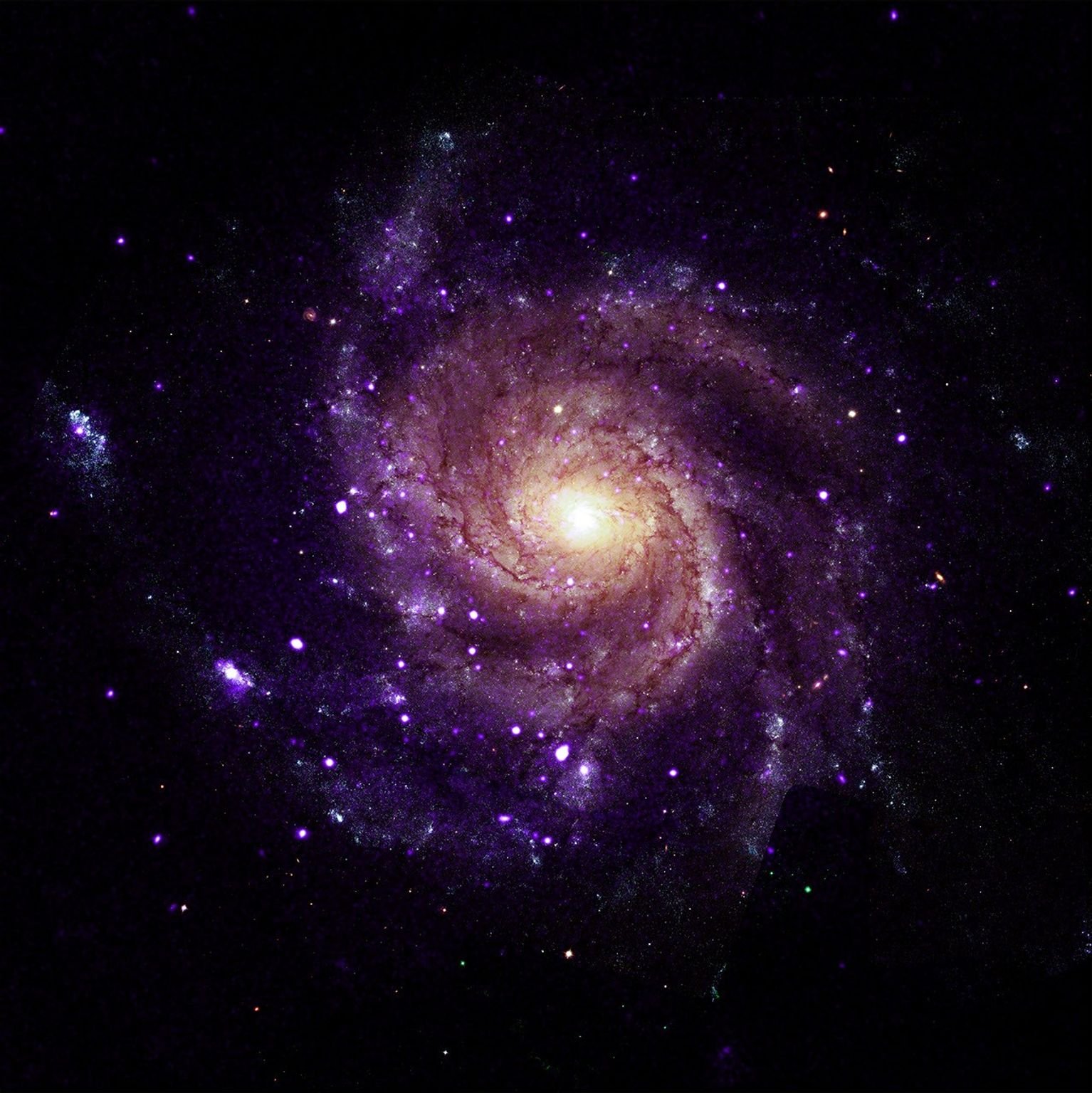
Scientists identified 84 of these objects while examining Chandra observations of six different galaxies. The galaxies include two spirals — the Andromeda Galaxy (M31) and the Pinwheel Galaxy (M101) — along with four elliptical galaxies.
What makes them unusual is how they appear in X-ray observations.
The sources are visible in Chandra images at the lowest X-ray energies, but they disappear when scientists examine higher-energy X-rays. This indicates that they produce far more low-energy X-rays than high-energy X-rays.
Because low-energy X-rays sit close to ultraviolet radiation on the electromagnetic spectrum, the researchers concluded that these objects are also producing enormous amounts of energetic ultraviolet light.
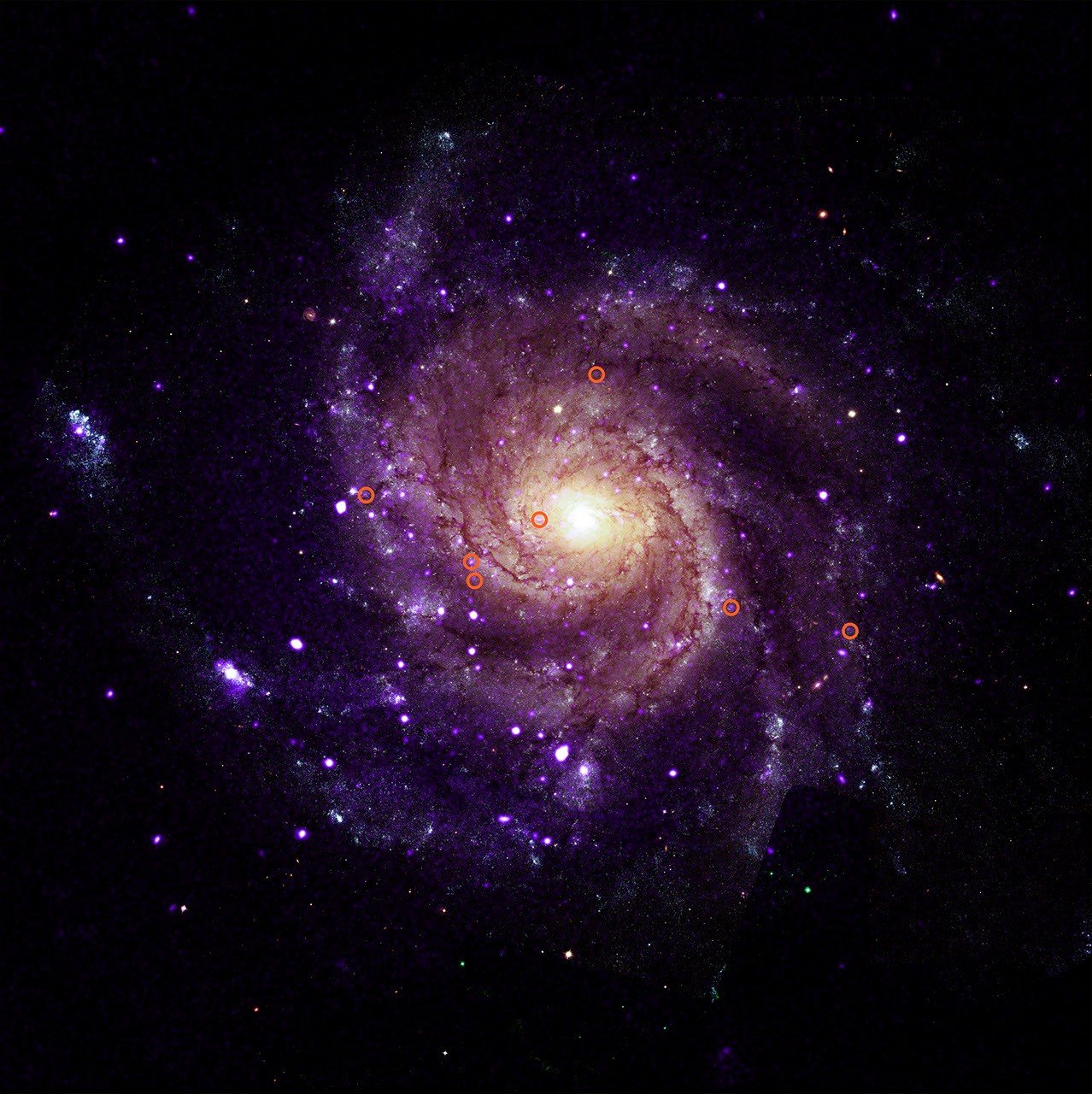
X-ray: NASA/CXC/Univ. of Alabama/M. Muhibullah et al.; Optical: NASA/ESA/STScI; Image Processing: NASA/CXC/SAO/N. Wolk
What Could Be Producing Them?
Scientists do not yet know exactly what these mysterious objects are.
One possibility is that they involve a black hole, neutron star, or white dwarf pulling material from a companion star.
As material is pulled away from the companion, it can become extremely hot and produce X-rays before eventually falling onto a white dwarf or neutron star — or into a black hole.
Binary systems like these are already known to astronomers. However, the newly discovered sources appear to produce an unusual combination of extremely soft X-rays and powerful ultraviolet radiation.
A Possible Connection to Type Ia Supernovae
The discovery could also provide clues about one of astronomy’s major mysteries: the origin of Type Ia supernovae.
Some white dwarfs that pull material from companion stars are thought to eventually explode as Type Ia supernovae. These explosions are particularly important because astronomers use them to measure distances across the universe and study its expansion.
Scientists have spent decades searching for the systems that eventually become Type Ia supernovae, but identifying their exact origins has remained difficult.
The newly discovered hypersoft X-ray sources could potentially represent some of these systems before they explode.
If astronomers can identify a future Type Ia supernova progenitor before the explosion occurs, it could provide valuable information about how these powerful stellar explosions begin.
They May Also Affect Galaxies
There is another mystery these objects could help explain.
The space between stars in galaxies contains gas whose atoms can have their electrons stripped away. This process, known as ionization, can influence how stars form and how galaxies evolve.
Massive, hot stars are known to contribute to this process, but they do not completely explain the amount of ionization observed in some galaxies.
The intense ultraviolet radiation produced by hypersoft X-ray sources could be an important additional source.
Why Were They So Difficult to Find?
The objects may have remained hidden because both their X-ray and ultraviolet radiation are difficult to observe.
Their low-energy X-rays are challenging for X-ray telescopes to detect, while their energetic ultraviolet radiation can be absorbed by hydrogen and helium gas between the stars.
This creates an almost invisible barrier between these objects and our telescopes.
By searching through observations already stored in the Chandra archive, researchers were able to look specifically for sources that appeared at low X-ray energies but disappeared at higher energies.
That approach revealed what appears to be an entirely new population of cosmic objects.
A New Cosmic Mystery
The discovery of 84 hypersoft X-ray sources opens a new area of research.
Astronomers now need to determine exactly what powers these objects, how common they are, and whether some of them could eventually become Type Ia supernovae.
The objects may also help scientists better understand how galaxies become ionized and how that process affects star formation.
For now, these strange sources remain a cosmic mystery — but NASA’s Chandra X-ray Observatory has given astronomers a new way to search for them.
And sometimes, finding something that does not behave like anything known before is exactly how a new chapter in astronomy begins.
Source: NASA Science — Chandra X-ray Observatory, September 9, 2026.