
More than half a century ago, a small spacecraft orbiting the Moon captured an image that changed the way humanity saw its home planet.
On August 23, 1966, NASA’s Lunar Orbiter 1 photographed Earth from lunar orbit for the first time. The resulting black-and-white image showed a crescent Earth rising above the rugged lunar horizon — a simple photograph that became one of the most memorable images of the early Space Age.
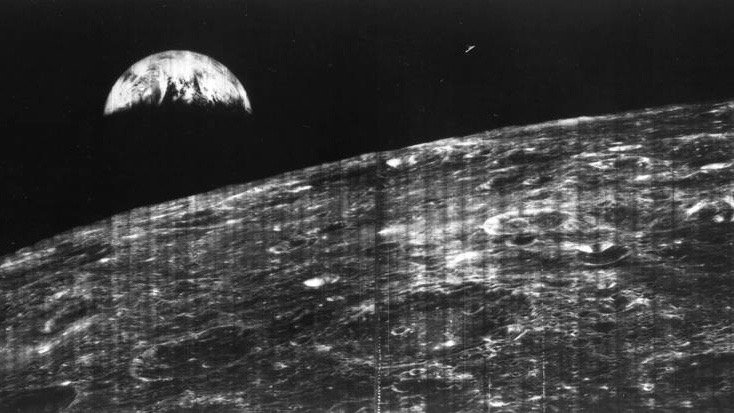
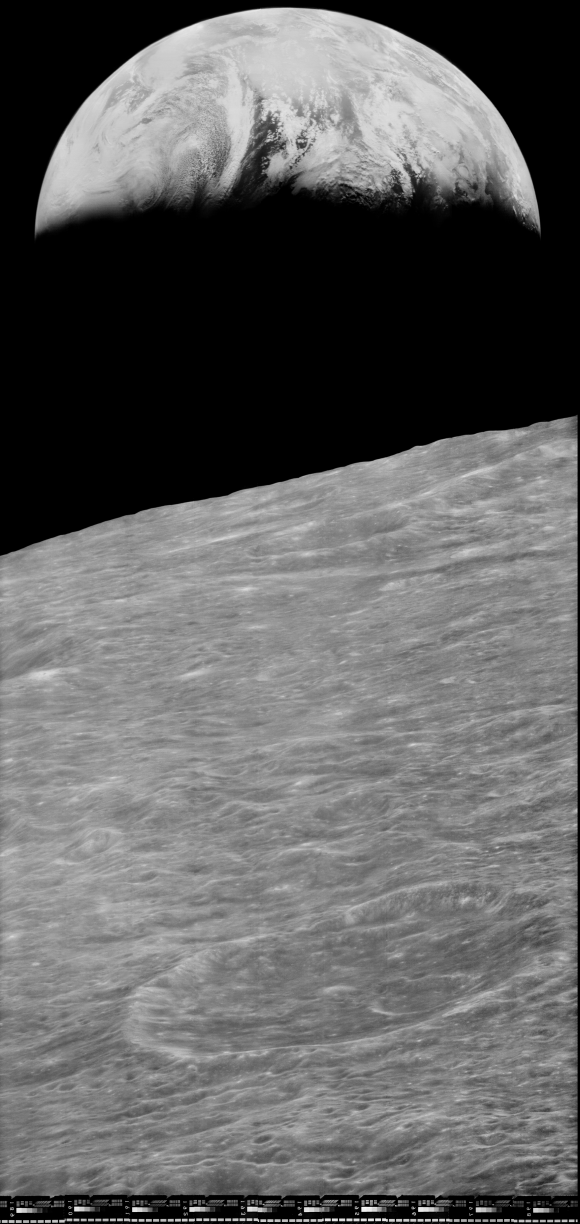
A View of Earth From the Moon
Lunar Orbiter 1 was launched on August 10, 1966, with an important mission: photograph the Moon and help NASA identify safe landing locations for the upcoming Apollo missions.
Four days later, on August 14, the spacecraft entered lunar orbit, becoming the first U.S. spacecraft to orbit the Moon.
During its 16th orbit, the spacecraft was passing around the far side of the Moon when it was pointed toward the horizon. As Lunar Orbiter 1 emerged from behind the Moon, its camera captured Earth appearing above the lunar surface.
The photograph was not the primary objective of the mission. Yet it became an extraordinary scientific and cultural milestone — the first photograph of Earth taken from the vicinity of the Moon.
What Did the Photograph Show?
The original photograph was far less detailed than the spectacular Earth images we see today. It showed a partially illuminated Earth against the darkness of space, with the curved and cratered lunar landscape visible below.
Earth was approximately 380,000 kilometers (236,000 miles) away from the spacecraft. The image showed parts of Earth extending from around the Mediterranean region toward southern Africa, with portions of the planet already in darkness.
Despite its limited resolution, the image offered something profound: for the first time, people could see their entire world from the neighborhood of another celestial body.
Technology Behind the Historic Image
Taking a photograph in space in 1966 was very different from using a modern digital camera.
Lunar Orbiter 1 used a photographic imaging system that exposed film aboard the spacecraft. The film was then developed onboard, scanned and transmitted electronically back to Earth, where the signals were reconstructed into photographs.
The spacecraft ultimately returned hundreds of photographs of the Moon, including images of potential Apollo landing sites. But the unexpected Earthrise photograph became one of its most famous achievements.
The Image Was Restored Decades Later
The original photograph was important, but much of its full-resolution information was not immediately available.
In 2008, the Lunar Orbiter Image Recovery Project worked with NASA to recover and digitally restore the historic image using surviving mission data and restored 1960s-era equipment. The result revealed a much clearer version of the original Earthrise photograph.
The restored image provides a remarkable bridge between two eras of technology: a photograph captured by a spacecraft more than 50 years earlier, recovered using modern digital techniques.
Before Apollo 8’s Famous Earthrise
Many people associate the phrase “Earthrise” with the famous photograph taken by the Apollo 8 astronauts in December 1968.
That image is indeed one of the most iconic photographs in human history. But Lunar Orbiter 1 had already photographed Earth from lunar orbit more than two years earlier, in 1966.
There was also another important milestone. In 1967, NASA’s Surveyor 3 became the first spacecraft to photograph Earth from the surface of the Moon.
These early images gradually changed our perspective from seeing Earth as the center of our surroundings to seeing it as a small world floating in the vastness of space.
Why This Photograph Still Matters
The Lunar Orbiter 1 Earthrise photograph was more than a technical achievement.
From the lunar distance, Earth appears small and vulnerable against the darkness of space. There are no visible borders between countries and no obvious divisions between people. There is simply one planet.
That perspective would become increasingly important as humans began traveling farther from Earth and photographing our planet from the Moon and beyond.
Today, spacecraft routinely photograph Earth from millions or even billions of kilometers away. But the first view from the Moon remains special because it marked one of humanity’s earliest opportunities to look back at our home world from another celestial body.
A Small Image With a Huge Legacy
Lunar Orbiter 1 eventually completed its mission after photographing potential Apollo landing sites and large areas of the lunar surface. On October 29, 1966, NASA deliberately sent the spacecraft into the Moon after its systems began deteriorating.
Its mission lasted only a few months, but one unexpected photograph became part of space exploration history.
On August 23, 1966, humanity saw Earth from the Moon for the first time.
More than 60 years later, that small crescent of Earth above the lunar horizon still reminds us of something remarkable: from the vastness of space, our entire world is just one small, shared home.
Quick Facts
Photograph: First view of Earth from the vicinity of the Moon
Spacecraft: NASA Lunar Orbiter 1
Date: August 23, 1966
Distance: About 380,000 km from Earth
Location: Lunar orbit
Image: Black-and-white
Mission purpose: Survey the Moon and identify potential Apollo landing sites
Restoration: Digitally restored in 2008 by the Lunar Orbiter Image Recovery Project
NASA mission status: Lunar Orbiter 1 intentionally impacted the Moon on October 29, 1966
Image credit: NASA / Lunar Orbiter Image Recovery Project.