
The Sun has produced another spectacular eruption, with a huge prominence launching plasma into space from the star’s northwestern limb.
The eruption occurred in a region that has already rotated onto the far side of the Sun. That means the resulting coronal mass ejection (CME) is traveling away from Earth rather than directly toward our planet.
The event was captured by several spacecraft, including NASA and ESA’s SOHO, NASA’s Solar Dynamics Observatory, and NOAA’s GOES-19 satellite.

A Huge Eruption on the Sun’s Far Side
According to the latest solar observations, the same northern region that produced a large prominence eruption the previous day erupted again — and this time the prominence was even larger.
Prominences are enormous structures made of relatively cool solar plasma suspended above the Sun’s surface by powerful magnetic fields. When these magnetic structures become unstable, they can erupt and send huge amounts of material into space.
In this case, the eruption generated a CME, but its location on the far side of the Sun means the material is moving away from Earth.
That makes this particular eruption visually impressive but not an immediate threat to our planet.
Solar Activity Has Become Relatively Quiet
Despite the spectacular eruption, the Sun’s flare activity during the past 24 hours has been relatively low.
Between September 10 and September 11, observers recorded nine flares:
- 8 B-class flares
- 1 C-class flare
- Strongest flare: C1.6
The C1.6 flare came from active region AR4530 on September 10.
Several sunspot regions are currently visible on the Earth-facing side of the Sun, although most remain relatively stable and magnetically simple.
More Solar Material Could Still Reach
Earth
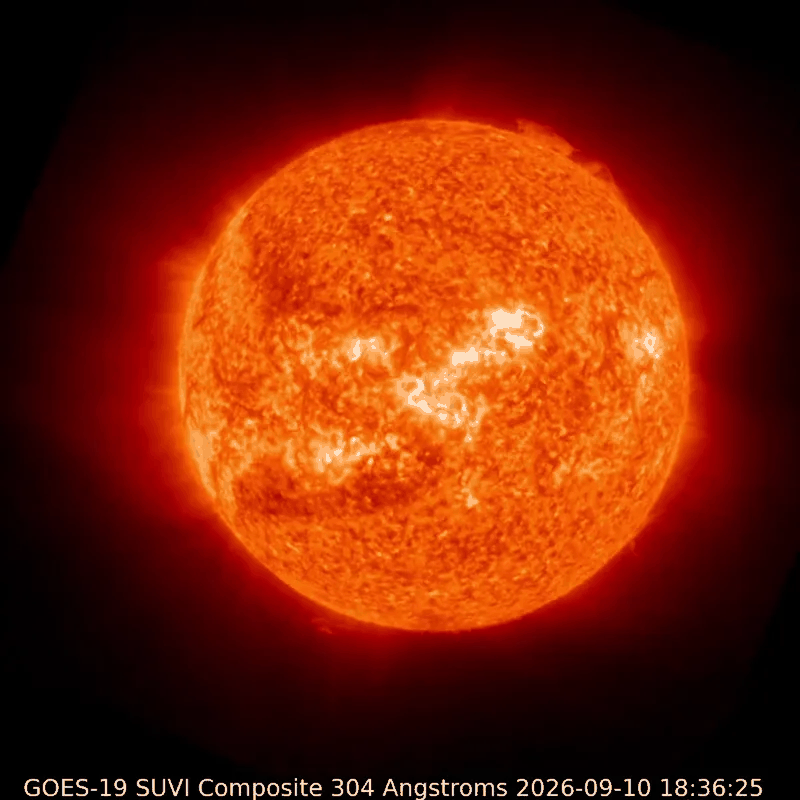
While the latest major eruption is heading away from Earth, the Sun has produced other eruptions in recent days.
Two filament eruptions from the Sun’s southwestern region produced slow-moving CMEs. Current modeling suggests that these events could produce a weak impact at Earth around September 14 or 15.
The exact timing and strength of any impact can change as new observations become available.
Could More Auroras Appear?
Earth has already experienced unsettled geomagnetic conditions during this period of increased solar activity.
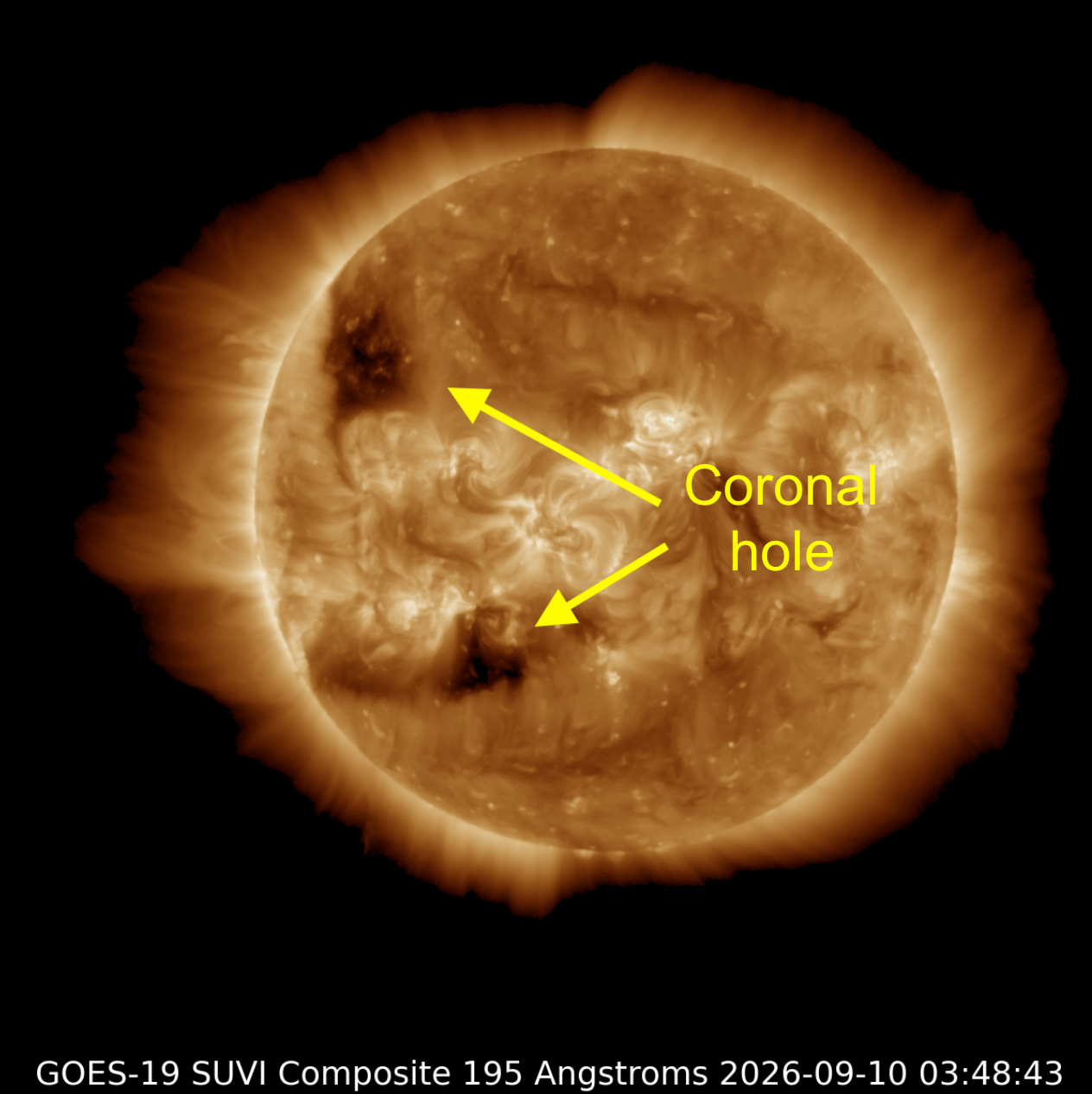
The planet’s magnetic field reached Kp values between 1 and 3 during the latest 24-hour period. At the same time, the solar wind remained at moderate speeds as the effects of earlier CMEs and a coronal-hole high-speed stream gradually weakened.
The forecast currently calls for quiet to unsettled geomagnetic conditions, although active periods remain possible as fast solar wind from a coronal hole interacts with Earth’s magnetic environment.
When solar wind and CMEs interact strongly with Earth’s magnetosphere, charged particles can travel toward the upper atmosphere and produce the beautiful auroras seen at high latitudes.
The Sun Is Still Keeping Scientists Busy
The latest eruption is another reminder that the Sun can remain active even when its flare count is relatively low.
Scientists continuously monitor solar prominences, sunspots, flares, CMEs and the solar wind because these events can influence conditions throughout the space environment around Earth.
For now, the newest massive eruption is safely traveling away from our planet. But other solar material released in recent days could still influence Earth’s magnetic field in the days ahead.
The Sun may look calm from Earth, but its surface and atmosphere are constantly changing.
What Is a CME?
A coronal mass ejection, or CME, is a massive cloud of magnetized plasma expelled from the Sun.
A CME can contain billions of tons of solar material and travel through space at hundreds or even thousands of kilometers per second. If one is directed toward Earth, it can interact with our planet’s magnetic field and produce geomagnetic storms and auroras.
Not every CME is Earth-directed — and the latest massive eruption from the Sun’s northwest is a good example of one heading safely away from us.
The Sun may be 150 million kilometers away, but its activity can still have a direct influence on our planet.