
There are some names in astronomy that become almost as famous as the discoveries themselves.Nancy Grace Roman is one of them.
She was a pioneering astronomer, NASA’s first chief astronomer and the first woman to hold an executive position at the agency. Long before the Hubble Space Telescope transformed our view of the universe, Roman was working to make space-based astronomy a reality.
Now, as NASA prepares to launch its next major space telescope, her name is once again heading toward the stars.
The Nancy Grace Roman Space Telescope is scheduled to launch on August 30, 2026, aboard a SpaceX Falcon Heavy rocket. Once in space, it will investigate some of the biggest mysteries in modern astronomy, including dark energy, dark matter and planets beyond our Solar System.
But who was Nancy Grace Roman, and why did NASA choose her name for such an important mission?
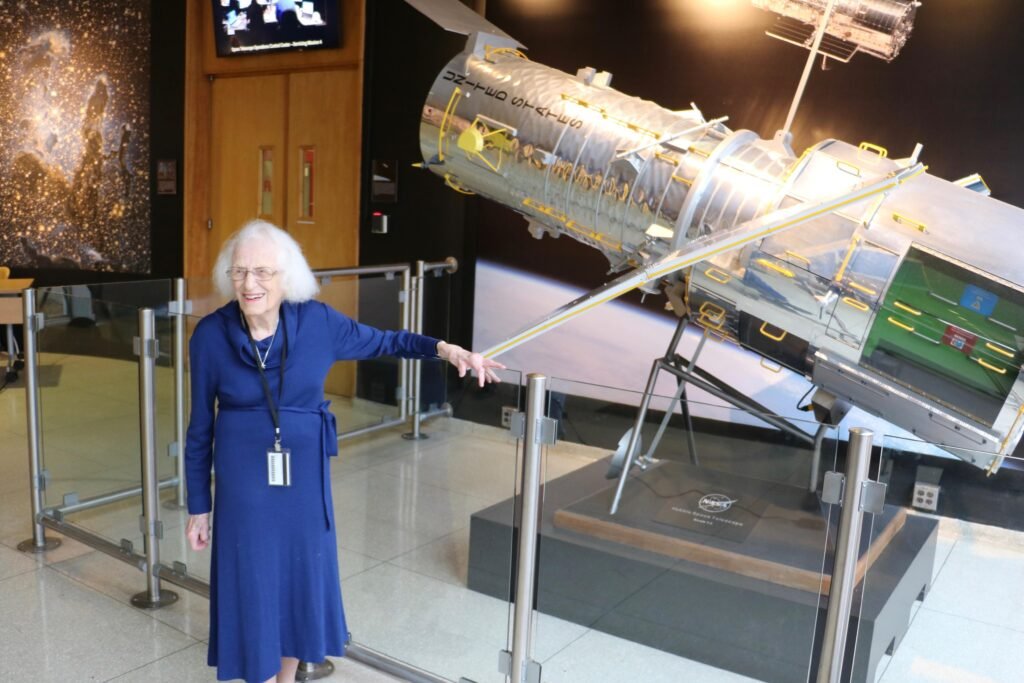
A childhood fascination with the night sky
Nancy Grace Roman was born on May 16, 1925, in Nashville, Tennessee.
Her interest in astronomy began when she was very young. Her mother would take her outside at night and show her the constellations and the aurora. Those early experiences helped spark a fascination that would eventually become her life’s work.
By the age of 11, Roman had started an astronomy club with other girls in her neighborhood.
She was already thinking seriously about becoming an astronomer while she was still in school.
At a time when women faced significant barriers in science, Roman chose to pursue astronomy anyway.
She attended Swarthmore College and graduated with a degree in astronomy in 1946. She later continued her studies at the University of Chicago and worked at Yerkes Observatory, becoming the first woman on its academic staff.
Her path into astronomy was not always easy.
Roman later recalled being discouraged from pursuing science simply because she was a woman.
But she continued forward.
Breaking new ground at NASA
When NASA was established in 1958, space science was entering a completely new era.
Roman joined NASA soon afterward and became the agency’s first chief astronomer.
She was also the first woman to hold an executive position at NASA.
Her job was not simply to conduct astronomical research. Roman helped build NASA’s astronomy program and worked with scientists, engineers and government officials to develop ambitious missions that could study the universe from above Earth’s atmosphere.
At the time, astronomers knew that Earth’s atmosphere limited what ground-based telescopes could see.
They wanted a large telescope in space.
That idea would eventually become Hubble.
The “Mother of Hubble”
The concept of a large space telescope existed long before Hubble was launched.
But turning that concept into a real NASA mission required years of scientific planning, political support and funding.
Roman played a critical role in that process.
She helped organize astronomers and worked to convince decision-makers that a large space telescope was worth the enormous investment.
Her ability to communicate the scientific importance of the project was particularly important when NASA needed congressional support.
Eventually, the dream became reality.
The Hubble Space Telescope launched in 1990 and went on to revolutionize astronomy.
It revealed distant galaxies, helped scientists measure the expansion of the universe and produced some of the most recognizable images ever taken of the cosmos.
Roman became known as the “Mother of Hubble” because of her important role in making the observatory possible.

A new telescope carries her name
In 2020, NASA renamed its Wide Field Infrared Survey Telescope, or WFIRST, in honor of Nancy Grace Roman.
The new name was fitting.
Roman had spent much of her career helping establish space-based astronomy. Now, a powerful new observatory would carry her name into the next generation of cosmic exploration.
The Roman Space Telescope is designed to do something that Hubble and the James Webb Space Telescope cannot do in quite the same way.
Instead of concentrating primarily on small areas of the sky, Roman will survey enormous regions of the universe.
Its field of view will be around 100 times larger than Hubble’s, allowing it to collect huge amounts of astronomical data much more quickly.
In other words, Hubble and Webb are excellent at taking deep cosmic close-ups.
Roman is designed to give astronomers a much wider view.
Searching for the mystery of dark energy
One of Roman’s biggest scientific goals is to investigate dark energy.
The universe has been expanding since the Big Bang. But observations show that this expansion is accelerating.
Scientists don’t yet know what is causing that acceleration.
Dark energy is the name given to the mysterious phenomenon behind it, but its true nature remains one of the biggest unanswered questions in cosmology.
Roman will survey enormous numbers of galaxies and other objects across the universe.
By measuring how cosmic structures have changed over time, astronomers hope to gain a better understanding of how the universe expanded and whether our current theories about dark energy are correct.
Mapping the invisible universe
Roman will also help astronomers investigate dark matter.
Dark matter does not produce or reflect light, which means conventional telescopes cannot see it directly.
But its gravity leaves fingerprints across the universe.
The gravity of dark matter can bend the light coming from distant galaxies. This effect, known as gravitational lensing, allows astronomers to map the distribution of invisible matter.
Because Roman can observe such a huge area of sky, it will be particularly useful for creating large-scale maps of dark matter.
These observations could reveal how dark matter shaped galaxies and the enormous cosmic web stretching across the universe.
Looking for distant worlds
Roman will also turn its attention toward planets beyond our Solar System.
Astronomers expect the mission to discover large numbers of exoplanets using a technique called gravitational microlensing.
When a star passes in front of another distant star, its gravity can temporarily magnify the background star’s light.
If a planet is orbiting the foreground star, the planet can create a tiny additional signal.
Roman will monitor enormous numbers of stars, giving scientists the opportunity to find worlds that are difficult to detect using other methods.
The telescope will also carry a Coronagraph Instrument designed to demonstrate technology for directly imaging exoplanets by blocking the overwhelming glare of their parent stars.
A different way of seeing the universe
Roman is not being built to replace Hubble or Webb.
Instead, it will complement them.
Hubble has spent more than three decades producing incredibly detailed observations across many wavelengths.
The James Webb Space Telescope is designed to look deeper into the infrared universe, revealing distant galaxies, stars and planetary systems.
Roman will take a much wider view.
It will survey huge sections of the sky and identify interesting objects and events that other telescopes can then investigate in greater detail.
This combination could create a powerful new way of studying the universe.
Roman will essentially help astronomers answer a simple question:
What happens when we stop looking at the universe one small piece at a time and start looking at the bigger picture?
A legacy that continues
Nancy Grace Roman died in 2018 at the age of 93.
She never saw the telescope named after her reach space.
But the mission represents exactly the kind of scientific future she spent her career helping to create.
She believed in the power of space-based observatories to transform our understanding of the cosmos.
Hubble proved that vision right.
Now, decades later, another telescope carrying her name is preparing to continue that journey.
When the Nancy Grace Roman Space Telescope begins surveying the universe, it will search for dark matter, investigate dark energy, discover distant worlds and map enormous portions of the cosmos.
And behind all of those discoveries will be the legacy of a woman who helped NASA learn how to look beyond Earth’s atmosphere in the first place.
Nancy Grace Roman once helped open a new window onto the universe.
Now, a telescope named after her is preparing to open an even wider one.
The next chapter begins
The Nancy Grace Roman Space Telescope is scheduled to launch on August 30, 2026, aboard a SpaceX Falcon Heavy from Launch Complex 39A at NASA’s Kennedy Space Center in Florida.
Liftoff is currently targeted for 7:26 a.m. EDT (11:26 UTC), with NASA’s live coverage beginning at 6:20 a.m. EDT.
After launch, Roman will travel toward the Sun-Earth Lagrange Point 2, roughly 930,000 miles from Earth, where it will begin its mission after commissioning.
The next generation of cosmic discoveries is about to begin.
And it will begin with the name of a woman who spent her life looking toward the stars.