
A spectacular new image from NASA reveals two galaxies caught in the middle of a dramatic cosmic encounter.
The system, known as II Zw 096, contains two galaxies merging at an extremely rapid rate. NASA’s latest image combines observations from three powerful space telescopes, revealing details that cannot be seen in ordinary visible light alone.
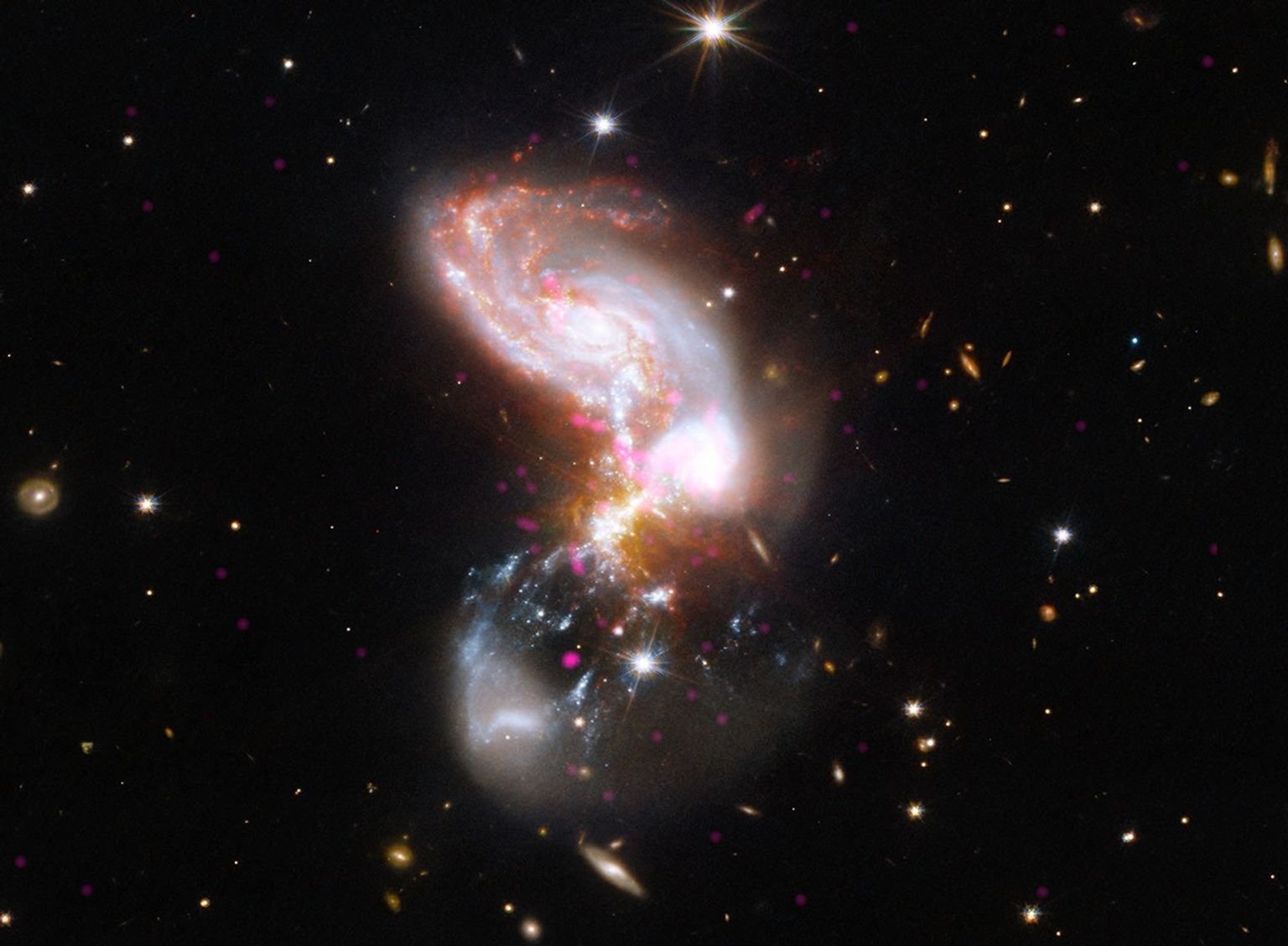
A Galaxy Collision Hidden in Multiple Wavelengths
The image brings together data from NASA’s Chandra X-ray Observatory, the Hubble Space Telescope, and the James Webb Space Telescope.
Each telescope reveals a different part of this violent cosmic event.
Chandra’s X-ray observations appear in magenta, highlighting extremely hot gas and powerful activity associated with black holes.
Hubble’s optical observations, shown in blue and white, reveal the visible structures of the merging galaxies.
Meanwhile, Webb’s infrared observations reveal regions hidden behind thick clouds of cosmic dust. These observations allow astronomers to see enormous stellar nurseries that would otherwise be difficult or impossible to observe.
Together, the observations create a much more complete picture of what is happening inside II Zw 096.
Two Galaxies in the Middle of a Merger
Galaxy mergers are among the most powerful events in the evolution of galaxies.
When galaxies pass close to one another, their enormous gravitational forces can distort their shapes and disturb huge clouds of gas and dust.
In systems such as II Zw 096, these interactions can compress gas and trigger intense episodes of star formation.
The collision can also influence material surrounding supermassive black holes at the centers of galaxies, producing powerful X-ray emission that Chandra can detect.
Why Infrared and X-rays Matter
Looking at a galaxy in only visible light is like seeing just one part of a much larger picture.
Dust can block visible light from distant regions, hiding young stars and other energetic activity.
Infrared observations from Webb can penetrate much of this dust, revealing previously hidden stellar nurseries.
X-rays provide another important perspective. Chandra can detect extremely hot gas and energetic processes associated with black holes and other powerful sources.
By combining these observations, astronomers can study both the spectacular structures and the energetic processes taking place during the merger.
A Window Into Galaxy Evolution
Galaxy mergers are not simply spectacular cosmic collisions. They are also important laboratories for understanding how galaxies evolve.
Events like II Zw 096 provide astronomers with clues about how gravitational interactions can reshape galaxies, stimulate star formation, and influence the activity of supermassive black holes.
Studying merging galaxies today can also help scientists understand processes that were much more common when the universe was younger.
The latest II Zw 096 image, released by NASA on September 11, 2026, demonstrates the extraordinary amount of information that can be uncovered when multiple space telescopes observe the same cosmic target.
What looks like a beautiful galactic gem is actually a violent and dynamic environment where galaxies, gas, dust, stars, and black holes are interacting on an enormous scale.
The Universe Looks Very Different in Different Wavelengths
Visible light shows us the galaxies we can see.
Infrared reveals structures hidden behind dust.
X-rays expose some of the hottest and most energetic activity.
Together, they allow astronomers to see a much deeper story of how galaxies collide and evolve.
Image credit: X-ray: NASA/CXC/SAO; Optical: NASA/ESA/STScI; Infrared: NASA/ESA/CSA/STScI; Image Processing: NASA/CXC/SAO/L. Frattare and J. Major.
Source: NASA / Chandra X-ray Observatory