
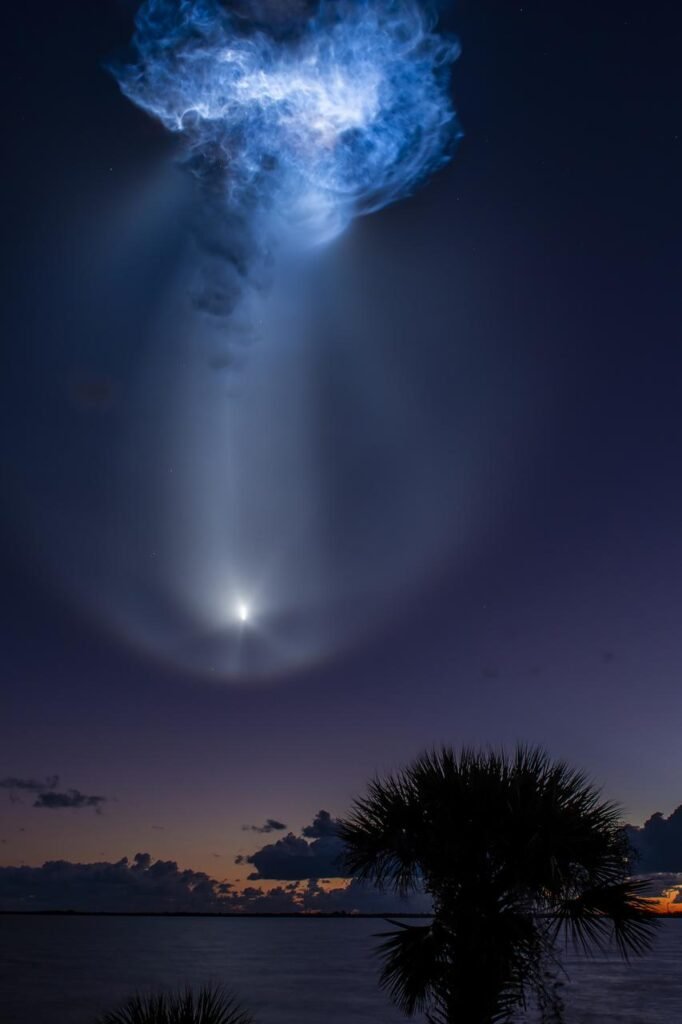
A SpaceX Falcon 9 rocket created a spectacular jellyfish-shaped glow in the sky during its early morning launch on October 13, 2026. The rocket carried a Dragon cargo spacecraft toward the International Space Station (ISS) as part of NASA’s 35th Commercial Resupply Services mission, known as CRS-35.
Why Did the Rocket Look Like a Glowing Jellyfish?
The unusual sight was caused by sunlight illuminating the rocket’s exhaust plume against the dark, predawn sky. This natural optical phenomenon, often called a “space jellyfish,” can occur when a rocket launches near sunrise or sunset.
As the rocket climbs higher into the atmosphere, its exhaust plume expands into a broad, glowing shape. At the same time, the observer on the ground may still be in darkness, while the plume at higher altitude is already illuminated by the Sun. The contrast creates the appearance of a giant, luminous jellyfish floating above the horizon.
Although the scene looks otherworldly, it is a combination of rocket exhaust, sunlight, altitude, and timing—not an actual object in space.

SpaceX CRS-35: Delivering Science to the Space Station
The Falcon 9 rocket lifted off at 6:33 a.m. EDT from Space Launch Complex 40 at Cape Canaveral Space Force Station in Florida. Its Dragon spacecraft carried more than 6,300 pounds of scientific investigations, supplies, and equipment to the orbiting laboratory.
Among the cargo were experiments designed to advance medical research, study biological processes in microgravity, and support the space station’s ongoing operations. The mission also carried the final pair of International Space Station Roll-Out Solar Arrays, which will help increase the station’s available electrical power.
Research conducted aboard the ISS helps scientists investigate questions that are difficult to study on Earth, with potential benefits for medicine, biotechnology, and future human space exploration.
A Beautiful Reminder of Space Exploration
Rocket launches are engineering achievements, but they can also create remarkable sights for people watching from the ground. The glowing jellyfish effect is a perfect example of how the physics of spaceflight can produce an unexpectedly beautiful display in Earth’s atmosphere.
As SpaceX continues delivering supplies and scientific experiments to the International Space Station, launches like CRS-35 support research that benefits life on Earth while helping prepare humanity for future missions beyond our planet.
Image credit: NASA/John Kraus
Source: NASA — SpaceX CRS-35 Launch Jellyfish