
Astronomers have discovered a surprising group of supermassive black holes that appear to be growing far faster than the galaxies surrounding them.
The finding challenges the long-standing idea that galaxies and the enormous black holes at their centers generally grow together in a closely connected relationship.
A Strange Imbalance
Nearly every large galaxy is believed to contain a supermassive black hole at its center. These cosmic giants can contain millions or even billions of times the mass of the Sun.
Astronomers have found a strong relationship between the mass of a galaxy and the mass of its central black hole. Typically, the black hole represents only a small fraction of the galaxy’s total mass.
But a recent study has identified an unusual population that doesn’t follow this pattern.
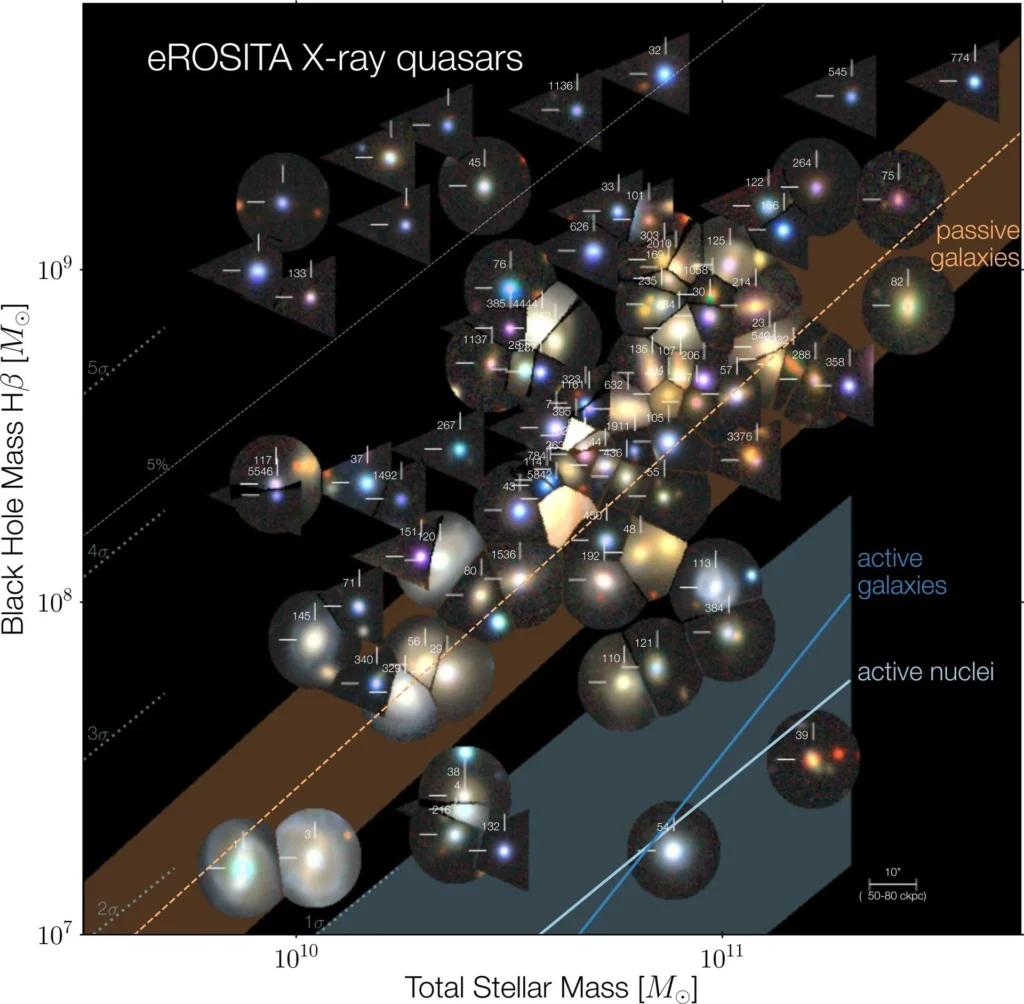
Researchers used observations from the eROSITA X-ray telescope, together with other observations, to study more than 20,000 quasars. Quasars are extremely bright objects powered by actively feeding supermassive black holes.
Because the brightness of a quasar is connected to the activity and mass of its central black hole, astronomers can use these objects to investigate how black holes grow.
Black Holes That Are Far Too Massive
Among the thousands of quasars studied, eight stood out.
Normally, the mass relationship between a supermassive black hole and its host galaxy is roughly 1 to 200. But in these unusual systems, the ratio was closer to 1 to 20.
That means the black hole can account for around 5% of the galaxy’s mass — roughly an order of magnitude larger than the typical proportion.
Even more interestingly, three of these quasars were among the brightest objects in the sample, suggesting that their black holes are currently consuming matter at exceptionally high rates.
According to the researchers’ estimates, some of these black holes could potentially double their mass within about a billion years.
Why Are Their Galaxies So Faint?
One of the most unusual characteristics of these systems is that their host galaxies are relatively faint.
A faint galaxy generally contains fewer stars than a massive galaxy such as the Milky Way. Yet at its center sits a disproportionately massive and actively growing black hole.
Astronomers aren’t yet sure why this happens.
One possibility is that these galaxies could eventually produce more stars and become more massive, bringing the relationship between the galaxy and black hole closer to what is normally observed.
Another possibility is that the rapidly growing black hole could influence its surroundings strongly enough to interfere with future star formation.
For now, researchers don’t have enough observations to determine which scenario is correct.
A Complicated Relationship
The discovery doesn’t mean that the connection between galaxies and their central black holes is wrong.
Instead, it suggests that the relationship may be more complicated than previously thought.
Black holes and galaxies clearly influence one another, but their growth doesn’t necessarily happen at the same rate all the time. A black hole may experience a period of extremely rapid growth while its host galaxy remains relatively small and faint.
Over longer periods, the galaxy may catch up — or the black hole’s activity could affect the supply of gas available for forming new stars.
Understanding this balance is important because supermassive black holes aren’t simply passive objects sitting at the centers of galaxies. When they actively consume gas, they can release enormous amounts of energy in the form of radiation and powerful outflows.
That energy can potentially influence the evolution of the surrounding galaxy.
More Cosmic Mysteries Ahead
The eight unusual quasars provide astronomers with a rare glimpse of a phase in which black hole growth appears to have temporarily outpaced galaxy growth.
But the sample is small, and scientists still need more observations to understand exactly how these systems formed and how they will evolve.
The discovery suggests that the story of galaxy formation may not be as straightforward as once thought.
Sometimes, the black hole may grow first — and the galaxy has to catch up.
Source: Buchner et al., “A large population of over-massive black hole quasars at z = 0.3–0.8 revealed by eROSITA,” Astronomy & Astrophysics (2026); Universe Today.