
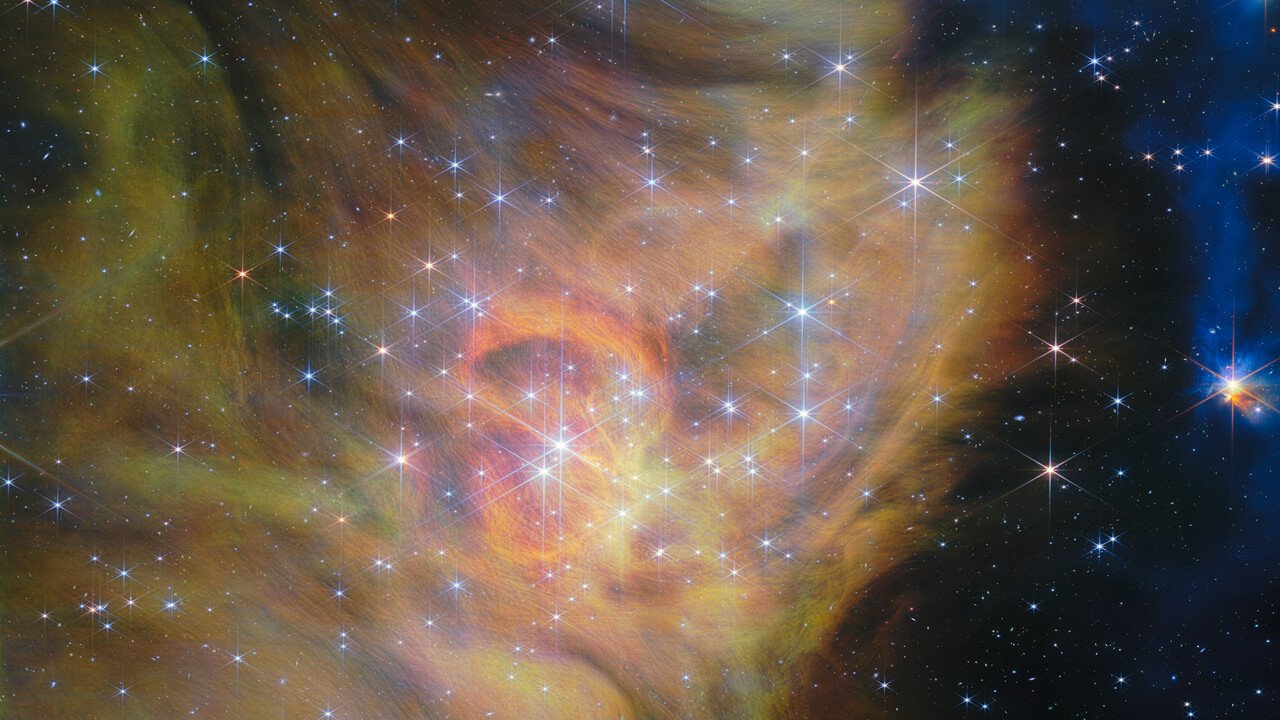
About 1,000 light-years away, in the constellation Perseus, a young stellar nursery is giving astronomers an extraordinary glimpse into how stars and planet-like objects are born.
The NASA/ESA/CSA James Webb Space Telescope has captured a spectacular new view of IC 348, a nearby star-forming region filled with young stars, swirling clouds of gas and dust, newborn protostars and powerful stellar outflows.
But hidden within this enormous cosmic landscape is something even more remarkable.
Astronomers using Webb have discovered brown dwarfs with masses as low as just twice that of Jupiter — the least massive brown dwarfs known. The discovery pushes the study of star-like objects into a new and surprising mass range.
A Stellar Nursery 1,000 Light-Years Away
IC 348 lies approximately 1,000 light-years from Earth in the constellation Perseus.
It is a young star-forming region where cold clouds of molecular hydrogen collapse under gravity to produce new stars. The result is a spectacular environment filled with glowing gas, dust, young stars and protostars.
The new Webb image is one of the largest images released to the public by the telescope so far, providing a remarkably detailed view of the region. The image covers a field of view of roughly 16 by 20 arcminutes and was created using several near-infrared wavelengths observed by Webb’s NIRCam instrument.
Webb Finds Brown Dwarfs Only Twice the Mass of Jupiter
The smallest normal stars have masses of roughly 8% that of the Sun.
Below that limit lies a mysterious class of objects known as brown dwarfs.
Brown dwarfs form in a similar way to stars, when clouds of gas and dust collapse under gravity. However, they do not become massive enough for their cores to sustain the hydrogen-fusion process that powers ordinary stars.
That makes brown dwarfs something of a bridge between stars and planets.
Previous Webb observations of IC 348, conducted in 2022, identified brown dwarfs with masses as low as three to four times that of Jupiter.
The new observations went even further.
Using deeper observations, astronomers have now identified brown dwarfs with masses of only about twice that of Jupiter — approximately 0.19% of the Sun’s mass. These are currently the least massive brown dwarfs known.
Their existence presents a major challenge for theories of star formation.
How Small Can a Star-Like Object Be?
One of the biggest questions surrounding brown dwarfs is how small an object can become while still forming through the same basic process as a star.
Stars form when enormous clouds of molecular gas collapse under gravity. As the material becomes denser, a protostar develops and eventually becomes a star if enough mass accumulates.
But at extremely low masses, the process becomes difficult to explain.
A brown dwarf only twice the mass of Jupiter is extraordinarily small compared with a typical star.
The discovery therefore raises an important question:
Where is the true lower limit of the star-formation process?
By studying these tiny objects in IC 348, astronomers hope to determine whether objects with only a few Jupiter masses can genuinely form like stars, rather than forming as planets and later being ejected from their planetary systems.
One Tiny Brown Dwarf May Have a Disc
Perhaps even more surprising, one of the newly discovered low-mass brown dwarfs appears to have a disc surrounding it.
Discs of gas and dust are important because they are associated with the formation of planets around young stars.
That raises an extraordinary possibility: an object with a mass comparable to a giant planet may itself have the material needed to form planets around it.
If confirmed, this would provide another fascinating example of how complicated the boundary between stars, brown dwarfs and planets can be.
The discovery does not mean that planets have definitely formed around this brown dwarf. Instead, the disc provides evidence that conditions around the object could potentially support planet formation.
Webb Also Detects a Mysterious Hydrocarbon Signature
The tiny brown dwarfs are not the only surprise.
When astronomers examined their spectra, they found a distinctive feature attributed to hydrocarbons — molecules made entirely from hydrogen and carbon.
This spectral feature has so far been seen only in the atmospheres of the lowest-mass brown dwarfs.
That could indicate that these extremely low-mass objects have unusual atmospheric chemistry and may represent a distinct spectral class of brown dwarfs.
Understanding this chemistry could give researchers another way to investigate how these objects form and evolve.
A Landscape Filled With Newborn Stars
The new image of IC 348 is spectacular not only because of the brown dwarfs.
In the upper-right portion of the image, Webb reveals a collection of protostars — extremely young stars still gathering material from their surrounding environments.
Some of these newborn stars are producing powerful jets of material. When these jets slam into the surrounding gas and dust, they create glowing structures known as Herbig-Haro objects.
One prominent feature is HH 797, a long, narrow outflow previously observed by Webb. A closer examination reveals that the source actually contains two protostars producing nearly parallel outflows.
Nearby is HH 211, another young stellar system displaying narrow jets and broader outflows.
These structures provide astronomers with a close-up look at the violent processes taking place as stars are born.
Webb’s Infrared Eyes Reveal the Hidden Universe
The incredible detail in this image comes from Webb’s ability to observe infrared light.
The telescope’s Near-Infrared Camera (NIRCam) was used to survey IC 348 and detect the warm glow from young stars and brown dwarfs.
Astronomers first selected potential brown dwarfs based on their colours and brightness. They then used Webb’s Near-Infrared Spectrograph (NIRSpec) to obtain detailed spectra and investigate their physical properties, including their masses.
The observations used to create this new image were obtained with NIRCam in 2024, while follow-up NIRSpec observations were conducted in 2025.
Together, these observations allowed researchers to probe deeper into IC 348 than before.
A Cosmic Laboratory for Star and Planet Formation
IC 348 is becoming an important laboratory for understanding the smallest objects produced during star formation.
The research team is investigating several questions at once: how low-mass brown dwarfs form, how populations of planetary-mass objects vary between different stellar nurseries, and what causes the unusual hydrocarbon signature found in the atmospheres of the smallest brown dwarfs.
The discovery of objects only twice the mass of Jupiter suggests that nature may be capable of producing star-like objects at surprisingly small masses.
And the possible presence of a planet-forming disc around one of them makes the story even more intriguing.
A New View of IC 348
The new Webb image gives us more than a beautiful picture of a nebula.
It shows a dynamic environment where stars are being born, jets are carving through clouds of gas and dust, brown dwarfs are forming, and perhaps even planetary systems are beginning to take shape.
At a distance of around 1,000 light-years, IC 348 is relatively close in astronomical terms, making it an ideal place for Webb to investigate these processes in extraordinary detail.
As astronomers continue to search the region, they may find objects even smaller than the newly discovered brown dwarfs.
That could help answer one of the most fundamental questions about cosmic formation:
How small can a star-like object really be?
Webb’s Journey Into IC 348
The ESA/Webb zoom video takes viewers from a wider view of the sky into the intricate structures of IC 348, revealing its young stars, clouds of gas and dust and the region where these remarkable brown dwarfs were discovered. The video is based on one of Webb’s largest publicly released images to date.
Image credit: ESA/Webb, NASA, CSA, K. Luhman, C. Alves De Oliveira, M. Zamani (ESA/Webb).