
Astronomers using NASA’s James Webb Space Telescope have identified the host galaxy of the most distant fast radio burst (FRB) detected to date. The discovery offers new clues about the mysterious origins of these powerful cosmic signals and provides an opportunity to study the distant universe in unprecedented detail.
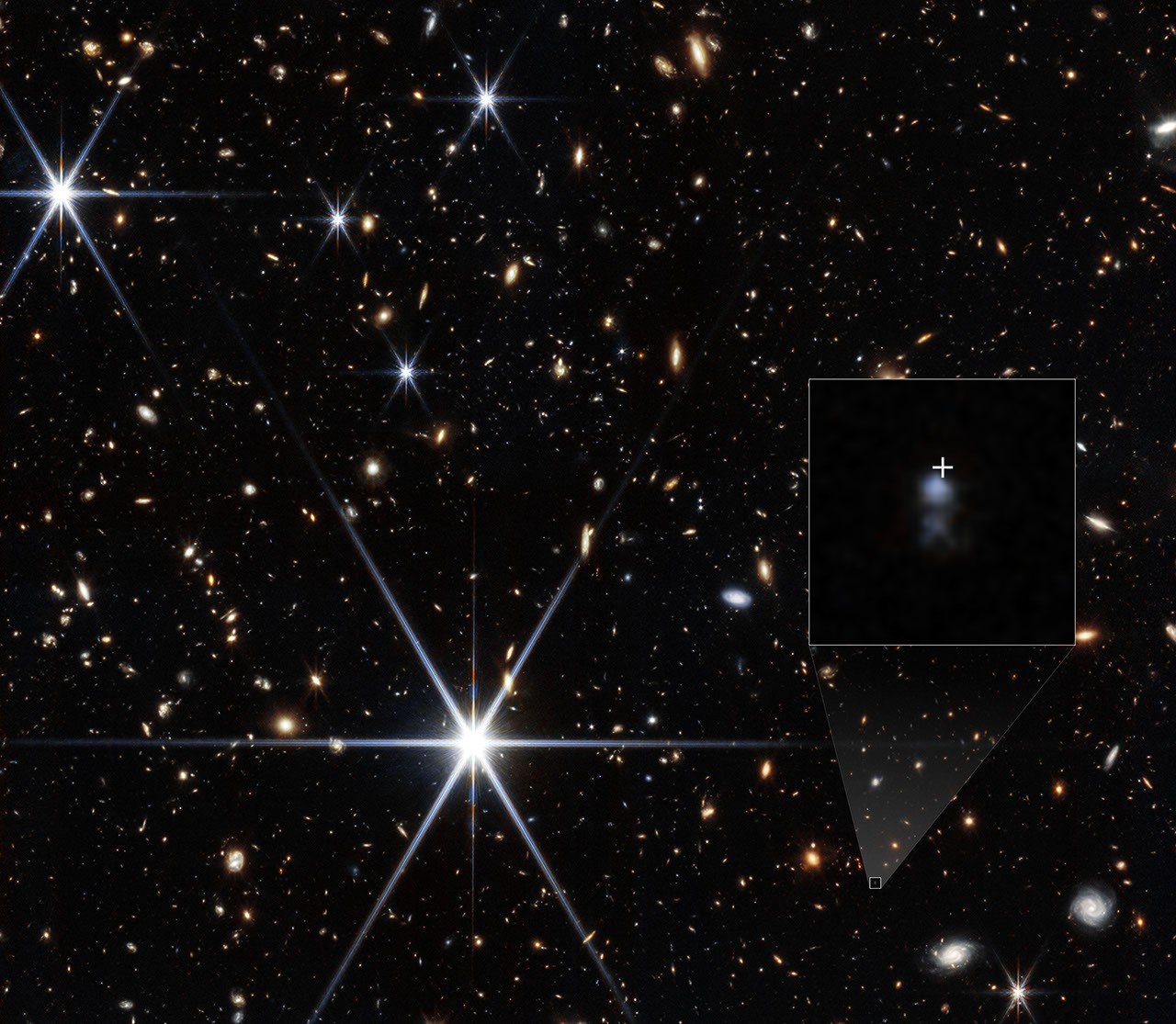
Image: NASA, ESA, CSA, STScI, Themiya Nanayakkara (USYD); Image Processing: Joseph DePasquale (STScI)
The burst, designated FRB 20240304B, was detected on March 4, 2024, by the MeerTRAP team using South Africa’s MeerKAT radio telescope. Follow-up observations with Webb revealed that the signal originated in a small dwarf galaxy that was actively forming stars when the universe was much younger.
What Are Fast Radio Bursts?
Fast radio bursts are extraordinarily brief flashes of radio waves that typically last only milliseconds. Despite their short duration, some release enormous amounts of energy, making them detectable across billions of light-years.
Scientists first discovered these unusual signals in 2007. Since then, astronomers have detected many more, but their exact origins remain uncertain. Most FRBs have been observed only once, making it difficult to investigate the objects responsible for producing them.
Researchers have proposed several possible explanations, including highly magnetized neutron stars called magnetars and collisions between neutron stars. Each new detection helps scientists test these theories and better understand some of the universe’s most energetic phenomena.
Webb Reveals a Surprisingly Small Host Galaxy
Although radio observations precisely located FRB 20240304B, astronomers initially struggled to identify its host galaxy. The galaxy was too faint to be detected by the ground-based optical telescopes used in the initial investigation.
NASA’s James Webb Space Telescope provided the breakthrough. Its Near-Infrared Camera (NIRCam) detected the faint galaxy at the burst’s location, while its Near-Infrared Spectrograph (NIRSpec) measured the galaxy’s redshift.
The measured redshift was 2.148, indicating that the burst occurred when the universe was approximately 3 billion years old, roughly 11 billion years ago.
The discovery was particularly surprising because the host galaxy was a small dwarf galaxy, estimated to be around 1,000 times less massive than researchers expected. It was also actively producing new stars, making it an unusual environment compared with many other galaxies associated with fast radio bursts.
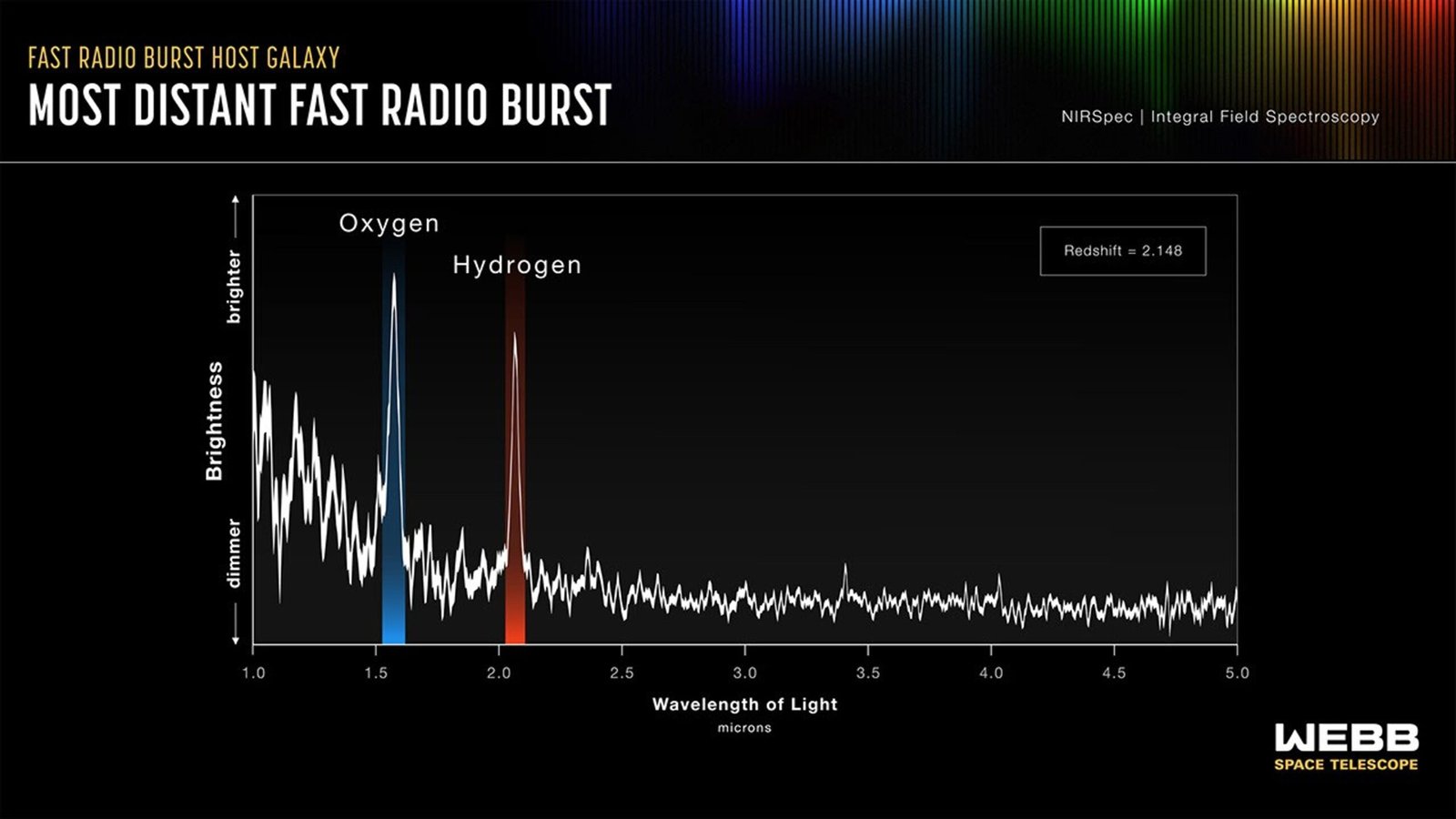
Illustration: NASA, ESA, CSA, Joseph Olmsted (STScI); Science: Manisha Caleb (SIfA)
A Clue to the Origins of Mysterious Cosmic Signals
The galaxy’s properties could help scientists determine which physical processes are capable of generating FRBs.
One proposed explanation involves the merger of two neutron stars. These extremely dense stellar remnants can gradually spiral toward one another before colliding. However, this process can take billions of years, making such mergers less likely to explain a burst associated with a galaxy dominated by young stellar activity.
Another possibility involves magnetars — neutron stars with extraordinarily powerful magnetic fields. These objects can release bursts of energy through intense magnetic activity, potentially producing fast radio bursts relatively soon after a massive star dies.
Because FRB 20240304B originated in a young, actively star-forming dwarf galaxy, the research team concluded that a neutron-star merger is very unlikely to have produced this particular burst. The finding strengthens the case for investigating other possible mechanisms, although it does not establish a single explanation for all FRBs.
Scientists will need to study many more bursts before they can determine whether different types of events produce these mysterious signals.
Fast Radio Bursts Can Reveal the Invisible Universe
The discovery offers another scientific opportunity beyond understanding how FRBs form. As radio waves travel through space, they interact with matter along their paths, leaving measurable effects in their signals.
Astronomers can use these changes to investigate otherwise difficult-to-detect material between galaxies, including gas and large-scale cosmic structures.
By studying FRB 20240304B, researchers identified evidence of two structures along its line of sight: a previously unknown galaxy cluster at a redshift of 0.3, approximately 3.5 billion light-years away, and the nearby Virgo Cluster, around 54 million light-years from Earth.
This makes fast radio bursts valuable tools for mapping the universe’s so-called cosmic web — the vast network of galaxies, gas, and matter that connects the large-scale structures of the cosmos.
Webb Opens a New Window Into the Distant Universe
The discovery demonstrates how the James Webb Space Telescope can work alongside ground-based radio observatories to investigate some of astronomy’s most challenging questions.
Researchers estimate that MeerKAT could detect and precisely locate several fast radio bursts each year at redshifts greater than 1, potentially revealing events from much earlier periods in cosmic history. Future radio observatories could increase that number, while Webb can help scientists identify and study the galaxies in which these bursts occur.
Each new observation could provide further evidence about the origins of FRBs, the evolution of galaxies, and the material spread throughout intergalactic space.
Although the mystery of fast radio bursts is far from solved, identifying the galaxy behind this exceptionally distant signal marks an important step toward understanding these brief but powerful flashes from the depths of the universe.
Source: NASA — James Webb Space Telescope science team.