
A rare total solar eclipse is set to cross parts of Europe on 12 August 2026, giving millions of people the chance to witness one of nature’s most spectacular astronomical events.
For those who cannot travel to the narrow path of totality, the European Space Agency (ESA) will bring the eclipse to viewers around the world through a live broadcast.
A Rare Eclipse Over Europe
A solar eclipse happens when the Moon moves directly between Earth and the Sun, temporarily blocking the Sun’s light.
During a total solar eclipse, the Moon completely covers the bright surface of the Sun. For a short period, daytime can turn into darkness, temperatures can drop, and the Sun’s outer atmosphere — the corona — becomes visible.
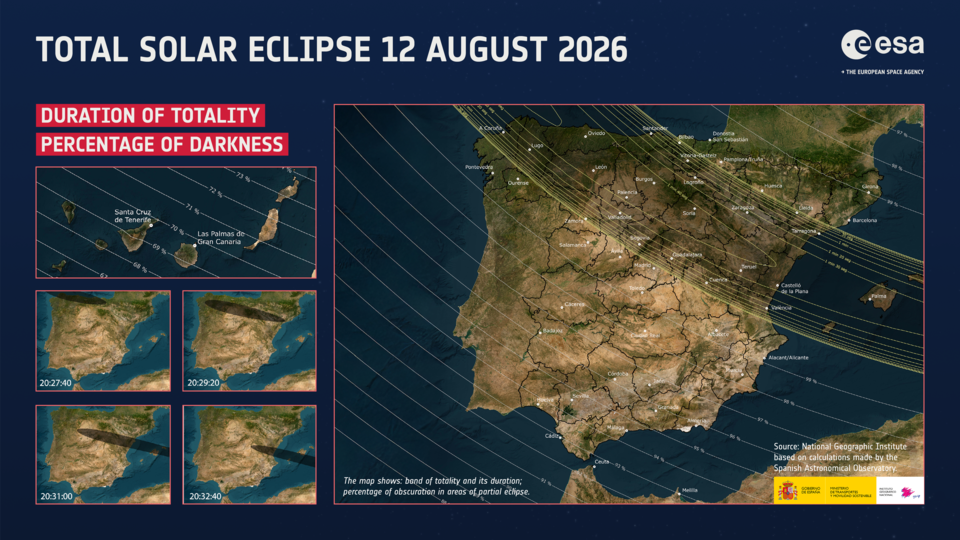
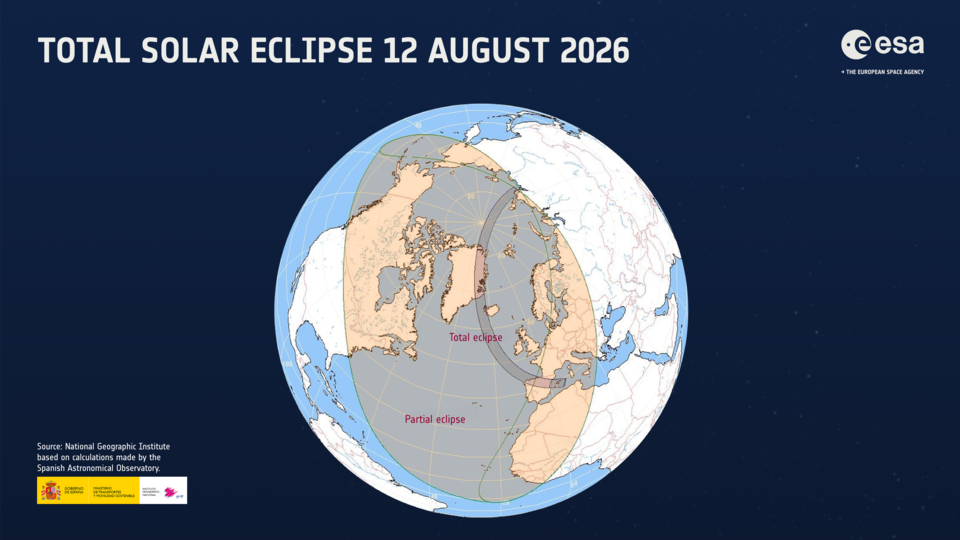
On 12 August, the path of totality will cross Greenland, Iceland, northeastern Portugal and Spain. Other parts of Europe will experience a partial eclipse, where the Moon will appear to take a bite out of the Sun.
ESA Will Broadcast the Eclipse Live
The European Space Agency is hosting a special live broadcast from the Observatorio Astrofísico de Javalambre in Teruel, Spain, located directly within the path of totality.
The broadcast begins at:
19:30 CEST on 12 August 2026
ESA says the programme will run for approximately 75 minutes and end around 20:45 CEST.
Viewers can watch through ESA Web TV or the ESA YouTube channel.

The Moment of Totality
One of the highlights of ESA’s broadcast will come at approximately 20:31 CEST, when the eclipse reaches totality at the Javalambre observatory.
Totality is expected to last about 1 minute and 21 seconds at this location.
During this brief period, the Moon will completely cover the Sun, plunging the observatory into darkness.
ESA plans to combine telescope observations, drone footage and live coverage from the ground to capture the event from multiple perspectives.
More Than Just an Eclipse
ESA’s broadcast will also explore the science behind eclipses and the Sun.
Hosted by space scientist and science communicator Dame Dr Maggie Aderin-Pocock, the programme will feature ESA Director of Science Professor Carole Mundell, along with ESA scientists and astronomers.
The broadcast will discuss the Sun’s mysterious corona, the role eclipses have played in scientific discoveries, and how ESA is working on missions that create artificial solar eclipses in space.
Why Javalambre Is an Ideal Location
The Javalambre observatory was selected as one of the key locations because it offers excellent conditions for observing the eclipse.
The site has relatively low light pollution and typically experiences little cloud cover. It also has a clear view toward the western horizon, where the eclipsed Sun will be setting.
Additional telescopes will provide close-up views of the different phases of the eclipse during the broadcast.
ESA will also receive live observations from other locations inside the path of totality, including León and Frómista in Spain. This gives the broadcast multiple opportunities to capture clear views of the eclipse.
How to Watch From Home
If you’re outside the path of totality, you don’t have to miss the event.Simply tune into ESA’s live coverage online from 19:30 CEST on 12 August 2026.
The broadcast will include:
-
Live telescope observations
-
Views of the total eclipse
-
Drone footage
-
Explanations about the Sun and its corona
-
Insights into ESA’s solar missions
-
Interviews with scientists and astronomers
 Live telescope observations
 Views of the total eclipse
 Drone footage
 Explanations about the Sun and its corona
 Insights into ESA’s solar missions
 Interviews with scientists and astronomers
ESA is also inviting viewers to send questions using #AskESA on social media, with selected questions being answered during the broadcast.
How to Watch the Eclipse Safely
If you’re lucky enough to be in an area where the eclipse is visible, never look directly at the Sun without proper protection.
Ordinary sunglasses do not provide enough protection. ESA recommends using certified eclipse glasses or appropriate solar filters during the partial phases of the eclipse.
There is a brief exception during totality: when the Moon completely covers the Sun, it is safe to look at the total eclipse without eye protection. However, protection must be put back on as soon as the Sun begins to reappear.
A Spectacular Day for Skywatchers
The 12 August 2026 eclipse is more than a beautiful celestial event. It is also an opportunity to experience the remarkable alignment of the Sun, Moon and Earth — and to see the Sun’s normally hidden outer atmosphere.
Whether you’re standing beneath the path of totality in Spain or watching from thousands of kilometres away, ESA’s live coverage means you can experience this rare event from almost anywhere.
Mark 12 August 2026 on your calendar and get ready to look up.
Watch the Eclipse Live
ESA’s live broadcast: 12 August 2026, 19:30–20:45 CEST
Watch on ESA Web TV
Watch on ESA YouTube
Source: European Space Agency (ESA). This article is an original summary based on ESA’s published eclipse information.