
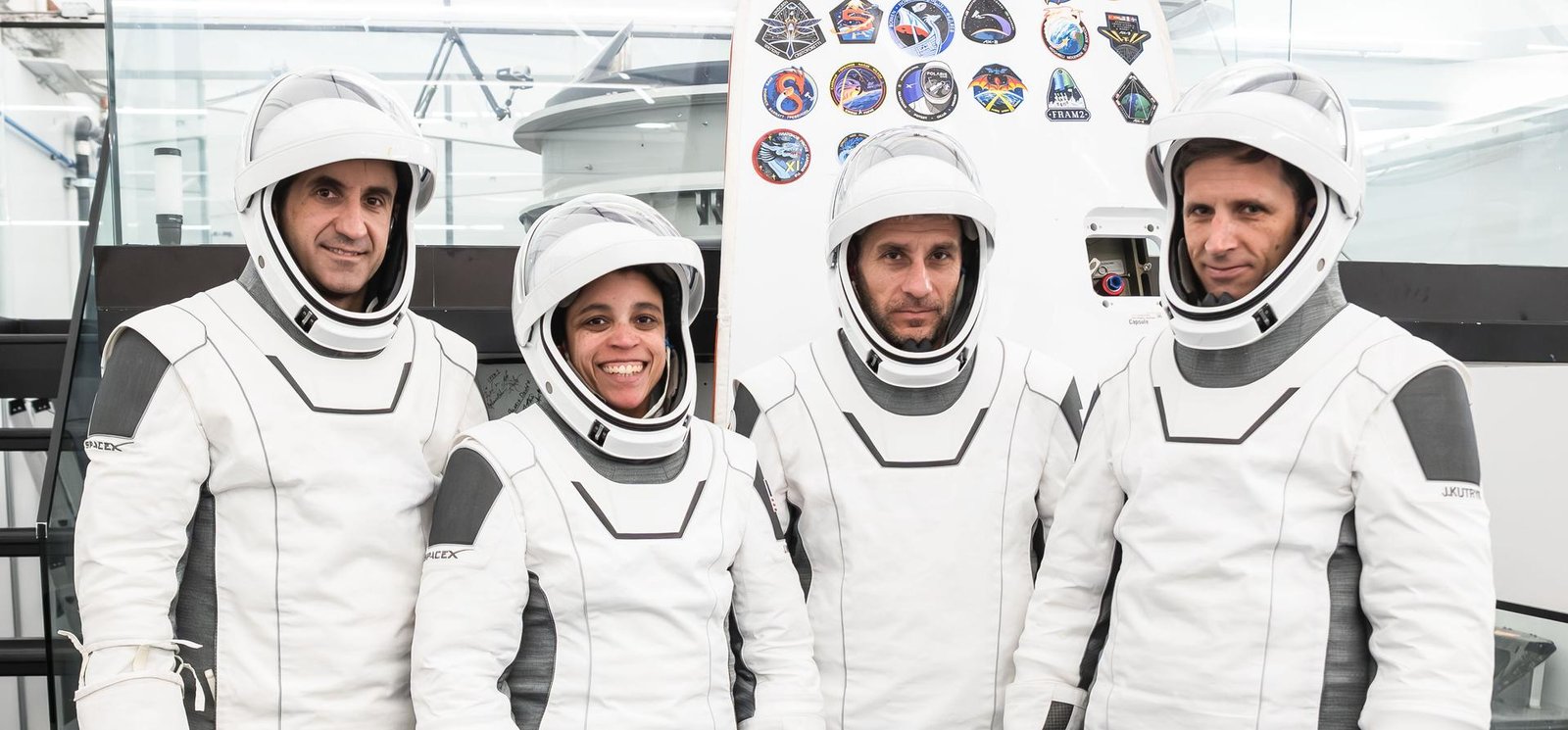
NASA and SpaceX have successfully launched the Crew-13 mission to the International Space Station (ISS), sending four astronauts and cosmonauts into orbit aboard a SpaceX Dragon spacecraft.
The crew launched on a SpaceX Falcon 9 rocket at 11:10 a.m. EDT on October 1, 2026, from Space Launch Complex 40 at Cape Canaveral Space Force Station in Florida. The mission marks another crew rotation under NASA’s Commercial Crew Program.
Meet the Crew
Crew-13 consists of four space travelers from three space agencies:
Jessica Watkins — NASA astronaut and mission commander
Luke Delaney — NASA astronaut and pilot
Joshua Kutryk — Canadian Space Agency astronaut and mission specialist
Sergey Teteryatnikov — Roscosmos cosmonaut and mission specialist
For Watkins, Crew-13 marks her second journey to the International Space Station. Delaney, Kutryk, and Teteryatnikov are making their first spaceflight.
A Fast Journey to the Space Station
After launch, the Dragon spacecraft entered orbit and began a series of automated maneuvers to approach the ISS.
The spacecraft was scheduled to dock with the forward-facing port of the station’s Harmony module at approximately 7 p.m. EDT. The planned journey from launch to docking was about 7 hours and 50 minutes, making it the fastest launch-to-docking trip by a U.S. spacecraft in International Space Station history.
Dragon can perform the docking autonomously, while the crew and mission controllers remain ready to take manual control if necessary.
Science in Microgravity
Crew-13 will spend its mission conducting scientific research and technology demonstrations aboard the orbiting laboratory.
One major area of research involves human stem-cell-derived tissues. Scientists will study these tissues in microgravity to support research into personalized medicine, disease modeling, and pharmaceutical testing, including work related to conditions such as heart disease and Parkinson’s disease.
The astronauts will also investigate plant growth and crop production using a new, mostly autonomous plant-growth system. Such research could become increasingly important as humans prepare for longer missions away from Earth.
Other experiments will examine changes in human blood flow during spaceflight and test a new diagnostic device designed to monitor astronaut health while in orbit.
Continuing Humanity’s Presence in Orbit
Crew-13 will join the Expedition 75 crew already living aboard the International Space Station. After a handover period, the previous Crew-12 astronauts will return to Earth aboard their Dragon spacecraft.
The International Space Station has provided a continuously occupied laboratory in low Earth orbit for more than 25 years. Research conducted there helps scientists understand how humans, plants, materials, and technology behave in microgravity while also supporting preparations for future exploration of the Moon and Mars.
Crew-13 is part of NASA’s broader Low Earth Orbit Program, which works with commercial partners to maintain reliable access to space and support research in orbit. The experience gained from these missions is also intended to help develop capabilities for future human exploration beyond low Earth orbit.
A New Chapter in Commercial Human Spaceflight
With another successful crewed Falcon 9 and Dragon launch, Crew-13 continues NASA and SpaceX’s ongoing human-spaceflight operations to the International Space Station.
The mission will combine scientific research, technology demonstrations, and routine station operations—while contributing to the knowledge and experience needed for humanity’s next steps beyond Earth orbit.
The journey to the Moon and Mars is being built one mission at a time.