
The universe can sometimes create optical illusions on a truly enormous scale. A stunning new image from NASA’s James Webb Space Telescope reveals distant galaxies stretched, magnified, and multiplied by the gravity of a massive galaxy cluster — creating what looks like a cosmic house of mirrors.
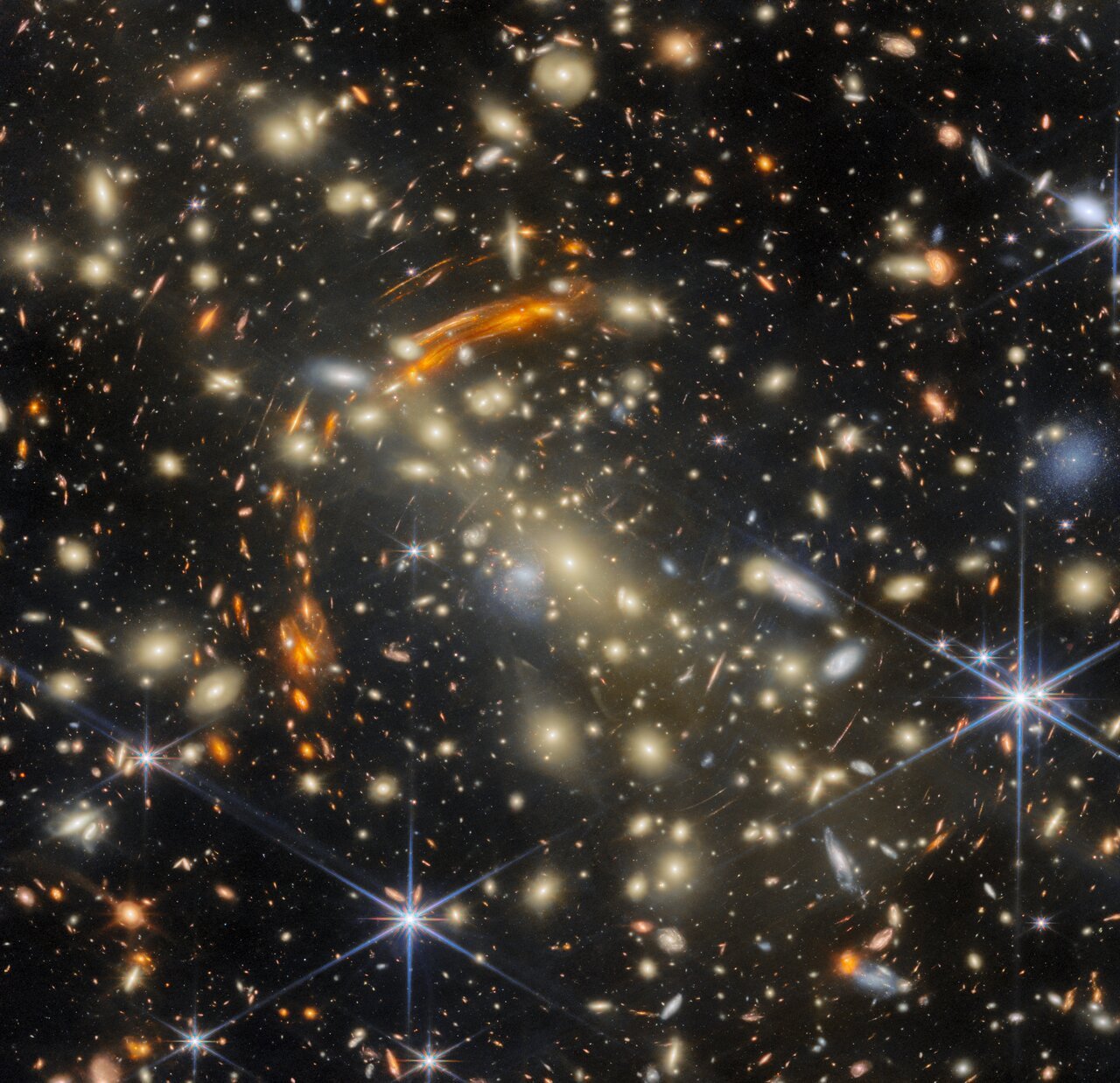
The image, released by the European Space Agency (ESA) on September 29, 2026, focuses on the galaxy cluster MACS J0454.1-0300, located in the constellation Orion. Webb’s powerful infrared vision reveals an extraordinary collection of galaxies, including distant objects whose light has been dramatically distorted by the immense gravity of the cluster.
A Cosmic Magnifying Glass
At first glance, the golden galaxies dominating the image appear to be the main attraction. They belong to MACS J0454.1-0300, a massive galaxy cluster whose light has travelled across the universe for billions of years.
But look more closely and another story emerges.
Many of the stretched and curved orange galaxies surrounding the cluster are actually much farther away. Their light passes through the enormous gravitational field of the foreground cluster, causing it to bend before reaching Earth.
This phenomenon is known as gravitational lensing.
Einstein’s theory of general relativity predicts that massive objects can bend the path of light. Galaxy clusters provide some of the most powerful examples of this effect, effectively acting like gigantic natural telescopes. By magnifying distant galaxies, gravitational lensing allows astronomers to study objects that would otherwise be far too faint or distant to observe directly.
Seeing the Same Galaxy More Than Once
The gravitational distortion in this Webb image is particularly remarkable because some background galaxies appear multiple times.
Under very specific conditions, gravitational lensing can produce two, three, or even four separate images of the same distant galaxy. Seeing four or more images is relatively uncommon and requires a precise alignment between the distant galaxy and the massive foreground cluster.
Astronomers found this rare configuration twice in Webb’s observations of MACS J0454.1-0300 — the first time this phenomenon has been observed more than once within the same galaxy cluster.
These distorted images provide astronomers with a window into the early universe. Some of the lensed galaxies existed only a few billion years after the Big Bang, while one of the observed galaxies dates to just 800 million years after the Big Bang.
Tiny Regions Magnified Hundreds of Times
The gravitational lens doesn’t simply make distant galaxies appear larger. In some cases, it magnifies individual regions within them.
Astronomers have identified bright structures, or “knots,” inside the lensed galaxies that correspond to regions as small as approximately 5 light-years across.
Some of these structures have been magnified by more than 300 times. Without gravitational lensing, such tiny and distant features would be extraordinarily difficult — or even impossible — for current telescopes to observe.
This natural magnification gives researchers an opportunity to investigate how stars formed and how galaxies developed when the universe was still young.
Webb Reveals What Earlier Observations Missed
MACS J0454.1-0300 was also observed by NASA’s Hubble Space Telescope, with an image released in 2014.
Comparing the two observations highlights one of Webb’s major strengths.
While many of the brighter features appear in both images, Webb reveals hundreds of additional galaxies that were not visible in the earlier Hubble image. These galaxies were not new objects — they had been there all along.
Webb’s sensitivity to infrared and redder wavelengths allows it to detect extremely distant galaxies whose light has been stretched toward longer wavelengths by the expansion of the universe.
Looking Back Into the Young Universe
The observations of MACS J0454.1-0300 are part of two scientific programmes using the galaxy cluster as a natural gravitational lens.
One programme searches for individual gravitationally lensed stars that existed during the first billion years of cosmic history. Researchers will monitor a particularly magnified galaxy in the cluster’s field for signs of individual stars whose light has been dramatically amplified by the lensing effect.
The second programme studies galaxy clusters across multiple wavelengths to better understand the beginning of star formation and the evolution of early galaxies.
The result is more than a beautiful space image. It is a glimpse into a universe that existed billions of years ago, with gravity itself helping astronomers bring otherwise invisible cosmic structures into view.
Webb’s “cosmic house of mirrors” demonstrates how the universe can provide its own natural telescopes — turning massive galaxy clusters into powerful lenses that allow us to look deeper into cosmic history than ever before.
Image credit: ESA/Webb, NASA & CSA, L. Furtak, S. Fujimoto.