
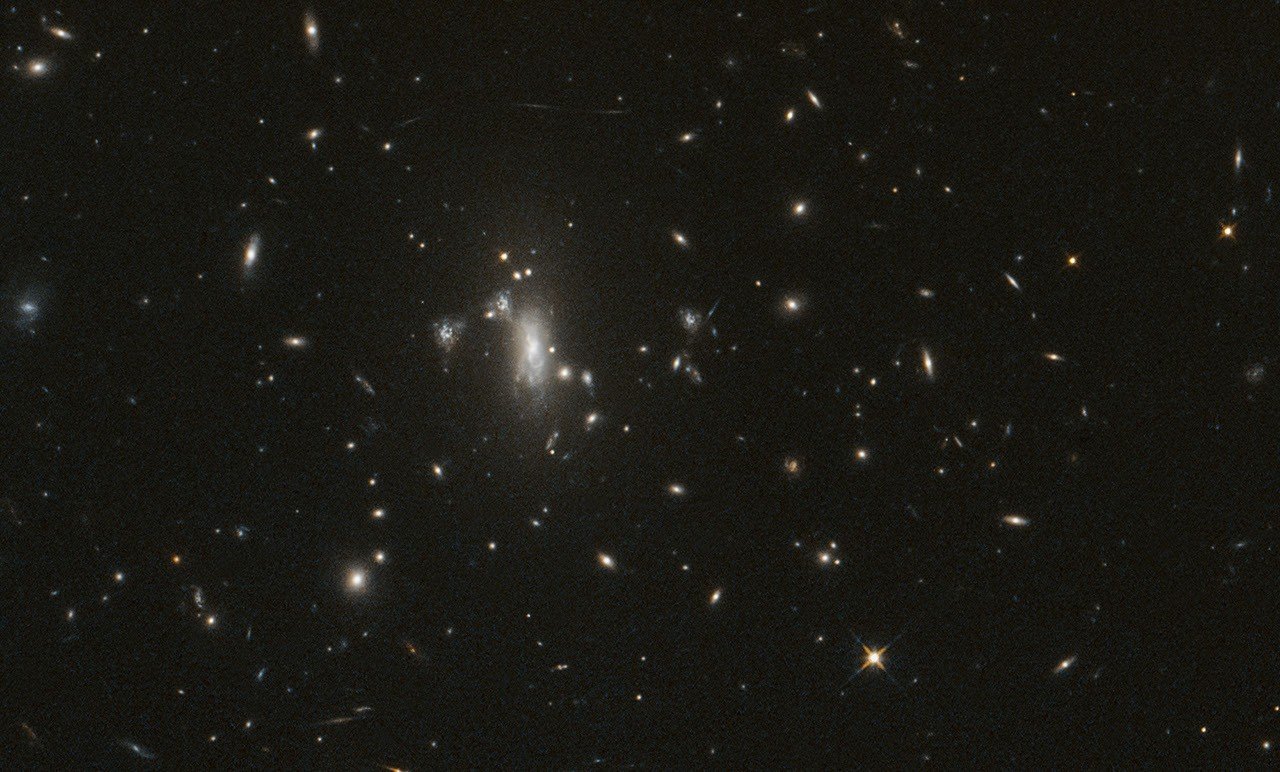
NASA, ESA, STScI, M. Pascale (UCLA); Image Processing: J. DePasquale (STScI)
After more than three decades in space, NASA’s Hubble Space Telescope has reached another remarkable milestone: 200,000 orbits around Earth.
Hubble completed its 200,000th orbit on September 19, 2026, marking another chapter in the extraordinary mission that has transformed our view of the universe. During its 36 years in orbit, the telescope has traveled more than 5 billion miles (8 billion kilometers) around Earth and has contributed to more than 1.7 million scientific observations.
But even as Hubble celebrated the milestone, it was busy pursuing a phenomenon that could help astronomers better understand one of the biggest questions in modern cosmology: how fast is the universe expanding?
Searching for a Supernova That Could Appear Again
One of Hubble’s recent observations focuses on a distant stellar explosion known as supernova Athena.
Athena was discovered by NASA’s James Webb Space Telescope in 2025. Astronomers are now using Hubble to repeatedly observe the region where the supernova appeared, looking for its possible reappearance.
The reason is an extraordinary phenomenon called gravitational lensing.
The distant supernova lies behind a massive galaxy cluster called MACS J0417. The enormous amount of mass in this galaxy cluster bends the fabric of space-time and changes the paths taken by light traveling toward Earth.
As a result, light from the same supernova can reach Earth along different routes.
This means astronomers may see the same explosion more than once — with the appearances separated by months or even years.
NASA researchers predict that another appearance of Athena could occur sometime between now and early March 2027.
A Natural Cosmic Magnifying Glass
Gravitational lensing can act like a gigantic natural telescope.
The gravity of a massive foreground galaxy cluster bends and magnifies light from much more distant objects behind it. This allows astronomers to study extremely distant galaxies and transient events that might otherwise be too faint to observe.
In the case of Athena, the different paths taken by its light provide something even more valuable.
By measuring when the supernova appears again, astronomers can learn more about how mass is distributed throughout the galaxy cluster MACS J0417.
That information can then be used to improve models of the gravitational lens and contribute to measurements of the universe’s expansion rate.
Helping Measure the Expansion of the Universe
One of Hubble’s most important scientific legacies is its role in measuring the rate at which the universe is expanding.
This measurement is commonly expressed through the Hubble constant, a fundamental value in cosmology.
The repeated appearance of a gravitationally lensed supernova provides another way to study this expansion. Because the light from the same event travels along different paths, the differences in arrival times contain information about the geometry and expansion of the universe.
Scientists can combine these observations with models of the gravitational lens to refine their measurements.
This makes Athena more than just another distant supernova. Its repeated appearances could become a valuable tool for studying some of the fundamental properties of the cosmos.
200,000 Orbits and Still Observing
Hubble’s 200,000th orbit is also a reminder of the telescope’s remarkable longevity.
Launched in 1990, Hubble has continued operating for more than 36 years. Its observations cover virtually every major area of astronomy, from planets and stars to galaxies, black holes, and the evolution of the universe.
Although newer observatories such as the James Webb Space Telescope and the upcoming Nancy Grace Roman Space Telescope provide powerful new capabilities, Hubble continues to offer something uniquely valuable.
Hubble observes the universe primarily in ultraviolet and visible wavelengths, complementing the infrared observations of Webb and the capabilities of other modern observatories.
Demand for Hubble remains extremely high. According to NASA, astronomers request roughly seven times more observing time than is available each year.
A Telescope Still Looking Into the Unknown
Hubble’s 200,000th orbit is not simply a number. It represents decades of continuous exploration and millions of observations that have changed humanity’s understanding of the universe.
And Hubble is not finished yet.
As astronomers continue watching MACS J0417 for another appearance of supernova Athena, the veteran space telescope is once again being used to investigate one of cosmology’s most fundamental questions.
More than three decades after launch, Hubble continues to prove that some of the universe’s most important discoveries can come from simply watching the sky — and waiting for the light to arrive.
Source: NASA, NASA’s Hubble Seeks Lensed Supernova, Marks 200,000 Orbits, September 23, 2026.