
A team of astronomers has made a groundbreaking discovery regarding Asteroid (44) Nysa, revealing that it may be the first known three-lobed asteroid. The findings, based on high-resolution imaging from advanced telescopes, also include the detection of a previously unknown moon orbiting this peculiar celestial body. This dual discovery not only adds to our understanding of Nysa but also hints at the complex history of asteroids in our solar system.
What led to this remarkable discovery?
Asteroid Nysa, one of the brightest and largest asteroids in the main asteroid belt, has been the subject of interest for over a century. Researchers had long suspected that its unusual brightness and enstatite-like surface composition might indicate a complex shape. Prior studies suggested it might be elongated or bilobate, but the true nature of its form remained a mystery until now. The latest observations utilized the SHARK-VIS instrument on the Large Binocular Telescope in Arizona and the SPHERE/ZIMPOL instrument on the Very Large Telescope in Chile, allowing astronomers to obtain unprecedented images.
How astronomers know about Nysa's structure
The research team employed advanced imaging techniques and data processing to enhance the quality of their observations. According to lead author Kate Minker of Lowell Observatory, these images are among the closest to spacecraft-quality imaging achieved from the ground. The data revealed significant surface features, including two large valleys that appear to connect multiple lobes of the asteroid, which the researchers interpret as neck-like connections. These observations suggest that Nysa might be a contact trinary—consisting of three connected components—or an irregularly shaped body. The team’s findings are documented in the study "Unmasking (44) Nysa: Evidence for a Trilobate Structure."
What scientists learned about Nysa's moon


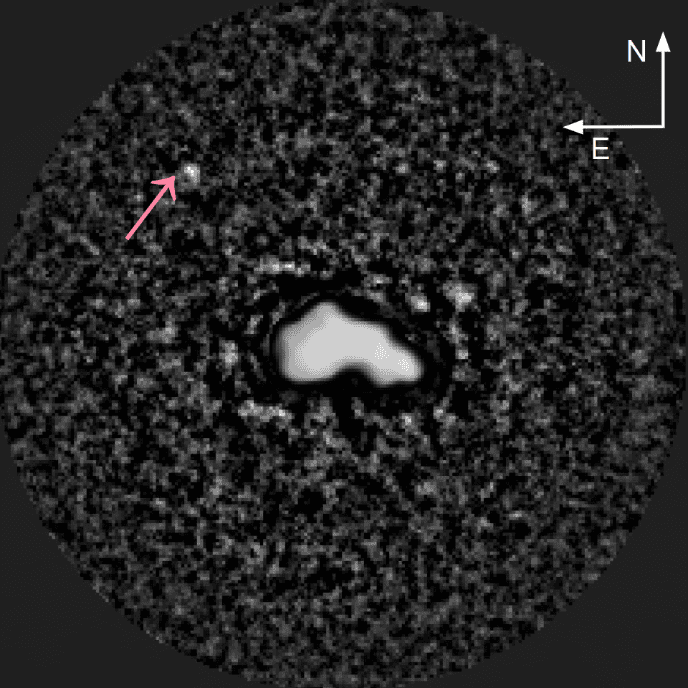
In addition to Nysa's unique shape, the team identified a previously unknown moon, designated S/2026 (44) 1. This moon, estimated to be about one kilometer in diameter, orbits Nysa at least 170 kilometers away. The detection was made using high-contrast imaging techniques, which helped to isolate the moon's faint light from the brightness of Nysa. As researchers continue to study Nysa and its moon, they hope to better understand the asteroid’s mass and density, which could clarify its formation history. The potential scenarios include a low-velocity reaccumulation of fragments from an ancient collision or remnants from a catastrophic event involving a larger parent body.