
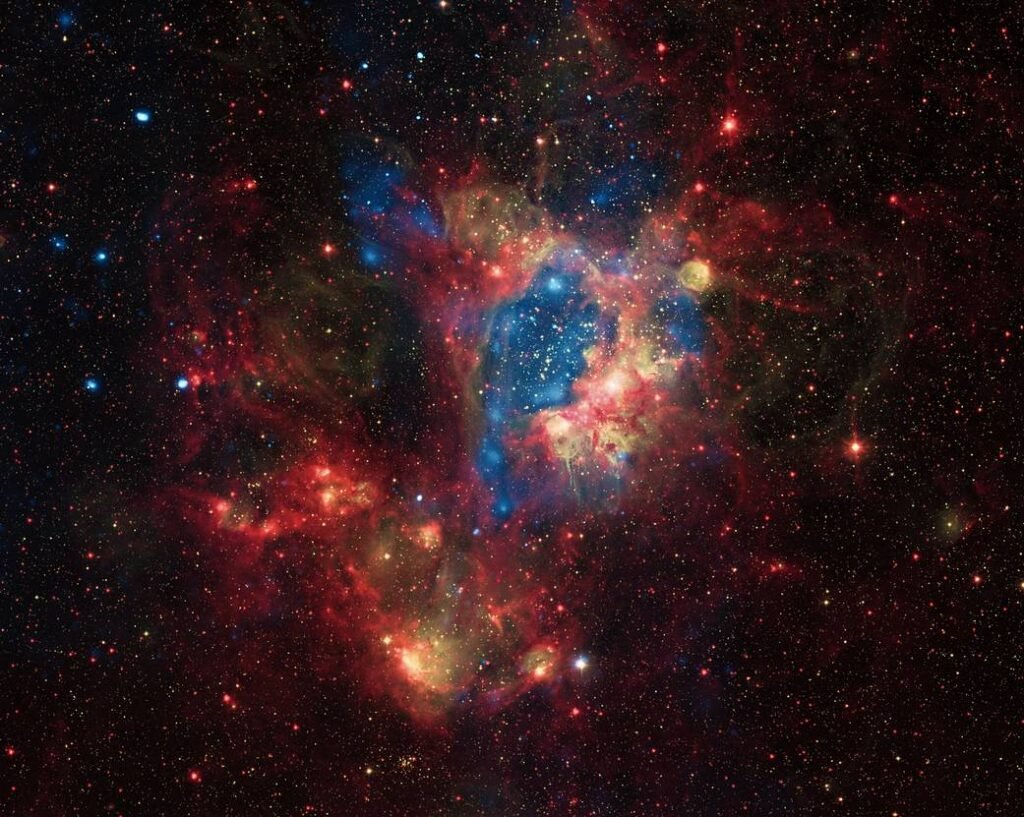
NASA has unveiled a striking composite image of a superbubble located in the Large Magellanic Cloud (LMC), a satellite galaxy of our Milky Way. This superbubble, known as N44, is about 160,000 light-years from Earth and is a vibrant site of star formation. The image highlights not just the beauty of this cosmic structure but also the complex processes at play in stellar evolution.
What’s happening in the superbubble?
At the heart of N44 lies the star cluster NGC 1929, where many new stars are forming. Some of these stars are particularly massive, and as they evolve, they emit intense radiation and expel matter at high speeds. This activity contributes to the formation of the superbubble, which is shaped by the winds and shock waves produced by these massive stars. Over time, these stars will end their lives in spectacular explosions known as supernovae.
How do astronomers know this?
Astronomers have utilized data from multiple observatories to study the superbubble. The Chandra X-ray Observatory provides X-ray data that reveals hot regions created by stellar winds and supernova shocks. Meanwhile, infrared observations from the Spitzer Space Telescope outline the cooler gas and dust surrounding the stars. Optical data from the Max-Planck-ESO telescope in Chile shows where ultraviolet radiation from young stars causes gas in the nebula to glow.
What the images show
The composite image combines X-ray, infrared, and optical data, presenting a detailed view of the superbubble's structure. The blue areas indicate hot regions filled with X-ray emitting gas, while the red areas highlight cooler dust and gas. Yellow regions show the optical light where ultraviolet radiation from young stars illuminates the surrounding gas. This multi-wavelength approach allows scientists to piece together a more complete picture of the superbubble's dynamics.