
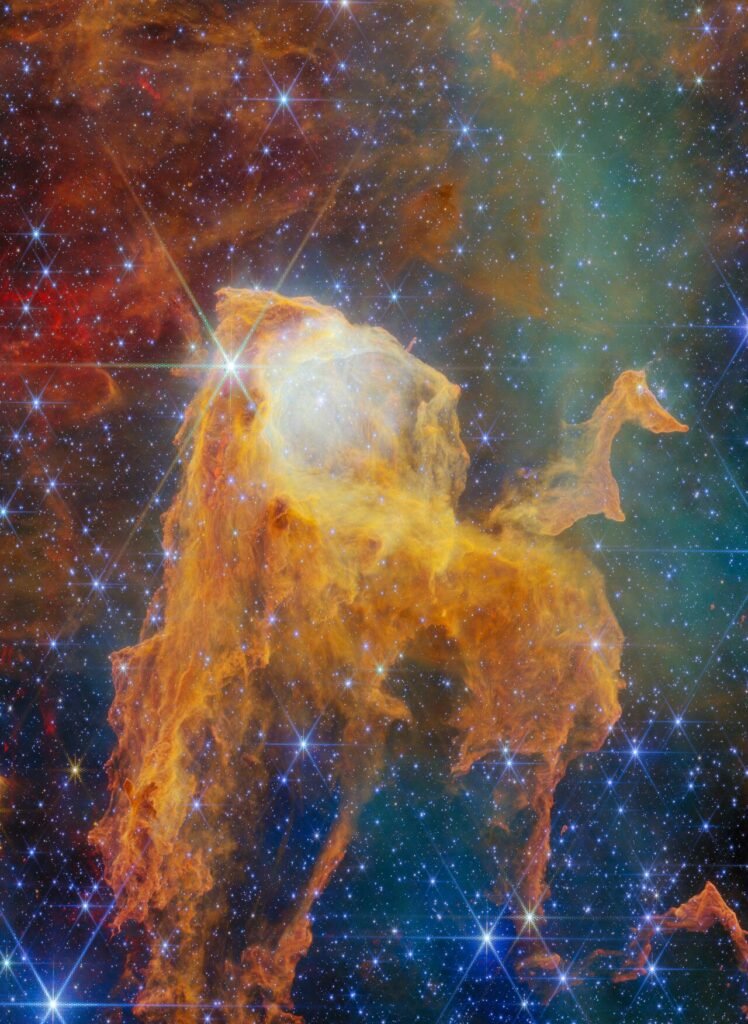
The James Webb Space Telescope has unveiled a breathtaking image of the Carina Nebula, showcasing a cosmic structure that resembles an open treasure chest. Located approximately 7,500 light-years away in the constellation Carina, this nebula is home to some of the most massive stars in our galaxy. It's a place where stellar birth and death are intricately intertwined, providing a unique laboratory for astronomers.
What makes this discovery significant?
The region highlighted in Webb's image, known as the Treasure Chest, is a cometary globule—a type of dense cloud of gas and dust that often resembles a comet. Within this cosmic chest lies a cluster of about 70 young stars, including a rare O-type star that is approximately 19 times more massive than our Sun. This discovery is particularly exciting for astronomers studying star formation, as the Carina Nebula is the nearest high-mass star-forming region where such processes can be observed in detail.
How does the surrounding environment influence the nebula?
The shape and appearance of the Treasure Chest are largely due to the intense radiation and stellar winds from neighboring massive stars, including the extraordinarily luminous Eta Carinae. This star system, which contains at least two massive stars, emits radiation about 5 million times greater than that of our Sun. Scientists believe that the cluster of stars within the Treasure Chest is still young—estimated to be around 1.3 million years old—allowing researchers to study how these stars interact with their environment as they emerge from their dusty cocoons.
What do scientists hope to learn next?
With ongoing observations from the James Webb Space Telescope, researchers aim to delve deeper into the processes of star formation and how these young stars impact their surroundings. The current research program is focused on understanding how stars collect gas from their environment and expel it through outflows, shaping the nebula's structure. As more data is gathered, astronomers expect to uncover even more about the life cycles of stars and the intricate dynamics of stellar neighborhoods.